
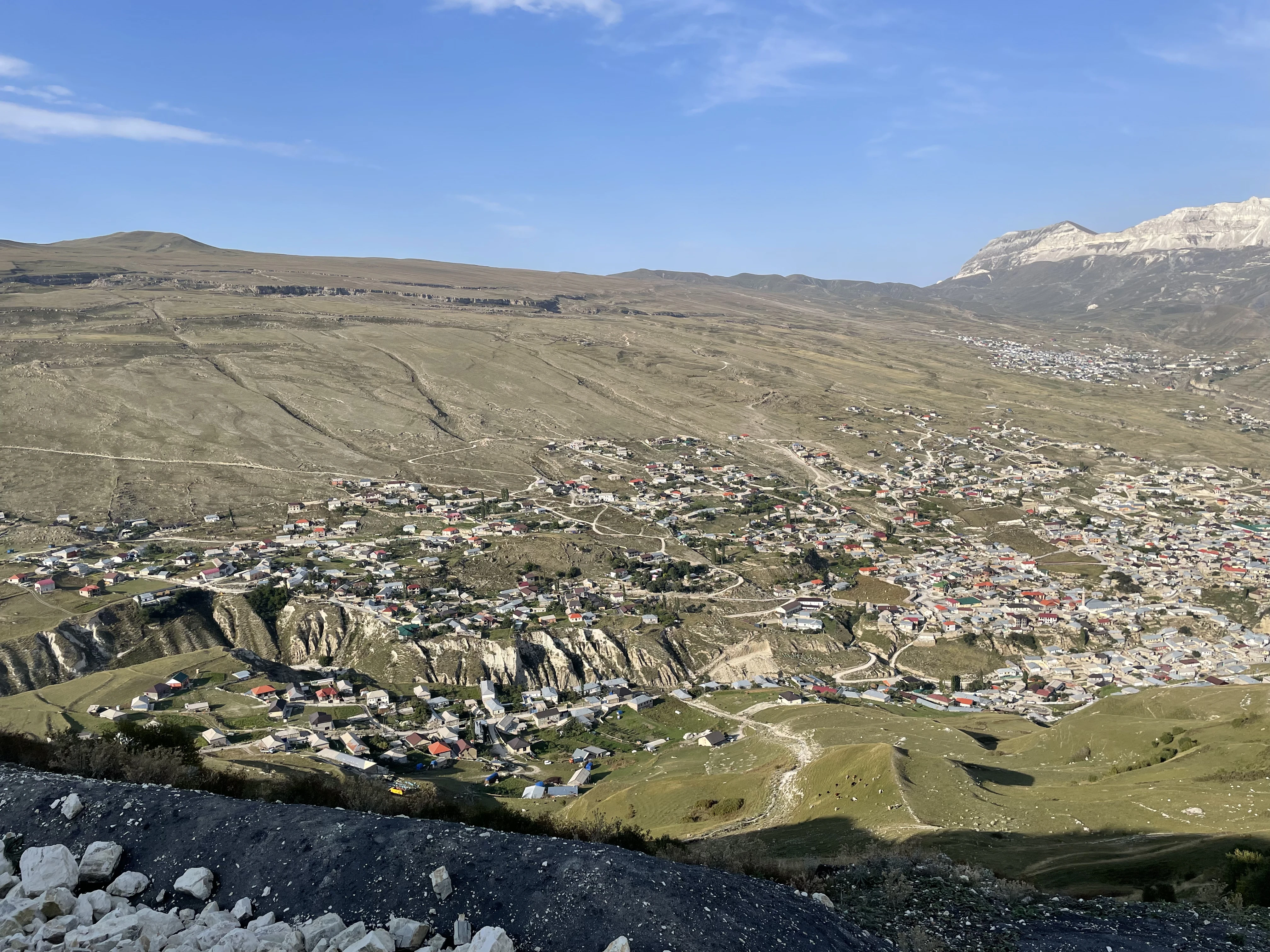
Panorama of Andi with Gagatli in the background and a mountain ridge, documentary photograph by Flandria12
← All peoples

North Caucasus · Dagestan

Andis

Gvannal

Andis: the history of communities in North-Western Dagestan, language, settlement and culture. Former beliefs, the spread of Islam, veneration of Bakhargam, felt-boot making, a detailed chronology and scholarly materials.
Regions:Dagestan
Andi and Gagatli · Flandria12, 2024 · CC BY 4.0

Language

Andi

Family

Nakh-Daghestanian family · Andic branch

Population

16,758 indicated Andi identity in Russia (2021)

History

Homeland and settlement. The Andis are one of the indigenous peoples of northwestern Daghestan. Historical Andia is associated with the mountain villages of the Botlikh district. Significant communities also live on the plain and in the cities.
The people and the language group. The Andic group unites several related languages. The Andis as a distinct people are not identical with all speakers of Akhvakh, Botlikh, Godoberi and other languages of this group.
Ancient names and materials. Scholarship has proposed comparisons of the Andis with ancient ethnonyms. Similarity of names alone does not prove a continuous history of a single people; such constructions require separate verification.
Society and self-government. Andia was a union of rural communities. The jamaat, elders and local authorities took part in deciding economic, legal and foreign-policy matters.
The letter of 1782. Correspondence between the Andi shamkhal, the elders and the jamaat with Kizlyar has survived. The document shows multilingual diplomacy, negotiations and the use of burkas as a gift.
The Caucasian War. Andi societies took part in Shamil's movement. Aglarov's study shows both support for the imamate and negotiations with the Russian administration; positions and interests within the society differed.
Economy and trade. Farming, livestock breeding, horticulture and crafts complemented one another. The fame of Andi burkas linked the mountain villages with markets in other parts of the Caucasus.
Administrative changes. The Botlikh canton was created on 22 November 1928; on 3 June 1929 it was transformed into a district. The territorial reforms of 1963 and 1965 changed its borders again.
Census and identity. In 2021 in Russia, 16,758 people indicated Andi identity separately, of whom 16,245 were in Daghestan. In the table the Andis fall within the Avar category; these figures must not be added again to the Avar total.

Settlement and local communities

Mountain communities. Andi, Gagatli, Zilo, Rikvani, Ashali and other villages preserve local speech and cultural features. The name of a common people does not cancel village identity. Muni and Kvanhidatl. Their speech was traditionally grouped into the Lower Andi group; the degree of its distinctness requires taking modern linguistic classifications into account. Plains settlement. Communities of the Khasavyurt, Babayurt and Kizilyurt districts and of the cities maintain ties with their mountain homeland. Moving does not in itself determine the loss of language or identity.

Language

Andi belongs to the Andic branch of the Nakh-Daghestanian family. It is an independent language, not a dialect of Avar.
A distinction is traditionally made between the Upper Andi and Lower Andi groups. The speech of Muni and Kvanxidatl differs considerably from that of Andi, Gagatli, Zilo and Rikvani; modern work discusses recognizing a separate Kvanxidatl-Muni language.
There is no officially adopted single written standard. Publications appear in a Cyrillic-based script, including children's books in the "Golden Fund of Andi" series. The various written experiments should be distinguished from a universally binding alphabet.
Language transmission is maintained within families, but the urban environment and language shift create difficulties for younger generations. Research documents local dialects and the differences between them.

Faith and history of religions

Former beliefs. These are reconstructed from folklore, local vocabulary and ethnographic records. What survives are separate layers, not a complete ancient canon. Tsʼob. Ethnographers describe it as the supreme deity of the former beliefs. The name was preserved in oaths and blessings, later reinterpreted in a Muslim context. Sky, luminaries and household spirits. Personifications of the sun and moon, ideas of the "Mother of the Wind" and the house snake have been recorded. These are data on the folklore of particular villages. Bakhargam and the sacred landscape. Mountains, materials and caves formed part of rain-petition and healing rites. Researchers trace the change in the meaning of these places after the adoption of Islam. Data on Christianity. Aglarov cites a local chronicle with an account of the former veneration of the cross. This is a written tradition that must be compared with other data; it does not establish a single Christian period for all communities. The spread of Islam. Seferbekov dates Islamization to the 13th–15th centuries; the academic survey singles out the 14th century. These frameworks describe a gradual process, not the simultaneous conversion of all villages. How the religion took hold. Mosques, madrasas, the work of qadis and instruction in Arabic book learning integrated Islam into public institutions. The transmission of knowledge also relied on the local speech. Scholarship of the 16th century. Aglarov cites a record of a book on Sufism copied at the madrasa of Molla Haji-Ali in 1562. This is evidence of developed religious education. The Sunni tradition. Current reference materials of the Russian Academy of Sciences characterize believing Andis as Sunni Muslims. Ethnic affiliation does not determine a person's personal convictions. The Muslim community of the 18th century. The letter of 1782 contains an appeal to an oath on the Quran. It documents the religious language of publicobligations in a particular era. Zikr and almsgiving. During the prayers at Bakhargan, zikr and the distribution of sadaka are described. Researchers regard the combination of these practices with the veneration of mountains as a local historical form of religious culture. The Soviet period. The restriction of religious institutions changed the education and public activity of communities. The family transmission of customs continued under the new conditions. The revival of the late 20th century. In Dagestan, religious education and the open activity of mosques expanded again. At the same time, disputes arose about the permissibility of local rites. Beliefs and modernity. Historical accounts of spirits and weather rites are not a common list of the beliefs of today's Andis. The degree to which traditions have been preserved varies.

Verified information

Language

  • Andi is a distinct language of the Andic branch of the Nakh-Daghestanian family.
  • The Andic language group comprises several independent languages.

Settlement and population

  • 2021 census: Russia 16,758 Andis; Daghestan 16,245. Counted within the Avar category.

Culture and daily life

  • A 1782 letter mentions black and white burkas as a diplomatic gift.

History

  • Seferbekov dates the Islamization of the Andis to the 13th–15th centuries.
  • The Botlikh canton was formed on 22 November 1928.

Detailed chronology

  1. Pre-Islamic traditions

    Nature cults and Ts'ob
    Reconstructed from language, folklore and ritual records.
  2. Medieval legends

    Information about Christianity
    Local chronicles preserve the memory of the veneration of the cross; the datings require caution.
  3. Thirteenth to fifteenth century

    Islamization of the communities
    Such a broad period is indicated in the study by R. I. Seferbekov.
  4. 14th century

    The establishment of Islam in the academic essay
    A narrower dating is considered alongside the broad periodization.
  5. 15th century

    Ali-Mirza al-Andi
    In historical literature he is known as a scholar and qadi.
  6. 1562

    A manuscript from the madrasa
    A record of the copying of a book testifies to religious education.
  7. 17th century

    Relations with neighboring domains
    Written traditions describe the struggle of the Andi communities for independence.
  8. 18th century

    Union of rural societies
    The jamaat and the elders act as collective representatives of Andi.
  9. January–April 1782

    A letter to Kizlyar
    Negotiations, the translation of a letter and the gifting of two burkas are recorded.
  10. First half of the 19th century

    Trade and military confrontation
    The communities' relations with the Russian administration change in the course of the Caucasian War.
  11. 1845

    A military expedition through Andia
    Aglarov views the events as part of the confrontation between the imamate and Russian troops.
  12. Second half of the 19th century

    A new administrative system
    The communities are incorporated into the district administration of the Dagestan Oblast.
  13. Late 19th century

    Burka-making craft
    The materials record the renown of the products and their export beyond the region.
  14. 1906

    A. M. Dirr's description
    A "Brief Grammatical Sketch of the Andi Language" is published.
  15. 1912

    A secular school in Andi
    An academic sketch reports the opening of the first secular school.
  16. 22 November 1928

    Botlikh Canton
    A new administrative unit is formed.
  17. 3 June 1929

    Transformation into a district
    Botlikh Canton receives district status.
  18. 1930s

    Change in burka production
    The declining role of cavalry and changes in clothing affect demand.
  19. Soviet period

    Restriction of religious institutions
    The conditions of public religious activity change.
  20. 1957

    Study of the Rikvani speech
    Ya. G. Suleymanov describes the Andi language based on Rikvani data.
  21. 1 February 1963

    Consolidation of the rural district
    The territories of Botlikh, Akhvakh and part of the Gumbet districts are merged.
  22. 12 January 1965

    Restoration of the district boundaries
    Botlikh District returns to its former territory.
  23. 1965

    The work of I. I. Tsertsvadze
    A monograph on the Andi language is published.
  24. Late 1980s–1990s

    Religious revival
    The open activity of Muslim communities in Dagestan expands.
  25. 2002

    Historical and ethnographic monograph
    M. A. Aglarov's study of the Andi people is published.
  26. 2010

    The Gagatli subdialect
    A work by Kh. S. Salimov is published.
  27. 2010

    Fairy tales in the Andi language
    The translated edition "Fairy Tales of the Peoples of the World" is published.
  28. 2013

    Study of former beliefs
    R. I. Seferbekov's work on mythology and Islam is published.
  29. 2014

    "Alip Mits'i"
    One of the attempts at an Andi alphabet in the "Golden Fund of Andi" series.
  30. Since 2016

    Documentation of the Zilo speech
    Samira Verhees investigates various aspects of Andi grammar.
  31. 2017

    Study of mountain cults
    Ramazanova and Seferbekov analyze the rituals of summoning the sun and rain.
  32. 2019

    Review of the "Golden Fund of Andi"
    M. Sh. Khalilov reviews the books of R. M. Ibragimov.
  33. 1 October 2021

    Census reference date
    16,758 people in Russia and 16,245 in Dagestan indicated Andi affiliation.
  34. 31 August 2024

    Documentary panorama
    Flandria12 photographs Andi and Gagatli; the image is used on the page.

Cuisine

  • Khinkal and the family meal

    Khinkal is mentioned in the everyday stories recorded by Aglarov. It is part of the local food culture, with family variations in preparation.
  • Ritual bread

    In Gagatli, during drought, unleavened bread called "pankir" was baked and divided among the residents. This is a description of a historical rite.
  • Festive treat

    For the spring holidays, shaped pastries were prepared; the festive "tree of abundance" was decorated with bread products and other treats.

Adats and traditions

  • Mutual aid and hospitality

    Kinship and neighborly ties were maintained through joint work and the hosting of guests. Public reputation was of great importance.
  • Village assembly

    The jamaat and the elders took part in managing communal affairs. A letter of 1782 shows collective representation in external negotiations.
  • Calendar and nature

    Rain-petitioning rites reflected the economy's dependence on the weather. Local variants differed by village and by the composition of participants.

Clothing

The Upper Andi women's costume was distinguished by the chukhtu headdress of crescent shape, adorned with embroidery or brocade, and a large white veil, the kazi. Lower Andi variants differed: the description of one group cannot be applied to all.
The burka was a felt outer garment. Items made of white and dark wool, the quality of the nap and the finishing techniques differed. Its economic and historical significance should not be turned into a claim of guaranteed protection against weapons.

Dances

  • Qibdil

    An old Andi dance is noted in descriptions of local culture. Modern stage performance should be distinguished from historically recorded variants.
  • Zikr

    Rhythmic collective commemoration belongs to religious practice. In the article it is described separately from the secular festive dance.

Music

Andi musical folklore is closely linked to Avar culture and preserves local features. The song tradition exists in the context of family and community holidays.
Tales, apt sayings and humorous stories occupied a notable place in oral culture. Printed publications in Andi help preserve the texts and pass them on to children.

Crafts

  • Felting of burkas

    The production of burkas included preparing the wool, felting and finishing. Historical descriptions especially note the quality of the items and their wide sale.
  • Craft and diplomacy

    In 1782, Andi representatives sent black and white burkas to Kizlyar. The document confirms the significance of the item as a valuable gift.
  • The salt of Kvanhidatl

    Historically, food salt was extracted in Kvanhidatl from local saline materials. The trade supplemented the community's economy.

Memorable Places

  • Andi and Gagatli

    Major historical centers of the local communities. The cover shows a real panorama of Andi with Gagatli in the background.
  • Bakhargam

    A revered mountain associated with the history of earlier beliefs, Muslim prayers and local legends.
  • Muni and Kvanhidatl

    Important centers of the Lower Andi speech variants. Their linguistic features are considered separately from those of Upper Andi.
  • The Muni tower

    A historical defensive structure at the southern entrance to the Andi basin; evidence of old communication routes and the fortification of the territory.

Names: examples of usage

Men's

    Women's

      People and cultural memory

      • Ali-Mirza al-Andi

        A 15th-century scholar and qadi, associated in historical literature with the will of Andunik.
      • Mamaykhan Aglarov

        A researcher of the history, communal structure and culture of the Andi people, author of a historical-ethnographic monograph of 2002.
      • Rasul Ibragimov

        Author of children's and educational publications in the "Golden Fund of Andi" series, which contribute to the development of written practices in the native language.

      Media

      Photo gallery

      Authorship and licenses are indicated in the image captions.