

North Caucasus · Dagestan
Archins
Arshishttib · Arshashdib
Language
Archi (Arshatten ch'at)
Family
Nakh-Daghestanian family · Lezgic group
Population
1,693 Archins in Russia (2021 census)
History
Settlement and local communities
Language
Faith and history of religions
Verified information
Language
- Archi is an independent language of the Lezgic group.
- The alphabet based on Avar Cyrillic was developed in 2006.
Settlement and population
- 2021 census: Russia 1693 Archi people, Dagestan 1677.
Culture and daily life
- The Surrey collection contains a memorial lament and oral narratives with performer data.
History
- In 1967 Sergeeva noted the insufficiency of materials for an exact dating of Islamization.
Detailed chronology
Pre-Islamic heritage
Reconstruction of early beliefsBased on later rituals and legends.Middle Ages
Memory of a Christian pastKnown from later accounts; the scale of influence has not been established.Middle Ages
Spread of IslamThe exact date of conversion remains insufficiently documented.July 1849
Destruction of Archi during the warThe episode is given in an academic essay.19th century
District administrationThe territories of Dagestan are incorporated into the new system of administration.Early 20th century
A. M. Dirr's linguistic descriptionThe grammar, texts and dictionary were published in 1908.1920s–1930s
Change of settlement patternsThe farmsteads gradually become permanent villages.Around the 1940s
Change of economic practicesThe reference book of the Russian Academy of Sciences notes the development of seasonal transhumant sheep breeding.Soviet period
Restrictions on religious lifeThe general context of Dagestan is examined in a scholarly study.1959–1963
Ethnographic expeditionsField materials are collected for Sergeeva's monograph.1967
The book "Archintsy"G. A. Sergeeva's historical and ethnographic study is published.1967
K. Sh. Mika ilov's grammarA description of the language with texts and dictionaries is published.1977
Structural description of the languageThe multivolume work of Kibrik and colleagues is published.Late 1980s–1990s
Religious revivalPublic religious life and education are developing.2002
Academic essayThe article on the Archi people is included in "Peoples of Dagestan".2004–2007
Dictionary projectSurrey staff create an Archi-Russian-English dictionary.2006
Cyrillic alphabetA new writing system based on Avar has been developed.2006
Fieldwork of Moscow State UniversityExpedition participants collect material on living speech.May 2007
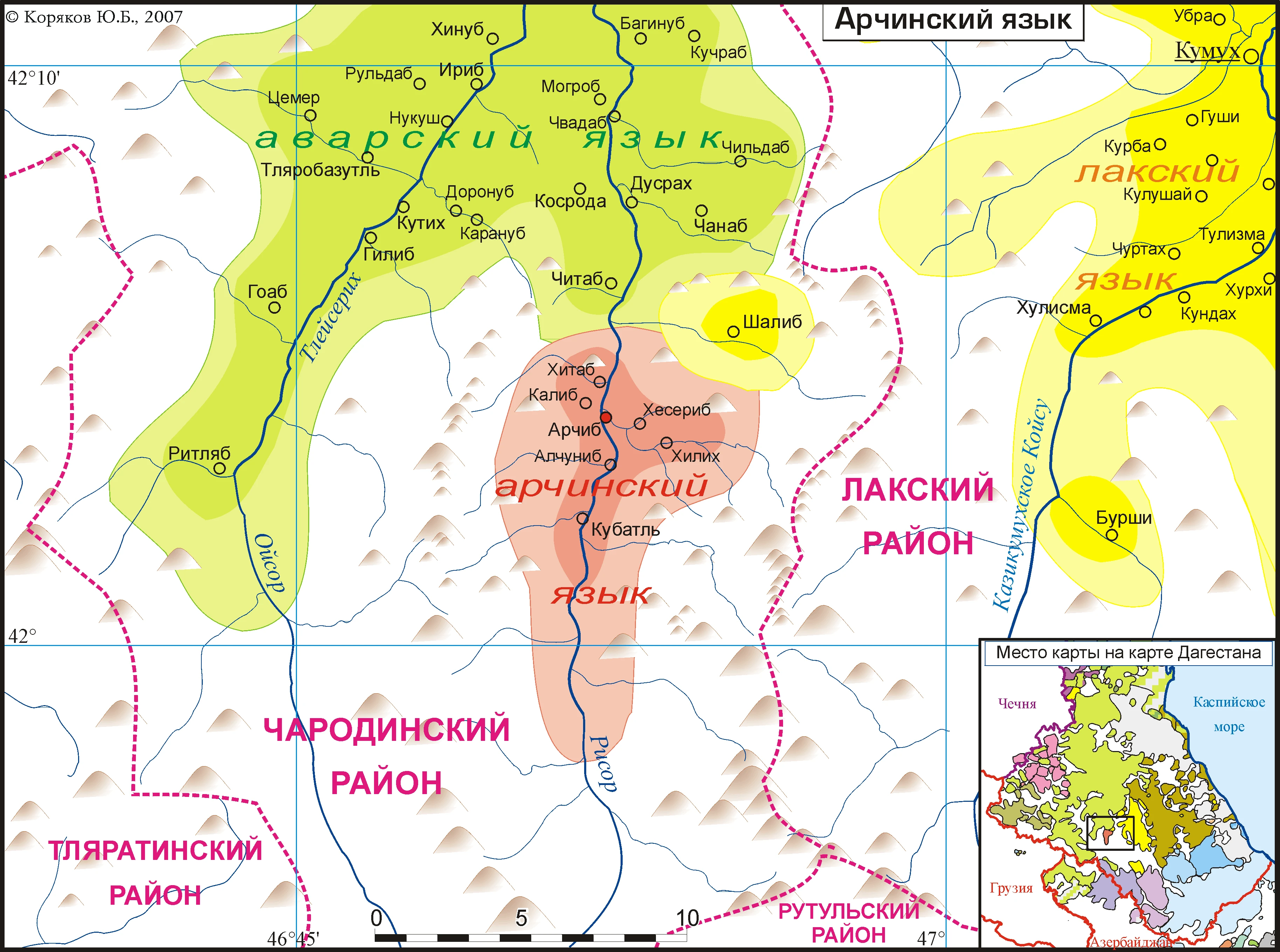
Linguistic mapYuri Koryakov compiles a map of the Archi area.2007
Archi-Russian-English dictionaryThe publication is noted in the bibliography of the Institute of Linguistics.September 2008
Report in EssexChumakina, Corbett and Brown present an educational overview of the language.2008
Publication of texts and materialsArkhipov, Daniel, Kibrik and Chumakina publish Archi materials.2017
A Study of Religious RevivalBobrovnikov analyzes a quarter century of change in Dagestan.1 October 2021
Census reference dateIn Russia, 1,693 Archis were counted, 1,677 of them in Dagestan.Modern documentation
Dictionary with soundPronunciation, word forms and examples are available.Modern documentation
Oral textsAnnotated stories are accompanied by translations and information about the performers.
Cuisine
Khinkal
Dough products were served with meat, cheese, fermented milk products and garlic seasoning. The materials of the House of Folk Art also note a dairy variant with cottage cheese.Pies and dumplings
The fillings included meat, cottage cheese, eggs and seasonal greens. Home recipes are not reduced to a single obligatory variant.Dairy products and winter stores
Sheep cheese, butter, dried meat and sausages are connected with pastoral farming and the seasonality of food.
Adats and traditions
Community and mutual aid
The assembly decided common economic affairs. Families took part in arranging weddings, funerals and public works. Historical norms should be distinguished from present-day law.Kunak ties and the market
On the way to Kumukh, Archi families stayed with acquaintances in Lak villages. Stable ties supported trade and mutual hospitality.
Clothing
Dances
Lezginka
In the cultural reference book it is noted as a popular dance. The name unites forms widespread in the Caucasus and does not mean exclusively Archi origin.
Music
Crafts
Wool weaving
Cloth, striped palases and pile woolen mats (bati) were made. The materials and technique are linked to local sheep breeding.Wood carving
Utensils and household items were decorated. Geometric ornamentation was combined with the practical tasks of domestic production.
Memorable Places
Archib and neighbouring villages
The high-mountain settlements are located close to one another along the Khatar and its tributaries. They are surrounded by mountain pastures and steep slopes.Map of the area
Yuri Koryakov's 2007 map shows the Archi villages between the Avar and Lak language areas. It is a linguistic map of its time, not a modern cadastre.
Names: examples of usage
Men's
Women's
People and cultural memory
Speakers and collectors of the language
Bulbul Musaeva is named the main consultant of the Moscow State University project. The documentation became a joint work of speakers and researchers.Performers of oral texts
Patimattay Magomedova, Yakub Magomedov and Butta Ziyavdinov are presented in the Surrey collection. Their recordings preserve individual speech and memory.Researchers of Archi
A. E. Kibrik, S. V. Kodzasov, A. V. Arkhipov, M. A. Daniel and colleagues took part in the documentation. The mention here does not imply the scholars' Archi nationality.
Media
Photo gallery
Authorship and licenses are indicated in the image captions.