

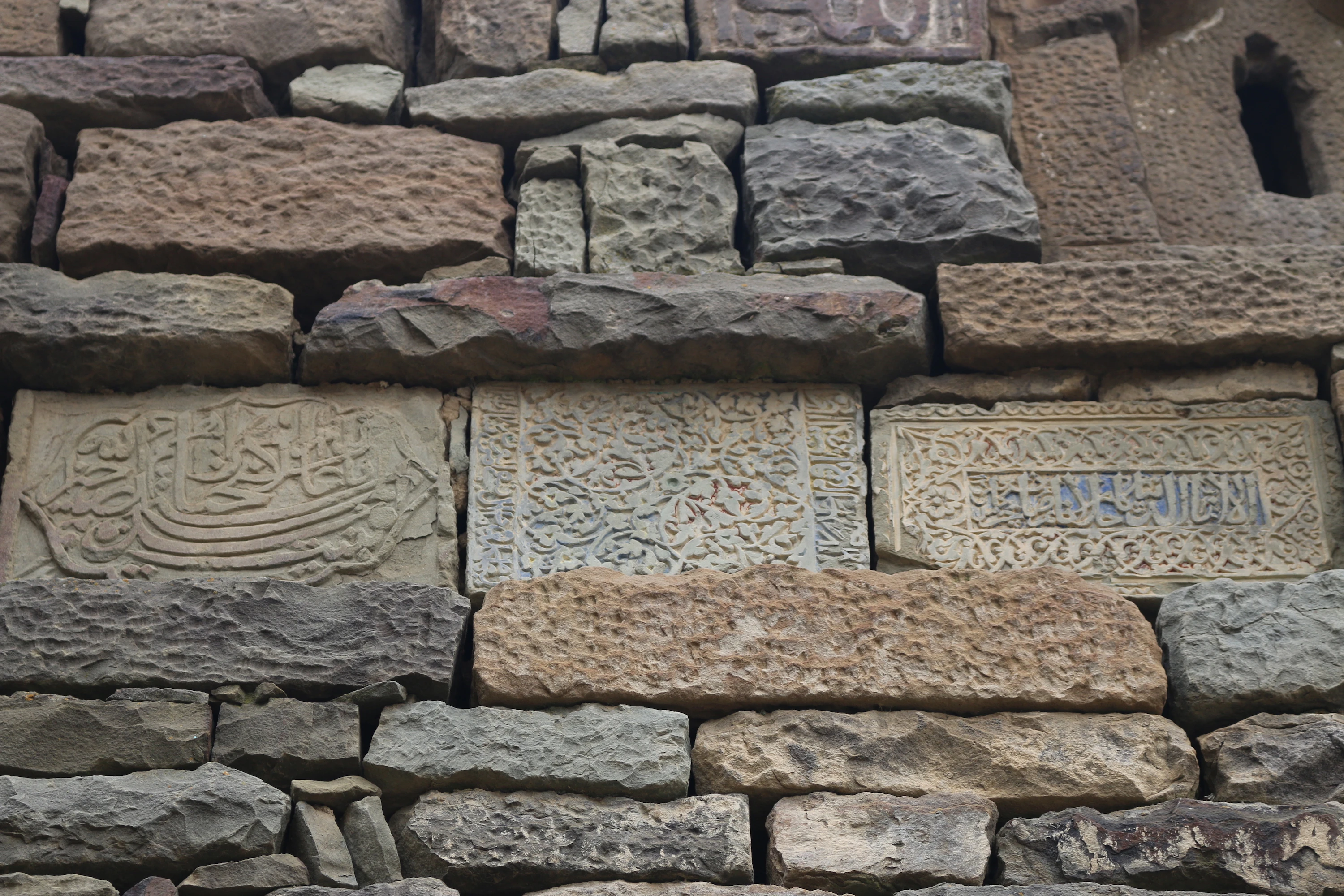
Carved stones with Arabic inscriptions in the wall of a building in Kubachi, photograph from 2020
← All peoples

North Caucasus · Dagestan

Dargins

Darganti · Dargan

Dargins (Darganti): a people of Dagestan with a diversity of local societies and Dargin languages. History, crafts, cuisine and traditions; former beliefs, Christian connections and the gradual spread of Islam, an extended chronology and scholarly materials.
Regions:Dagestan
Stone reliefs and inscriptions in the masonry of a building, Kubachi. Photo by PersianDutchNetwork, 2020 · CC BY-SA 4.0

Language

The Dargin languages and literary Dargin

Family

Nakh-Daghestanian family, Dargwa group

Population

626,601 in Russia (2021 census)

History

The Dargins and local societies. The Dargins, Darganti, are one of the indigenous peoples of Daghestan. Their historical life is connected with mountain, foothill and lowland settlements, rural communities and their unions. The modern community cannot be imagined as a single state with unchanging borders.
Kaitag, Zirihgeran and mountain unions. Medieval written testimonies describe various political and craft centres. Zirihgeran is associated with Kubachi; Kaitag had its own history of rulers and associations. Identifying ancient names with modern groups requires verification of the evidence.
Akusha-Dargo. The federation of unions of rural communities played a notable role in the politics of Daghestan. Its relations with neighbouring domains and with the Russian authorities changed; communal institutions and local initiative were important participants in these relations.
Specialization of settlements. Farming and livestock herding were combined with craft and exchange. In a number of settlements a pronounced specialization developed; Kubachi, Kharbuk and Amuzgi took part in interconnected metalwork production.
Islam and education. Inscriptions, mosques and local written testimonies show a gradual Islamization. Different settlements had their own stages of conversion and of the development of Muslim scholarship.
The Caucasian War. At the beginning of the 19th century Akusha-Dargo found itself within the sphere of military campaigns and negotiations with the Russian Empire. The campaign of 1819 became a significant milestone in the change of the political situation, but it did not end the entire history of resistance and local self-government.
The Soviet period. The creation of the Daghestan ASSR in 1921 changed the administrative conditions of life for the peoples of the republic. Schools, the press, cultural institutions and the transformation of the economy affected communities in different ways.
Resettlements and new places of life. The history of Sulevkent includes the forced resettlement of its inhabitants to Chechnya in 1944 and the subsequent establishment of a new settlement in Daghestan after 1957. This specific experience must not be turned into a claim of a single deportation of all Dargins.
The modern community. Dargins live in Daghestan and other regions of Russia, in cities and in rural areas. According to the census with a critical date of 2021, 626,601 Dargins were recorded in Russia. This is a country-level ethnic figure, not the number of speakers of each Dargwa language or the world population.

Local societies and linguistic diversity

General and local affiliation. The name "Dargins" unites societies with differences in speech, historical organization and culture. Akusha, Urakhi, Tsudakhar, Gubden, Kaitag and Kubachi are connected with different local histories. Kaitag people and Kubachi people. They are often included in the broad Dargin community while retaining separate local names and cultural features. Linguistic classification, ethnographic group and a person's self-identification are different levels of description. There is no definitive list of languages. Classifications of the Dargin group have changed as descriptions appeared. One cannot declare a single number of languages or dialects to be indisputable and eternal; the author and year of the study should be indicated. Migration and urban life. The size of an ethnic group, command of the literary language and home speech do not coincide. Census data must be accompanied by the year and territory of enumeration.

Language

The Dargwa language varieties belong to the Nakh-Daghestanian, or East Caucasian, family and form the Dargwa group. They should not be assigned to the Turkic languages because of historical contacts with Kumyk.
In official and literary practice the common name "Dargwa language" is used. Linguists distinguish several languages within the group; their number and boundaries depend on the classification. Differences between varieties can considerably hinder mutual understanding.
The literary norm was formed on a North Dargwa basis, primarily that of Akusha. It is used in education and literature, but it does not replace the home speech of all local societies.
Arabic-script writing, Ajam, preceded Soviet standardization. In 1928 the Latin script was adopted, and in 1938 Cyrillic. The study of the Sanzhi language examines these changes together with the history of the Dargwa group.
P. K. Uslar's book "The Khyurkili Language" was published in 1892. It is an early detailed description of the Urakhi variety; the historical title of the book should not be mechanically transferred to all modern Dargwa languages.
The Sanzhi language is described in a dedicated grammar by Diana Forker. Detailed documentation of a small local variety helps preserve texts and linguistic knowledge that is not reflected in a single common literary standard.

Faith and history of religions

Pre-Islamic beliefs. Ethnographic research records accounts of patrons of nature and the economy, sacred places, prohibitions and protective actions. Later records make it possible to study local beliefs, but they do not reconstruct a single unchanging religion of all the ancient Dargins. The sun, the moon and the weather. Among the Tsudakhar people, Seferbekov describes the sun in the image of a girl and the moon in the image of a young man, as well as accounts of the angels of rain and hail. The author links the latter images to a reinterpretation of earlier beliefs in a Muslim environment. This is an ethnographic interpretation, not a dated ancient canon. The name TsIalla in the records. Seferbekov cites a record of the name Zalla by Güldenstädt dating from the 1770s. The late recording of the name serves as evidence of the history of beliefs, but by itself it does not establish what the beliefs looked like in all Dargin societies many centuries before the record. The grain field and domestic well-being. The Tsudakhar materials describe a spirit of the field, the last sheaf, a woman with a sickle who helps the reapers, and a doll made of dough. These images are connected with the harvest and prosperity; they cannot automatically be transferred to all Dargin groups or to modern religious practice. Rain and sun rites. Field materials from Kharbuk and Kubachi collected in 2017–2024 show special actions for drought and bad weather. They relate to specific communities and situations; they cannot be presented as the modern behaviour of every Dargin. Christian traces and caution in attribution. Medieval Dagestan was religiously heterogeneous. When interpreting carved stone, burials and travellers' reports, it is necessary to distinguish the date of the monument, the place of discovery and the conclusion about the faith of the inhabitants. A single motif does not prove that the whole people professed Christianity. What is known about Christian connections. Aliyev examines missionary connections, local traditions and historical names, emphasising that the spread of Christianity was not simultaneous. His reconstructions must be correlated with the nature of each piece of evidence. The claim of a simultaneous baptism of all Dargins is not confirmed by the materials. How Islam spread. The process proceeded through connections with Muslim centres, preachers, political relations and armed clashes. For Dargin societies, medieval inscriptions and local reports are important; the arrival of the Arabs in Derbent is not equivalent to the conversion of all mountain villages. Local centres of the spread of Islam. The academic history of Dagestan links the spread of the new faith not only to external campaigns but also to local rulers and centres. Urkarakh, Kalakoreish and Ashty became conduits of religious culture. Networks of communication and learning linked settlements that converted at different times. Kalakoreish and written evidence. The mosque, mihrab and epitaphs of Kalakoreish make it possible to study the Muslim culture of Kaitag. The tradition of the Qurayshi origin of the founders should be designated as a tradition, distinguishing it from datable inscriptions. Kubachi and the dating of conversion. The academic history of Dagestan cites a report of the conversion of Kubachi in 1306 with the participation of Sheikh Hasan. This is a local date from a historical reconstruction, not a single year of the adoption of Islam by all Dargins. How to read reports about "infidels". The military rhetoric of conquerors is not equivalent to a description of the faith of the population. The authors of the academic history of Dagestan explain Timur's use of this designation as a political justification for war and do not consider it proof of the absence of Islam in Kaitag and Zirikhgeran. The Sunni tradition. Historically, Sunni Islam, predominantly of the Shafi'i school of law, became established among believing Dargins. The local community, education and religious authorities participated in the transmission of knowledge; ethnicity does not determine a person's degree of religiosity. Adat and Muslim law. Customary law and Sharia norms interacted and could diverge. The "Code of Preserved Laws of Kaitag-Dargo" makes it possible to examine legal life in a specific social environment without conflating all local customs with religious prescriptions. Family rites and local culture. The Kubachi wedding combines religious beliefs, family participation, festive clothing and ritual actions. A study of 2017–2018 shows a local complex and its changes in the town. The Soviet period. Anti-religious policy restricted institutions and public practice. At the same time, family knowledge and local religious memory could be preserved. The history of communities requires the study of specific documents, not the assumption of a complete disappearance of faith. After the collapse of the USSR. The opening of religious educational institutions, new connections and disputes about permissible practices became part of the public life of Dagestan. Researchers emphasise the diversity of the processes usually called the "Islamic revival". Religious life today. Eid al-Fitr, Eid al-Adha, Friday prayer and family rites are important for Muslim communities. Among the Dargins there are people with different attitudes to religion; historical field descriptions cannot be presented as statistics on all modern believers.

Verified information

Language

  • The Dargwa group belongs to the Nakh-Daghestanian language family.
  • The number of languages distinguished within the group depends on the scholarly classification.

Settlement and population

  • In Russia, according to the census with a critical date of 2021, 626,601 Dargins were recorded.

Culture and daily life

  • Kubachi, Kharbuk and Amuzgi were linked by craft specialization and exchange.

History

  • The Islamization of Dargwa societies occurred gradually and differed from place to place.
  • The Dargwa Theatre opened on 11 September 1961.

Detailed chronology

  1. Middle Ages

    Kaytag and Zirikhgeran
    written evidence describes various political and craft centers.
  2. Late 10th century, according to academic reconstruction

    Initial stage of Islamization of some societies
    The 1996 History of Dagestan dates the beginning of this process in Dargin societies and Kaytag to this time. This is a generalized reconstruction, not a single date for the conversion of the people.
  3. 11th–13th centuries

    Muslim epigraphy
    Inscriptions in Kaytag and neighboring areas show the gradual spread of Islam.
  4. 12th–13th centuries

    The mihrab of Kalakoreish
    The carved monument is connected with the development of local Muslim architecture.
  5. 1306, according to a historical account

    Conversion of the inhabitants of Kubachi
    Academic research links the event with Sheikh Hasan; the date refers to this village.
  6. Early 14th century

    The mosque in Ashty and the conversion of the Zirikhgeran
    The written evidence of the mosque's construction is connected with the establishment of Islam among the Zirikhgeran; this concerns a local process.
  7. 14th–15th centuries

    Changes in the political environment
    Military campaigns and interaction with neighboring societies change the organization of the region.
  8. 1494

    Early Dargin records in Arabic script
    Kaymarazov reports on short texts from the late 15th century in manuscript books. These are evidence of written practice, not the date of the language's emergence.
  9. 1507

    A dated Dargin record in an old book
    A short text discovered by M.-S. Saidov in 1960 is dated 1507. The find shows the use of Arabic script for local speech.
  10. Until the 20th century

    The development of Arabic-script writing
    Dargin records and Arabic scholarship coexist in the manuscript environment.
  11. 17th century

    Legal monuments of Kaytag-Dargo
    Customary law receives written fixation; its text is studied in historical context.
  12. 18th–early 19th century

    Kaytag embroideries
    Museum collections preserve items dated to this time, with individual attributions.
  13. 1770s

    Record of the name Zalla
    Seferbekov refers to Gildenstedt's recording of this name. The date of the record differs from the time of the notion's origin.
  14. Early 19th century

    Akusha-Dargo in regional politics
    The union of communities participates in relations with neighboring domains and the Russian authorities.
  15. 1819

    The campaign of Russian troops into Akusha-Dargo
    The military campaign changes the position of the union and the conditions of relations with the imperial administration.
  16. 19th century

    The poetic tradition of Batyray
    Folk memory preserves the lyric works of the poet from Urakhi.
  17. Mid-19th century

    Changes in weapons production in Kubachi
    According to the Russian Ethnographic Museum, the manufacture of rifles and defensive armament declined under the influence of competition from European goods.
  18. 1859

    The fall of Shamil's imamate
    The capture of Gunib completes an important stage of the war in Dagestan and changes the political conditions of the region.
  19. May 1861

    B. A. Dorn's journey
    The scholar visits Kubachi and Kalakoreish and records carved stones and inscriptions.
  20. 1892

    Publication of "The Khurkilin Language"
    The fifth volume of P. K. Uslar's linguistic works is published.
  21. Late 19th century

    Kubachi masters at international exhibitions
    A museum publication notes the masters' participation in exhibitions and the awards they received; the craft was incorporated into new markets and forms of presentation.
  22. 1913–1914

    Early museum acquisitions
    Items from Kubachi and a Dargin men's costume enter the Russian Ethnographic Museum.
  23. 1916

    Acquisition of embroideries by the MAE
    Collecting records become part of the history of the museum collection.
  24. 20 January 1921

    Formation of the Dagestan ASSR
    A decree of the All-Russian Central Executive Committee determines the autonomous status of the republic.
  25. 1926

    L. I. Zhirkov's grammar
    One of the studies of the Dargin language, noted in the scholarly bibliography, is published.
  26. 1926

    Study of the monuments of Kalakoreish
    A. S. Bashkirov's work on the medieval monument of the aul is published. Scholarly study helps distinguish legends, architecture and epigraphy.
  27. 1928

    Transition to the Latin script
    A new stage of written standardization begins.
  28. 1930

    Encyclopedic article on literature
    An early Soviet survey of Dargin literature is published; its assessments reflect the time of publication.
  29. 1938

    Transition to Cyrillic
    Cyrillic script becomes the basis of the standardized writing system.
  30. 1944

    Forced resettlement of the Sulevkent residents
    The inhabitants of a specific village are resettled to Chechnya; the event requires a separate description.
  31. 1954

    S. N. Abdullaev's grammar
    The scholarly bibliography records a work on the phonetics and morphology of the Dargin language.
  32. 1955

    Training of Dargin actors
    The first studio is created at the Yerevan Theatre Institute.
  33. 1957

    New Sulevkent in Dagestan
    The returning residents establish a new settlement; some people also return to the old village.
  34. 11 September 1961

    Opening of the Dargin Theatre
    The Omarla Batyray Theatre begins operations in Izberbash.
  35. 1971

    Essays on Dargin dialectology
    The work of S. M. Gasanova reflects the development of research on local varieties.
  36. 1985

    Museum expedition documentation of Kubachi
    Items of clothing, household utensils and photographs of the everyday environment are collected.
  37. 1990s

    Change in religious life
    Open religious practice and education receive new conditions for development.
  38. 1995–1997

    Historical and archaeographic expedition to Kalakoreish
    An expedition of Dagestan State University investigated the complex of monuments and written evidence.
  39. 2001

    Publication of Dargi Folktales
    A collection of oral narratives is published with an introduction to Dargin grammar.
  40. 2010s

    Teaching of chain mail making
    In Kubachi, a school club turns to the historical craft as cultural heritage.
  41. 2013

    Study of Tsudakhar mythology
    R. I. Seferbekov publishes an analysis of mythological characters. This is the date of the scholarly publication, not of the origin of the beliefs described.
  42. 2017–2018

    Field study of the Kubachi wedding
    Observations and interviews document the contemporary ritual complex.
  43. 2020

    Grammar of the Sanzhi language
    A detailed description by Diana Forker is published by an open-access scholarly publisher.
  44. 2021

    Russian population census
    626,601 people who indicated Dargin ethnic affiliation were counted.
  45. 2022

    Publication of the study of the Kubachi wedding
    Field materials describing local customs are introduced into scholarly circulation.
  46. 2025

    Study of the rituals of Kharbuk and Kubachi
    A scholarly article summarizes materials on actions in case of drought and bad weather.
  47. 2026

    New museum materials on Kubachi
    The Russian Museum of Ethnography publishes an account of the craft and its masters.

Cuisine

  • Khinkal

    Ethnographic materials describe the dough, meat and broth, as well as the order of the meal. Regional methods of preparation differ; a single restaurant recipe does not exhaust Dargin cuisine.
  • Bread, flour and dairy products

    Food is connected with agriculture, milling and animal husbandry. Purchased flour and changes in the economy gradually altered home cooking.
  • Festive meal

    Wedding treats and the joint preparation of food have local forms. For Kubachi, the study records a particular order of treats, which cannot be declared obligatory for all Dargins.
  • Cuisine of town and village

    Migration and urban life change the menu, mealtimes and ways of buying food. Traditional dishes coexist with new everyday habits.

Adats and traditions

  • Jamaat and mutual aid

    The rural community was a space of joint decisions and obligations. Family ties and communal organization should be considered within a specific village and historical period.
  • The Kubachi wedding

    Field research identifies processions, the carrying of the dowry, the participation of relatives and festive performances. The urban wedding preserves some elements while changing their conditions and sequence.
  • Ritual and weather

    Calling for rain and sun belongs to occasional actions performed as needed, not to an annual holiday with a fixed date.
  • Master and apprentice

    The folklore of craft villages conveys respect for skill, labor and learning. Proverbs and stories help to understand the social significance of craftsmanship.

Clothing

Traditional clothing had features common to all Dagestan as well as local differences. Museum collections make it possible to examine a specific men's ensemble, its place of origin and its date of acquisition, instead of a generalized stage image.
Kubachi festive women's attire includes local forms of dress, coverings and jewelry. Their use in the modern wedding is described on the basis of field materials; festive clothing must be distinguished from everyday clothing.
Collections of clothing, footwear and photographic materials gathered in Kubachi in 1985 make it possible to compare objects and their use. Material and date matter more than the claim that a single ensemble represents an entire people.

Dances

  • Wedding dance

    In Kubachi, dance is part of the collective celebration, processions and socializing. Its place in the ritual is studied through observations of specific weddings.
  • Rural setting and stage

    Folk performance and theatrical production have different aims. The Dargin Music and Drama Theatre develops stage art in its native language while maintaining a connection with literary culture.

Music

The song tradition includes lyrical, everyday and ritual forms. Proverbs, tales and songs reflect labor, craft and human relations; the genre and circumstances of performance should be indicated separately.
Omarla Batyray is a classic of Dargin poetry whose works were preserved in folk memory and later published. The verse text, the oral melody and the modern arrangement represent different forms of the work's life.
The Batyray Music and Drama Theatre opened in Izberbash in 1961. Its work combines Dargin speech, dramaturgy, translations and performing art.

Crafts

  • Kubachi metalworking

    Chasing, engraving, niello and other techniques required specialization. The creation of a single object could bring together several craftsmen and neighboring villages.
  • Kharbuk and Amuzgi

    Craft centers were linked by the division of labor and exchange. Their role cannot be reduced to identical production in all villages.
  • Kaytag embroidery

    Silk embroideries are studied through material, technique, ornament and museum provenance. The name of a collection does not guarantee a single place of manufacture for each object.
  • The object and its attribution

    Embroideries from museum collections have different dates, places of acquisition and collectors' records. This information helps to separate scholarly attribution from a later commercial name.

Memorable Places

  • Akusha

    The historical center of a communal union helps to understand the political and religious life of mountainous Dagestan. Its history includes local institutions, negotiations and military events.
  • Kalakoreish

    The mosque, the carved mihrab and the tombstone inscriptions are important materials for the history of Kaytag. Local traditions and documented monuments require separate description.
  • Kubachi

    The craft village is known for its artistic metalworking and centuries-old ties with other cultural centers. The photograph on the page shows carved stones with inscriptions built into the masonry of a building in Kubachi.
  • Urakhi

    The village is associated with the poetic memory of Omarla Batyray. Library editions and studies help to examine his legacy and the history of how the poems were recorded.
  • Sulevkent

    The history of the old and new settlements links milling, craft and the resettlements of the 20th century. They should not be merged into a single undated geographical point.

Names

Men's

  • Abazi (Dargwa)
  • Dudesh (Dargwa)
  • Urshi (Dargwa)
  • Qubzar (Dargwa)
  • Tsaib (Dargwa)

Women's

  • Aba (Dargwa)
  • Abazay (Dargwa)
  • Attaba (Dargwa)
  • Zhaga (Dargwa)
  • Zhata (Dargwa)
  • Ts'aiba (Dargwa)
  • Ts'ibats (Dargwa)
  • Tsaibat (Dargwa)

People and cultural memory

  • Omarla Batyray

    A classic of Dargin poetry. His lyric poetry and song heritage were transmitted orally; biographical information requires comparison of materials.
  • Akhmedkhan Abu-Bakar

    Writer, playwright and screenwriter, author of works about life in Dagestan. His work is connected with Dargin literature and the cultural milieu of Kubachi.
  • Manaba Magomedova

    A metal artist whose work is presented in the museum narrative about Kubachi craftsmanship. Original creative work develops on the basis of tradition but is not reduced to repeating it.

Media

Photo gallery

Authorship and licenses are indicated in the image captions.