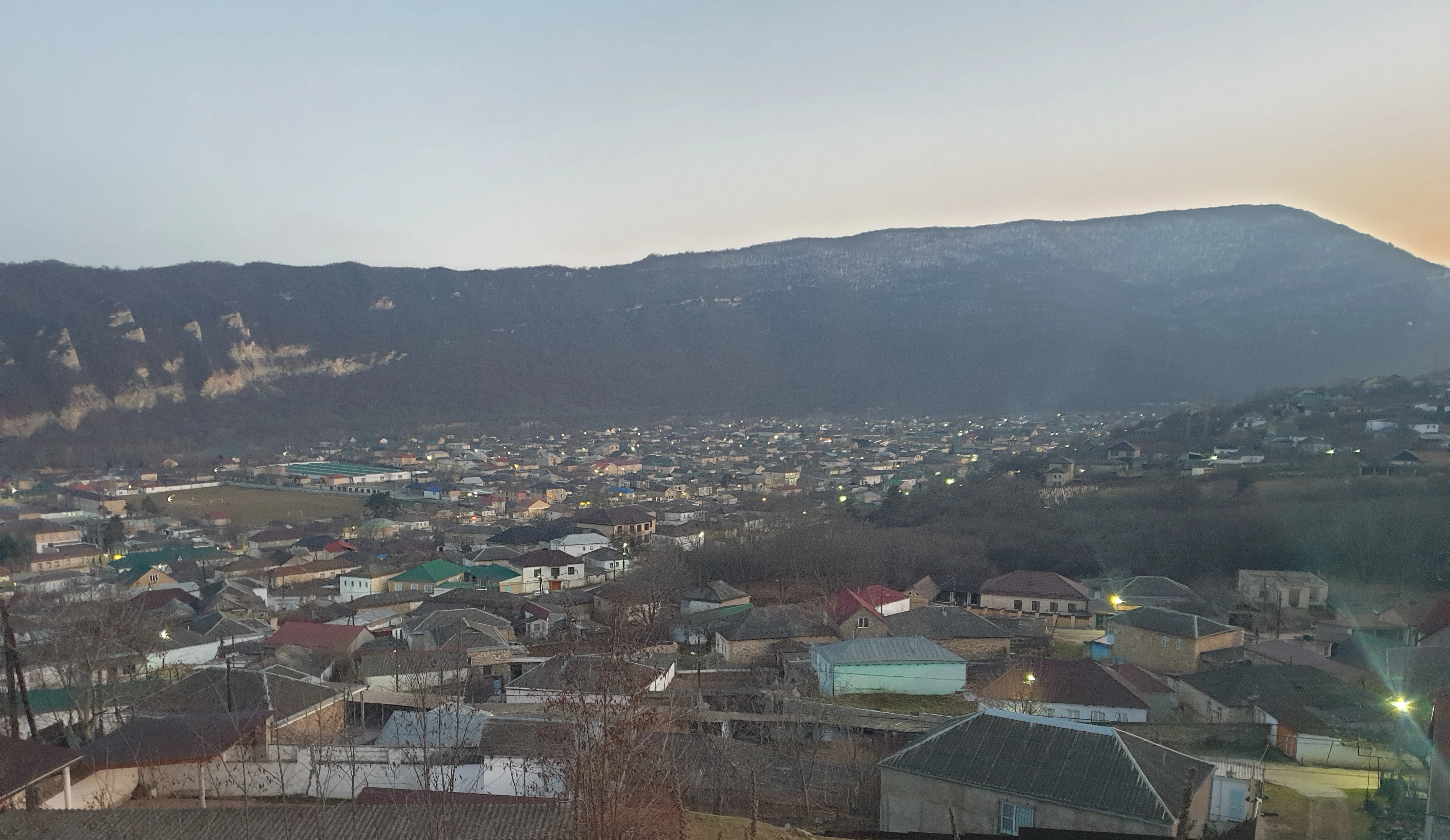
Documentary photograph of the village of Majalis on a mountain slope at sunset, Askhab Dargo, 2023
← All peoples

North Caucasus · Dagestan

Kaitags

Khaidak · Khaidaklan

Kaitags: the history of Khaidak, the Kaitag language and local societies, embroidery culture, traditions and settlement. Former beliefs and the gradual spread of Islam, a detailed chronology and scholarly materials.
Regions:Dagestan
Majalis · Askhab Dargo, 2023 · CC BY-SA 4.0

Language

Kaitag (Khaidak)

Family

Nakh-Daghestanian family · Dargic branch

Population

The community's population has not been established separately

History

Kaytag and the Kaytags. Kaytag, or Khaydaq, is a historical region of Daghestan. The borders of the domain and the composition of its population changed; the history of the state cannot be fully equated with the history of a single modern ethnic group.
Place in the Dargic world. Kaytag belongs to the Dargic branch of the Nakh-Daghestanian family. Scholarly works contain both the treatment of it as a separate language and the traditional designation of it as the Khaydaq dialect.
Rulers and communities. The authority of the utsmi coexisted with rural communities. In the 13th–14th centuries, relations among them, local rulers and neighbouring associations unfolded through conflicts and restructuring.
Eighteenth-century connections. The correspondence of Ahmad Khan with Nader Shah shows complex relations of pressure, negotiation and resistance. The Kaytags took part in the joint struggle of Daghestanian societies in 1741–1742.
Abolition of hereditary power. By a proclamation of 26 January 1820, Yermolov announced the deprivation of the utsmi lineage of its hereditary rights. The reforms that followed changed the administration but were not completed in a single day.
How to read the census. In the 2021 Rosstat table, 37 Kaytags are recorded separately in Russia, of whom 32 are in Daghestan. This line is included in the Dargic category and does not measure the whole community: many are counted as Dargins.
Estimate of speakers. The resource of the Institute of Linguistics of the Russian Academy of Sciences gives about 40 thousand speakers of Kaytag. This is an approximate linguistic estimate, not an exact worldwide population of the people.

Settlement and local societies

Mountain societies. Historical descriptions single out Shurkant, Kattagan, Irchamul and Kara-Kaitag. Their composition and subordination changed; the modern boundaries of the district do not repeat all historical boundaries. Lower Kaitag. The plain and foothill zone linked the inner societies with trade routes. The multilingual character of the area does not allow every inhabitant of the old utsmiate to be considered a Kaitag. Native villages and migration. The Kaitag language is spoken in the Kaitag, Kayakent and Derbent districts, in the cities of Dagestan and in other regions.

Language

Kaytag, also called Khaydaq or Khaytaq, is one of the Dargic languages. Closeness to literary Dargin does not mean a complete identity of speech, grammar and vocabulary.
The description by the Russian Academy of Sciences lists the Shurkant, Kattagnin, Irchamul and Lower Kaytag varieties. Within Lower Kaytag, several local variants are distinguished. The terms "variety" and "dialect" may be used differently in different works.
Kaytag speech is preserved in family communication; in multilingual Majalis, Kumyk and Russian are also important. The conditions for transmission to children depend on the family, migration and the language environment.
The Urssivar electronic dictionary describes words, grammatical forms, meanings and dialect variants. The compiler, Magomed Magomedov, works with the participation of Uzlipat Gasanova and Murad Gasanov.
The version of the database as of 23 June 2026 contains 5,392 articles. The project publishes materials on the internet, in PDF and in open machine-readable formats; the contents of the database continue to be updated.
The modern version of the Cyrillic alphabet was developed in 2024–2026. This is work on digital support and standardization; it should be distinguished from the universal introduction of a school literary norm.

Faith and history of religions

Modern tradition. Believing Kaitag people traditionally profess Sunni Islam. Individual beliefs and the degree of religiosity are not determined by ethnicity. What is known about early beliefs. Alimova describes the veneration of the sun, moon, trees and the house snake based on later ethnographic materials. This is a reconstruction, not a complete ancient catechism. Christianity in the regional context. Medieval reports about neighboring domains reflect religious diversity. They cannot be turned into proof of a simultaneous Christianization of all Kaitag people. 7th–8th centuries. The Arab campaigns and the consolidation in Derbent created conditions for the penetration of Islam into Kaitag. Military subjugation, the emergence of Muslim authority and the conversion of the population were different processes. A 10th-century report. Al-Masudi calls the ruler of Haidak a Muslim. Historians discuss the equation of the names Haidak and Jidan; testimony about a ruler does not mean that all inhabitants shared the same religion. Local chronicles. The materials tell of newcomers from Taif, a mosque near Barsh and conflicts with Urchamul. These narratives require a critical treatment of dates and genre, not literal repetition. Non-simultaneous conversion. The chronicles distinguish Muslim communities from mountain societies that resisted the new faith. Islamization proceeded locality by locality, through political and inter-community ties. The mosque and the qadi. The establishment of mosques and the activity of judges incorporated Islam into public administration. Alongside preaching, military and legal mechanisms were at work. Inscriptions as evidence. The stelae of the cemetery of the rulers of Kala-Koreish bear Arabic prayers and Quranic verses. The studied monuments date from the 14th century to 1803/04 and document a long Muslim tradition. Sacred places. Ethnographers recordedvisits to pirs, sacrificial offerings and the distribution of meat. These practices must be considered with indication of time and village. Amulets and stories about spirits. Old records contain jinn, shaitans and household spirits. Prayer amulets combined local notions with Muslim texts. Ramadan and sacrifice. A historical description notes the festival of the end of fasting and Kurban Bayram. Their lunar calendar differs from seasonal agricultural festivals. The Soviet period. The restriction of religious institutions in Dagestan changed the forms of education and public practice. The transmission of religion could continue within the family and the local circle. Religious revival. Since the end of the 20th century, the public life of communities and education expanded. Bobrovnikov's all-Dagestan study also shows disputes about tradition; it is not a census of the beliefs of Kaitag people.

Verified information

Language

  • Kaytag is distinguished as a separate language in modern classifications of the Dargic languages.
  • The Urssivar database as of 23 June 2026 contains 5,392 articles.

Settlement and population

  • A separate census line does not reflect the entire Kaytag community.

Culture and daily life

  • The 19th-century embroidery REM 3105-1 is worked in silk threads on cotton fabric.

History

  • In 2017–2018, more than 40 stelae of the necropolis of the rulers of Kala-Koreysh were studied.

Detailed chronology

  1. Pre-Islamic heritage

    Nature and household patrons
    Reconstructed from late ethnographic records.
  2. 7th–8th centuries

    Arab campaigns
    A long process of religious and political change begins.
  3. 10th century

    Reports of al-Masudi
    The ruler of Haydak is called a Muslim; the religion of the entire population is not separately established.
  4. 13th century

    Mongol expansion
    The political position of Kaytag changes under the influence of conquests and conflicts.
  5. Late 13th–early 14th century

    Communities and rulers
    Researchers consider the internal crisis and intervention by neighbors.
  6. Middle Ages

    Local accounts of Islamization
    The chronicles tell of Barsh, the newcomers from Taif and Urchamul.
  7. 14th century

    The necropolis of Kala-Koreysh
    The early stelae of the studied series date to this time.
  8. 17th–18th centuries

    The institution of the utsmiy
    The hereditary title of the rulers is studied through written and linguistic data.
  9. 18th century

    Gerber's description
    Information is recorded about the population, economy and political structure of Kaytag.
  10. 1741–1742

    Struggle against Nadir Shah
    The Kaytag people act together with other Dagestani societies.
  11. 18th–early 20th century

    Surviving embroideries
    The museum collection represents textiles from various periods and localities.
  12. 1803/04

    A late date in the series of stelae
    This is the date of the upper boundary of the surveyed series of the rulers' necropolis.
  13. 26 January 1820

    Deprivation of the utsmiy family of hereditary rights
    The decision is announced in Yermolov's address.
  14. 1820s–1830s

    Restructuring of administration
    The military administration carries out further reforms.
  15. Second half of the 19th century

    District administration
    Kaytag is included in the administrative system of the Dagestan Oblast.
  16. 19th century

    Embroidery REM 3105-1
    The museum documentation attributes the item to the Kaytag people.
  17. 19th–early 20th century

    The ethnographic period of the monograph
    Alimova studies daily life, economy and spiritual culture.
  18. Soviet period

    Restrictions on religious institutions
    The all-Dagestani context is examined in scholarly works.
  19. End of the 20th century

    Religious revival
    The public activity of communities and education expand.
  20. 1998

    The monograph "Kaytagi"
    The work of B. M. Alimova is published.
  21. 2004

    Study of the Haydak speech
    The work of S. M. Temirbulatova is published.
  22. 2009

    Publication of folklore
    Kh. M. Gabibova's "Haydaqla folklor" is published.
  23. 27 March 2014

    Opening of the Culture Center
    The Center of Traditional Culture begins work in Majalis.
  24. 2017–2018

    Expeditions to Kala-Koreysh
    More than 40 gravestones have been surveyed.
  25. 2019

    Publication of the study of the necropolis
    The results of the study of inscriptions and reliefs are published.
  26. 2020

    Russian–Kaytag phrasebook
    The publication includes a sample alphabet.
  27. 2 March 2021

    Museum online album
    The REM presents a collection of Kaitag embroidery.
  28. 1 October 2021

    Census reference date
    A separate line contains 37 records in Russia and 32 in Dagestan; this is not the entire people.
  29. 25 January 2023

    Photograph of Majalis
    A documentary photograph by Askhab Dargo is used on the page.
  30. 2024–2026

    Modern alphabet
    The Urssivar project is developing a Cyrillic writing system.
  31. 23 June 2026

    Version of the electronic dictionary
    The database contains 5392 entries.

Cuisine

  • Bread and flour dishes

    Wheat and barley flour, and later corn flour, were important in the historical diet. The composition depended on locality and prosperity.
  • Khinkal and stuffed dishes

    Flour products were combined with meat and dairy products. Variants of the cuisine differed between mountain and foothill villages.
  • Orchards and economy

    The foothills and plain supported farming, horticulture and viticulture; animal husbandry supplemented the economy. Natural zones influenced products and seasonality.

Adats and traditions

  • The rural community

    The assembly and local officials regulated common affairs. The position of communities differed; the history of adats cannot be reduced to the orders of the utsmi.
  • Family and ritual textiles

    Museum materials link certain embroideries to life-cycle rites. Their purpose is established from field and collection documentation, not only from the pattern.
  • Transmission of the craft

    Materials of the House of Folk Art describe the work of craftswomen with young people and the use of old motifs in modern items. This is ongoing cultural work.

Clothing

Historical clothing included shirts, trousers, the men's beshmet and cherkeska, women's dresses and head coverings. Variants depended on locality, age and prosperity; the ethnographic monograph shows specific ensembles.

Dances

  • Village and stage forms

    Materials of the Center of Culture describe the dance ensemble of the school of arts and the folklore group "Kaitag". The stage program is an arrangement of the traditions of its time.

Music

The Center of Culture presents ensembles of zurnachi and chungur players. Instrumental music is connected with festivals, joint performance and teaching; the composition of the ensemble changes according to the situation.
Folklore publications and recorded stories preserve local dialects. The RAS resource points to collections of tales and to Kh. M. Gabibova's work "Haidakla folklore".

Crafts

  • Kaytag embroidery

    The name became established after the descriptions of E. M. Schilling. Similar items are known also beyond Kaitag proper; the name of an artistic tradition is not an exact ethnic attribution of each object.
  • Silk on a cotton base

    The REM holds a 19th-century embroidery, No. 3105-1: cotton fabric and silk threads, 93 by 64 centimeters. The item has its own museum history.
  • Stone carving and epigraphy

    The stelae of Kala-Koreish combine Arabic inscriptions, complex ornament and relief images. They testify to the skill of the carvers and to links between artistic traditions.
  • A living craft

    Contemporary craftswomen create panels, pillows and accessories and teach young people. The Center of Culture displays old items and new works side by side.

Memorable Places

  • Majalis

    The administrative center of the Kaitag district and a multilingual village. The page uses a documentary photograph by Askhab Dargo of January 25, 2023.
  • Kala-Koreish

    A historical center associated with the Kaitag rulers. The study of its necropolis includes reading the names, dates and religious texts on the gravestones.
  • Museum collections

    The REM publishes Kaitag embroideries of the 18th to early 20th century. The collection allows comparison of different villages, eras and methods of decoration.

Names: examples of usage

Men's

    Women's

      People and cultural memory

      • Ahmad Khan, utsmi of Kaitag

        His relations with Nadir Shah are studied through Persian firmans. The materials reveal the complexity of political choice, and not only the later heroic image.
      • Bariat Magomedovna Alimova

        Author of a historical and ethnographic study of the Kaitags of the 19th and early 20th centuries. Her work covers the economy, family, clothing and spiritual culture.
      • Uzlipat Gasanova and Sapiyakhanum Temirbulatova

        Researchers of the Kaytag language, its lexicon and grammar. Their works are listed in the scientific bibliography of the Russian Academy of Sciences.
      • Magomed Magomedov and the Urssivar participants

        They work on an electronic lexical database and digital tools for Kaytag. The project is based on interaction between speakers and researchers.

      Media

      Photo gallery

      Authorship and licenses are indicated in the image captions.