

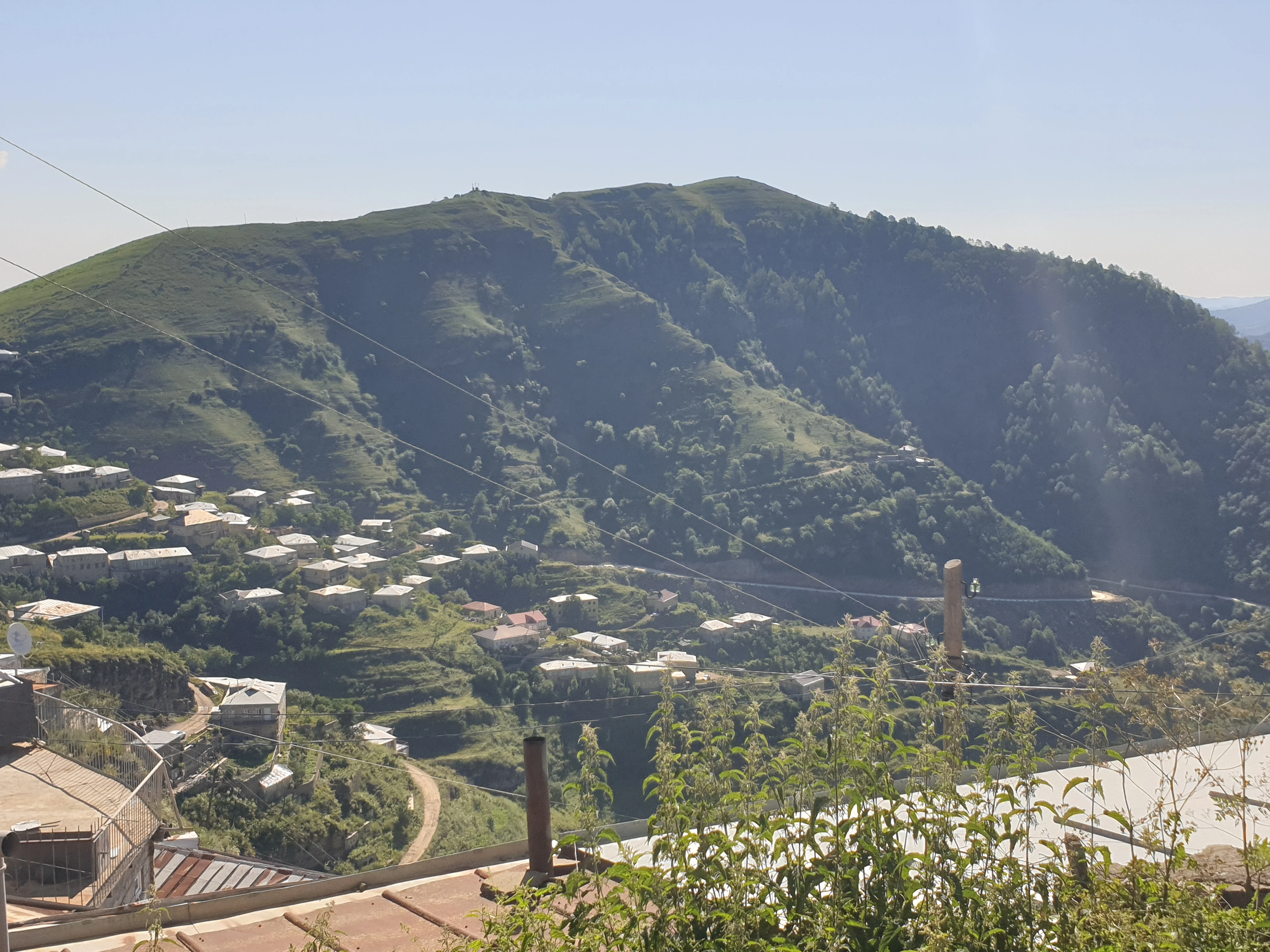
Documentary view of Kubachi and the green mountain slopes, photograph by Asħab, 2022
← All peoples

North Caucasus · Dagestan

Kubachis

Ughbug · Ughbugan

Kubachis: the history of Kubachi and Zirikhgeran, language, jewelry art, costume and traditions. Early beliefs, ties with Derbent and the gradual establishment of Islam, a detailed chronology and scholarly materials.
Regions:Dagestan
Kubachi · Asħab, 2022 · CC0

Language

Kubachi (Kubachi-Ashty)

Family

Nakh-Daghestanian family · Dargic branch

Population

Total number not separately established

History

Kubachi and Zirihgeran. Kubachi is the historic centre of Dagestan's decorative arts. M. M. Mammaev identifies it with medieval Zirihgeran, linking written sources with local monuments; the localization and dating have been debated by scholars.
Local roots and external ties. Claims of an entirely European or Near Eastern origin for the inhabitants and their art are not established fact. Mammaev argues for local continuity with the participation of visiting craftsmen and the exchange of artistic techniques.
Rural self-government. The Chine council was elected by the communal assembly and handled judicial and executive affairs. The Batirte retinue protected the village and communal lands; accounts of its organization combine descriptions and legends.
Craft economy. Craftsmen specialized in different operations. Kubachi residents cooperated with their neighbours: Amuzgi supplied blades, Kharbuk made gun barrels. A finished item could be the result of work by several specialists.
Artel and combine. A collective artel was created in 1924 and transformed into an arts combine in 1960. Soviet production combined serial items and unique authored works.
Census and self-identification. In 2021 Rosstat separately counted 559 Kubachi people in Russia, of them 500 in Dagestan. The category is included within the Dargin category. It does not equal the full size of the community, many of whose members are recorded as Dargins.

Settlement and local communities

Kubachi and the diaspora. The historical core is located in the Dakhadayevsky District. Ashty, Dirbag and Sulevkent. Their speech is considered together with Kubachi, but local communities cannot automatically be united into one ethnic group. Language, origin and self-identification differ.

Language

Kubachi belongs to the Dargin branch of the Nakh-Dagestan family. In modern classifications the Kubachi-Ashty language is distinguished; the traditional name "Kubachi dialect" is also found in the literature.
The Russian Academy of Sciences resource distinguishes the Kubachi proper, Ashty and Sulevkent varieties. Linguistic unity does not imply identical ethnic self-identification: the Ashty and Sulevkent people have their own local characteristics.
Family transmission of the language persists, but the Russian Academy of Sciences resource notes the onset of language shift. Russian is used in education and interethnic communication; written practices should be distinguished from a single school literary norm.
The scholarly bibliography includes A. A. Magometov's grammar of 1963, F. O. Abakarova's study of folklore of 1996 and a Russian-Kubachi phrasebook of 2002. These publications help preserve the living speech and local texts.

Faith and history of religions

Contemporary religion. Believing Kubachi people traditionally profess Sunni Islam. Personal convictions and degrees of religiosity vary. Early beliefs. Historical descriptions record weather rituals, veneration of trees, amulets and protection against the evil eye. These accounts relate to particular eras and do not define the views of all contemporary residents. Zoroastrian influence. Mammaev links medieval authors' reports of the funeral customs of Zirihgeran with the Zoroastrian tradition and contacts with Iran. This is a historical interpretation of the materials, not a surviving local creed. Evidence on Christianity. An academic survey mentions its some spread according to old reports and traditions. The scale and the balance of religions cannot be presented as an exact census of medieval beliefs. The role of Derbent. Trade, political and cultural ties connected Kubachi with one of the centres of Muslim learning. The transmission of religion did not occur only through military campaigns. The campaign of 1126. In al-Garnati's retelling, the Derbent emir tried to force the inhabitants of Zirihgeran to accept Islam and pay tribute. The account of the unsuccessful campaign also contains miraculous motifs. Study in the 12th century. Mammaev draws attention to the participation of Zirihgeran people in the study of Shafi'i law in Derbent described by al-Garnati. This points to early Muslim ties of part of the population. The turn of the 13th–14th centuries. In Mammaev's studies, the establishment of Islam in Kubachi is associated with this time. Early contacts and subsequent rooting should not be reduced to a single day of conversion. Difference between quarters. A tradition says that the upper quarter adopted Islam seven years later than the lower one. The symbolic number and oral transmission do not allow the story to be used as an exact calendar record. Inscriptionsand the 14th century. A stele in the Bidaq khuppe cemetery is dated 783 AH, or 1381/82. Kufic inscriptions and decoration are material evidence of Muslim culture. Religious education. The mekteb and madrasa taught Arabic literacy, the Quran and the fundamentals of sharia. Scholarship and local written practices supported the continuity of religious life. Numbers, memory and rituals. Seven and forty occur in folklore, wedding and memorial customs. Their study shows a combination of historical cultural layers rather than the existence of a single unchanging system of beliefs. Soviet restrictions. Policy toward religious institutions changed public education and practice. Family transmission of religion continued under different conditions; this is a Dagestan-wide context. The late 20th century and the present. The revival of communities and education was accompanied by debates about traditions. Bobrovnikov's study describes regional processes, not the identical biography of every Kubachi family.

Verified information

Language

  • Kubachi belongs to the Dargin branch of the Nakh-Dagestan family.

Settlement and population

  • Census records and speakers' own assessments refer to different indicators.

Culture and daily life

  • A 1958 casket by Abdulla Abdurakhmanov is held in the REM, No. 7115-1.
  • An earring by Manaba Magomedova is dated 1965, REM 7553-3/1.

History

  • One of the studied stelae is dated 783 AH, or 1381/82.

Detailed chronology

  1. Early Middle Ages

    Zirikhgeran in historical reconstructions
    Localization and early dating are discussed on the basis of written and material sources.
  2. Before the establishment of Islam

    Zoroastrian influence
    Mammaev links it to Iranian contacts and accounts of burial customs.
  3. 8th–13th centuries

    Links with Derbent
    Trade, political and religious contacts develop.
  4. 1126

    The campaign of the Derbent emir
    Al-Garnati conveys an account of an unsuccessful attempt to subjugate Zirikhgeran.
  5. 12th century

    Study of Islamic law
    The Zirikhgerans take part in studies in Derbent.
  6. Thirteenth to fifteenth century

    Development of stone-carving art
    Reliefs, architectural details and tombstones have survived.
  7. Late 13th–early 14th century

    The establishment of Islam
    Mammaev identifies such a period; the conversion was not instantaneous.
  8. 1381/82

    A dated stele
    One of the studied monuments bears the date 783 AH.
  9. The Middle Ages and later

    Chine and Batirte
    Self-government and the protection of the community are described in historical and ethnographic works.
  10. 19th century

    Craftsmen working away from home
    Seasonal migration and exchange maintain Kubachi's ties with the cities of the Caucasus and other regions.
  11. Second half of the 19th century

    District administration
    Kubachi is incorporated into the system of the Dagestan Oblast.
  12. Late 19th–20th century

    Changes in kaz embroidery
    Craftswomen master new stitches and artistic solutions.
  13. Until the early 20th century

    Mekteb and madrasa
    Religious schools teach Arabic literacy and Islamic knowledge.
  14. 1908

    A new stage in the work of Said Magomedov
    Because of an eye disease, the master turns to trading in antiquities.
  15. 1924

    Establishment of the artel
    Collective jewelry production begins.
  16. 1927

    The last described "shah's performance"
    The date is given by a museum album based on historical materials.
  17. 1930s

    Stabilization of the artel's work
    Orders expand and new forms of products appear.
  18. 1949

    The book by E. M. Shilling
    "The Kubachins and Their Culture" is published.
  19. 1958

    The casket of Abdulla Abdurakhmanov
    The work is held in the REM under number 7115-1.
  20. 1960

    Art workshop combine
    The artel is transformed into an arts and crafts enterprise.
  21. 1963

    Grammar of Kubachi
    A work by A. A. Magomedov is published.
  22. 1965

    Earring by Manaba Magomedova
    The original work is documented in the REM collection.
  23. End of the 20th century

    Religious revival
    The general process in Dagestan changes the conditions under which communities operate.
  24. 1996

    Study of folklore
    F. O. Abakarova publishes texts and ethno-local features.
  25. 2002

    Russian-Kubachi phrasebook
    A publication by F. O. Abakarova is released.
  26. 2006

    Study of numbers and rituals
    Mammaev analyzes the symbolism of seven and forty.
  27. 2016

    New studies in art history
    Works are published on Derbent and the origins of the Kubachi tradition.
  28. 1 October 2021

    Census reference date
    Separately counted are 559 Kubachins in Russia and 500 in Dagestan; this is not the whole community.
  29. July 5, 2022

    Documentary photograph of Kubachi
    A photograph by Asħab is used on the page.
  30. 2022

    Study of two 14th-century stelae
    Mammaev compares the inscriptions, ornament and dating.
  31. November 2025–February 2026

    Joint museum exhibition
    Collections of the REM and the National Museum of Dagestan are presented.
  32. May 2026

    Museum online publications
    The REM publishes materials on the village of the masters and traditional culture.

Cuisine

  • Khinkal

    It was made from wheat and corn flour; it was served with broth, meat and garlic seasoning. Family methods of preparation differed.
  • Pies and filled products

    Meat, cottage cheese, eggs, potatoes, pumpkin and seasonal greens were used. The set of products changed over time.
  • Soups and dairy food

    Historical descriptions mention soups with beans, rice and lentils, milk soups, porridges, cheese and cottage cheese.

Adats and traditions

  • Union of unmarried youth

    Participation was associated with learning endurance, mutual aid and communal solidarity. The museum album also describes a "shah's performance", last staged in 1927.
  • Dowry and domestic gatherings

    Dishes and artistic objects took part in family continuity. Museum descriptions show the role of copper vessels in the dowry and the ceremonial room.
  • Transmission of craftsmanship

    Work in the home workshop and training under elders linked the craft to the family. Individual authorship was combined with collective assistance and specialization.

Clothing

A recognizable part of the women's costume, the kaz veil, is a long white panel with embroidery. In different periods gold and silk threads, prikrep, chain stitch and satin stitch were used. Variants depended on age and occasion.
The historical men's ensemble included a shirt, trousers, a beshmet, a cherkeska, a papakha and a belt. Festive women's garments were complemented by jewellery; the old ensembles were not the everyday clothing of every inhabitant.

Dances

  • Askaila and military training

    Scholarly descriptions of Batirte mention paramilitary dances. Their interpretation is linked to the history of the youth organization and requires distinguishing reconstruction from contemporary performance.
  • Festive performance

    The museum album examines the costumed actions of the youth union. The stage adaptation is not a literal reproduction of all historical rites.

Music

Traditional music includes songs and dance melodies. The cultural reference work names the zurna, drum, chungur and harmonica. Local song vocabulary is also linked to the work of jewellers.
The collection "Kubachi Folklore" by F. O. Abakarova contains local texts and translations. It allows the speech and imagery of a specific tradition to be studied.

Crafts

  • Jewellery work

    Kubachi masters use engraving, niello, casting, filigree, enamel and other techniques. A single object may require several specializations.
  • Stone carving

    Medieval reliefs and tombstones combine images, plant ornament and Arabic epigraphy. The authorship and origin of individual monuments are debated by scholars.
  • The casket of Abdulla Abdurakhmanov

    REM 7115-1, 1958: silver, base metal and velvet; engraving, repoussé, casting, gilding and other operations are documented.
  • Work by Manaba Magomedova

    An earring of 1965, REM 7553-3/1, made of silver and glass. The museum indicates the author, date and features of the composition with a figure of a doe.

Memorable Places

  • Old Kubachi

    The terraced layout follows the relief of the mountain slope. The old quarters and new construction represent different stages of the settlement's history.
  • Bidakh khuppe

    The historic Muslim cemetery preserves highly artistic stelae. Researchers compare inscriptions, ornament and carving technique to refine dates.
  • Museum collections

    Items from the REM and the National Museum of Dagestan allow objects to be studied together with collection documentation. A joint exhibition in 2025–2026 presented different aspects of the culture.

Names: examples of usage

Men's

    Women's

      People and cultural memory

      • Said Magomedov

        A Kubachi master, artist and antiquarian who took part in forming the Dagestan collections of the REM. His biography can be traced through museum acquisitions.
      • Abdulla Abdurakhmanov

        A hereditary jeweller and engraver. The authorship of specific works is confirmed by museum records, including the casket of 1958.
      • Manaba Magomedova

        A metal artist who combined the Kubachi tradition with individual creative exploration. The surviving objects allow her work to be studied through dated examples.
      • Misrikhan Mammaev

        A researcher of the history and art of Zirikhgeran-Kubachi. His works are devoted to the origin of the artistic tradition and to individual carved monuments.

      Media

      Photo gallery

      Authorship and licenses are indicated in the image captions.