
North Caucasus · Dagestan
Laks
Lak
Language
Lak · Lakku maz
Family
Nakh-Daghestanian family
Population
173,416 in Russia (2021 census)
History
Settlement and local communities
Language
Faith and history of religions
Verified information
Language
- Lak belongs to the Nakh-Daghestanian language family.
Settlement and population
- Russia: 173,416 Laks; Daghestan: 162,518. Census date 1 October 2021.
Culture and daily life
- Balkhar pottery is made by coiling clay ropes, followed by painting and firing.
History
- The date of 778–779 in the account of the Kumukh mosque is conveyed by a later historical inscription.
- The resettlement of part of the Laks in 1944 was forced.
Detailed chronology
The early Middle Ages
Mountainous Dagestan and its neighboursThe history of local societies develops through contacts with the political and religious centres of the Eastern Caucasus.778–779 in a later inscription
The legend of the founding of the Kumukh mosqueThe date is transmitted by historical tradition; the inscription is not an 8th-century building document.11th–12th centuries, scholarly dating
The establishment of Islam in LakiaA. G. Bulatova follows L. I. Lavrov's periodisation, distinguishing the penetration of the faith from its taking root.14th–15th centuries
Muslim epigraphy of KumukhThe stone monuments preserve Arabic inscriptions and ornamental compositions.1484–1485
Tombstone of Umar, son of AhmadThe dated inscription mentions a pilgrimage and testifies to religious life.18th–first half of the 19th century
The khanate and land tenureKhan's lands, communal rights and dependent land use coexist.1741–1743
Nadir Shah's campaignMilitary operations affect Dagestan and change the living conditions of local societies.1788 or 1792
Birth of Jamaluddin of Ghazi-KumukhBiographical sources preserve different datings.1788–1789
Repair of the Kumukh mosqueA later historical inscription reports a repair under Muhammad Khan; this concerns the report of the inscription.1820
Russian military campaign and change of powerThe political position of the Kazikumukh domain changes substantially.First half of the 19th century
Development of Sufi connectionsJamaluddin of Ghazi-Kumukh becomes a significant religious teacher.1859
The fall of Shamil's imamateThe end of the war in Dagestan changes the political conditions for local societies.1859–1860
Transition to district administrationThe Kazikumukh khanate is replaced by a district administrative organisation.1865
Kazikumukh alphabetAn early textbook is published with the participation of Abdullah Omarov.1866
Death of Jamaluddin of Ghazi-KumukhHis mentoring tradition is preserved in biographies and student connections.1877
Uprising in DagestanThe uprisings encompass Laki societies; the subsequent suppression affects their life.1878
Birth of Ali KayaevThe future historian and enlightener is born in Kumukh.1894
Birth of Garun SaidovThe future poet and playwright is born in Vachi.1905–1906, presumably
Restoration of the Kumukh mosqueA later inscription mentions the works of the mosque community; the year has been read by a researcher as tentative.1909
Birth of Effendi KapievThe future writer and translator is born in Kumukh.1913
Printed work of Ali KayaevThe catalogue records the publication of a work on astronomy in Temir-Khan-Shura.1914
Theatre circle in KumukhThe history of the local amateur movement, with which the Laki Theatre is associated, begins.20 January 1921
Formation of the Dagestan ASSRA decree of the All-Russian Central Executive Committee determines the autonomous status of the republic.1928
Latin scriptThe Laki script switches to the Latin alphabet.1935
Professional Laki TheatreThe institution links this year to its professional founding.1938
Cyrillic scriptThe new alphabet becomes the basis of the modern written language.1943
Death of Ali KayaevThe scholar's life comes to an end; his manuscript heritage becomes the object of further study.1944
Forced resettlement of part of the LaksFamilies from mountain villages are resettled onto the lands of deported Chechens.1957
Photographic record of wedding attireL. F. Vinogradova photographs a woman in a wedding dress in Shovkrakh.1973
Training of actors for the Laki TheatreThe Yerevan Institute of Art and Theatre graduates another national studio.1980s
Balkhar textiles in the museum collectionThe carpet REM 12196-63 dates to this time.23 July 1991
Decision on a new resettlementThe Congress of People's Deputies of Dagestan adopts a decision on the resettlement of the Laki population and the restoration of the Aukhovsky district.1990s
Renewal of open religious lifePublic practice and education are restored; new trends and discussions emerge.2000
Monograph by A. G. BulatovaA historical and ethnographic study of the Laks of the 19th and early 20th centuries is published.2006
Acquisition of the Balkhar collectionThe REM receives a collection of objects gathered by P. K. Gammadova.2010
A study of rain-calling ritesA comparative work by L. B. Gmyrya with Laki materials is published.2014
Publication of the artistic monuments of KumukhM. M. Mammaev examines them within the system of regional cultural ties.2018
Laki-Russian dictionary by I. Kh. AbdullaevThe scholarly bibliography records a large dictionary edition.2019
Study of the memory of Abu MuslimV. O. Bobrovnikov compares legends, chronicles and inscriptions.2021
Russian population census173,416 Laks were counted in the country, of whom 162,518 are in Dagestan.2023
Study of land useZ. B. Ramazanova publishes a work on Laki forms of ownership and land use.
Cuisine
Lak khinkal
Small pieces of dough are cooked with broth and served with meat and seasonings. Ethnographers record several local variants.Kurze and greens
Fillings include meat, egg, spring onion and seasonal wild herbs; recipes differ by village and family.Pies
In Lak cuisine, pies with cheese, greens, meat and other fillings are widespread. Their preparation is linked to seasonal products and the household.Grain and dairy products
Mountain farming and animal husbandry determined the everyday diet. The level of prosperity and the conditions of a particular settlement changed the composition of the table.Festive treat
The communal meal and ritual baking were part of family and calendar holidays. The historical description refers to a particular era and local practice.
Adats and traditions
The rural community
The jamaat took part in the management of land and economic affairs. Rights to arable land, pastures and water were secured through various forms of ownership and use.Helping neighbours
Joint labour in construction and economic work sustained the life of the mountain village. Forms of assistance depended on the composition of the community and its resources.The guest house and the road
Crafts, trade and travel linked the Lak villages with lowland and urban centres. Kinship and neighbourly ties helped maintain these relations.Calendar and harvest
Rituals connected with weather and harvest show the dependence of rural life on the natural cycle. Actions and names differed by village.Wedding memory
A museum photograph from Shovkrakh, 1957, records a woman in a wedding dress and shawl. Such documents give a specific date and place, without replacing the whole description of a wedding.
Clothing
Dances
The "sapa" rite
A. G. Bulatova describes the calendar ritual at Vatsilu and its dance elements. The participants interpreted the local practice through the Muslim pilgrimage tradition.Professional stage
The Lak theatre develops a musical-dramatic stage culture. A production represents an authorial work that may reinterpret tradition.
Music
Crafts
Balkhar ceramics
The craftswomen form a vessel from a clay coil, smooth the walls on a hand wheel, paint it with slip and fire it. The technology and local materials form the basis of a recognisable craft.Textiles
The museum holds a Lak pileless carpet from Balkhar from the 1980s, REM 12196-63. The record notes the wool threads, the technique and the place of origin.Craft life
The Balkhar collection includes utensils, leather and wooden items, clothing and equipment. The objects make it possible to study domestic production together with exchange and the work of craftsmen.
Memorable Places
Kumukh
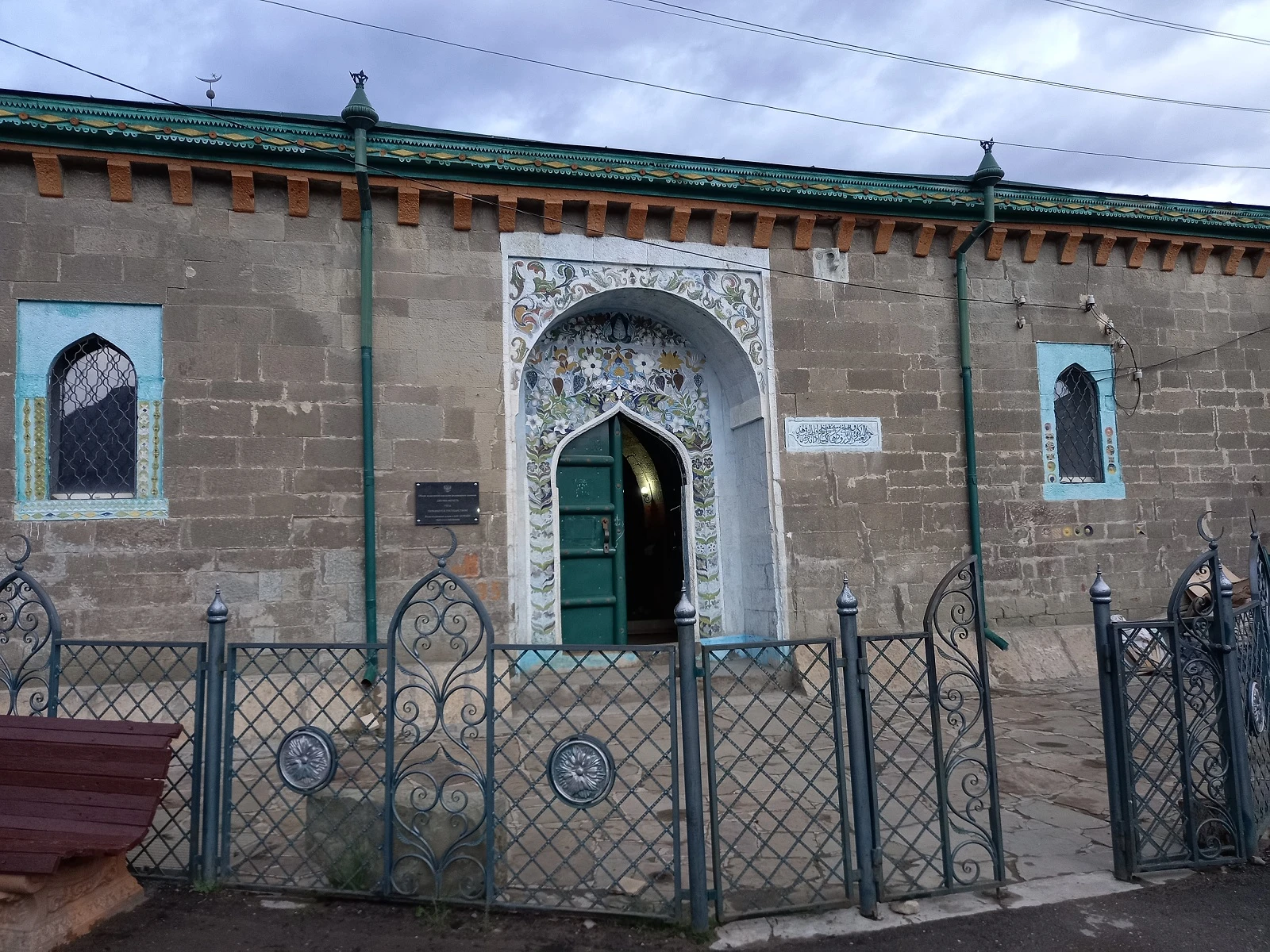
The historical centre of Lak political and religious life. The page shows an actual photograph of the Juma Mosque taken on 9 May 2021.Balkhar
A Lak village known for its ceramics. The museum's description of the technology helps distinguish the local craft from items merely stylised after it.Vachi
The birthplace of Garun Saidov, poet, playwright and publicist. His legacy is connected with the formation of modern Lak literature.Kurkli
The village is connected with the teacher and ethnographer Abdullah Omarov. His works help to study Lak daily life, language and education in the 19th century.The Novolak settlements
The history of these communities includes the forced resettlement of 1944 and subsequent decisions on a new place of residence. It is important to preserve the memory of the different stages separately.
Names
Men's
- Bartsu (Lak)
- Byurni (Lak)
Women's
- Tʼutʼi (Lak)
- Ninu (Lak)
- Chava (Lak)
- Zunzul (Lak)
People and cultural memory
Abdullah Omarov
Teacher, ethnographer and associate of P. K. Uslar. He took part in preparing school materials and in collecting Lak folklore.Jamaluddin of Ghazi-Kumukh
A Sufi teacher from Kumukh, spiritual authority for Imam Shamil. In biographies his year of birth is given variously: 1788 or 1792; he died in 1866.Ali Kayaev
Encyclopaedic scholar, theologian, historian and enlightener, 1878–1943. He studied written evidence and the cultural heritage of Dagestan.Garun Saidov
Born in Vachi in 1894. Poet, playwright, translator and publicist, one of the founders of modern Lak literature.Effendi Kapiev
Writer, publicist and translator, born in Kumukh in 1909. His work is connected with the multilingual literary environment of Dagestan.
Media
Photo gallery
Authorship and licenses are indicated in the image captions.