
North Caucasus · Dagestan
Tabasarans
Tabasarans
Language
Tabasaran · Tabasaran chʼal
Family
Nakh-Daghestanian family · Lezgic branch
Population
151,466 in Russia (2021 census)
History
Settlement, dialects and local communities
Language
Faith and history of religions
Verified information
Language
- Tabasaran belongs to the Lezgic branch of the Nakh-Daghestanian family.
Settlement and population
- Russia: 151,466; Daghestan: 126,319 Tabasarans. Census with a reference date of 1 October 2021.
Culture and daily life
- The museum carpet "komis" from Khuchni, 1974–1975, is a flat-woven, double-sided piece.
History
- The periodization of the 8th–14th centuries describes stages of Islamization, not a single date of the people's conversion.
Detailed chronology
The early Middle Ages
Tabasaran and DerbentThe region is considered within the system of political and cultural contacts of the Eastern Caucasus.Before the early eighth century, research scheme
Local religious traditionsThe periodization records the predominance of earlier cults; their content is reconstructed from later materials.722–723
Campaigns of Arab troopsWritten accounts link al-Jarrah's military operations with Tabasaran.Eighth to mid-tenth century
The initial stage of IslamizationAccording to A. R. Shikhsaidov's scheme, the adoption of the new religion by elites did not mean the simultaneous conversion of the entire population.Mid-tenth to fourteenth century
The establishment of IslamThe spread of the faith was accompanied by the transformation of local religious practices.Thirteenth to fifteenth century
Burial ground near KhivSeferbekov considers the epigraphically dated burials of Gamag-nakvar as material on religious change.The second half of the sixteenth century
The maysumate and the qadiateSeparate northern and southern domains take shape, alongside unions of rural societies.1806
Subjecthood of local rulersAlimova's monograph describes the acceptance of the qadi and maysum into Russian subjecthood.1813
Annexation of TabasaranThis stage in the change of political status is noted in the historical and ethnographic study.December 1860
Kaytago-Tabasaran OkrugA new administrative unit of the Dagestan Oblast is created.February 1866
New naib administrationA new system is introduced in the okrug in place of the traditional organization of administration.Late 19th–early 20th century
Economy and societyFarming, livestock raising and domestic crafts meet the basic needs of rural communities.1909
Birth of Abumuslim JafarovThe future writer and enlightener is born in Khiva.1915
Birth of Manaf ShamkhalovThe biography of one of the founders of Tabasaran literature begins.20 January 1921
Formation of the Dagestan ASSRA decree of the All-Russian Central Executive Committee determines the autonomous status of the republic.1930s
Restriction of open local cultsField evidence records the cessation of some public prayers at festival stones.1932
Latin scriptUse of the new Tabasaran alphabet based on Latin script begins.29 April 1932
First issue of "Krasny Tabasaran"A study of the history of the press gives the date of the newspaper's appearance in Latin script.1933
"First Steps"Abumuslim Jafarov's first poetry collection is published.1934
Early prose and dramaJafarov publishes short stories and the play "From Darkness to Light".1938
Cyrillic alphabetSoviet writing switches from Latin to Cyrillic script.1944
Manaf Shamkhalov's first bookA collection of poems and stories, "For the Motherland, for Freedom", is published.Until the 1960s
Preservation of an agrarian ritualThe ritual described by the ethnographer shows the long coexistence of local and Muslim elements.Second half of the 20th century
Mountains, plain and cityMigrations, education and new occupations change the geography and everyday life of communities.1974–1975
"Komis" carpet from KhuchniThe documented REM item 8506-25 dates to this time.1977
Museum collections and photographsE. G. Torchinskaya collects clothing and textiles and photographs life in Tabasaran District.After 1991
Open religious lifeThe development of mosques and education is accompanied by different approaches to religious tradition.2001
Professional national theatreThe State Tabasaran Drama Theatre is created.2007
Expedition to ChereREM documents the local tradition of flat-woven carpet making.2021
Population censusIn Russia, 151,466 Tabasarans were counted; in Dagestan, 126,319.
Cuisine
Khinkal
Thin khinkal and shell-shaped pieces were prepared; meat or a separate sauce was served with the dough. Family recipes differ.Bread and stuffed pies
Grains formed the basis of the diet. Bread was baked in various ways, and pies were made with available seasonal fillings.The seasonal table
Dairy products, meat, legumes and wild greens supplemented flour dishes. The composition of food depended on the season and the family's prosperity.Festive baking
For Ebeltsan, researchers recorded pancakes called "gvanzhrar" and ritual breads. The ceremonial role of a dish differs from its everyday consumption.
Adats and traditions
Community and mutual aid
The rural community organized joint work and regulated relations among residents. Historical norms changed along with governance and the economy.Family and hospitality
Family ties, helping relatives and receiving guests occupied an important place in daily life. Nineteenth-century descriptions are not binding rules for the modern family.The beginning of field work
Rites of the first furrow linked the agricultural calendar with a communal meal and wishes for the harvest; local variants should not be conflated.Community memory
Stories about saints, ancestors and revered places conveyed ideas about the protection of the village and moral conduct. These are folklore testimonies that require critical reading.
Clothing
Dances
Dance in public life
Dance culture was part of weddings and celebrations. The modern stage reworks local heritage, so a concert production should not be presented as an unchanging ancient rite.The theatrical stage
The National Drama Theatre develops the language, movement and musical forms of performance; its professional history begins in 2001.
Music
Crafts
Carpet weaving
The tradition includes various techniques. The museum's "komis" from Khuchni, dated 1974–1975, is made without pile, on a cotton warp with a wool weft. The museum's attribution links it to the Tabasarans and Lezgins.Weaving of Chere
S. A. Stolyopina's 2007 expedition documented the pileless fabrics and carpets of the village of Chere. Field recording helps preserve information about local techniques and items.Domestic production
Knitting socks and making sacks, bags and textiles served everyday needs. These activities are attested by museum collections, not only by modern souvenirs.
Memorable Places
Khuchni
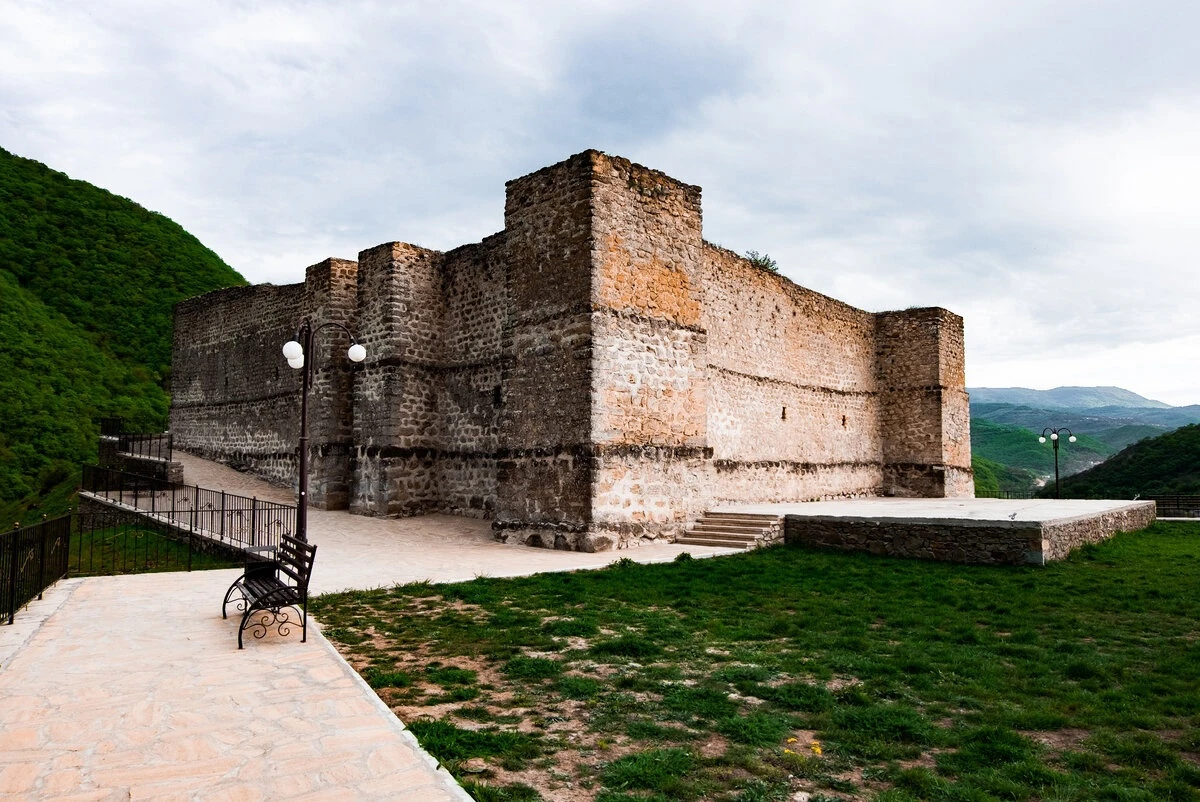
The historical centre of northern Tabasaran. The photograph of the fortress on the page shows the modern appearance of the monument; the legend of the seven brothers and their sister is not used as proven construction history.Khiv
An important centre of Tabasaran cultural memory; the biographies of the writers Abumuslim Jafarov and Manaf Shamkhalov are connected with the village.Chere
A village where a Russian Museum of Ethnography expedition studied and collected samples of pileless weaving.Derbent
One of the urban centres of Tabasaran settlement and the location of the State Tabasaran Drama Theatre.
Names: examples of contemporary usage
Men's
- Bazut (Tabasaran, archaic)
- Karuch (Tabasaran, archaic)
- Shingar (Tabasaran, archaic)
- Shisin (Tabasaran, archaic)
Women's
- Azlena (Tabasaran, archaic)
- Bichakh (Tabasaran, archaic)
- Kemser (Tabasaran, archaic)
- Laviyat (Tabasaran, archaic)
- Talum (Tabasaran, archaic)
- Tamal (Tabasaran, archaic)
People and cultural memory
Abumuslim Jafarov
A poet, prose writer and playwright born in Khiv in 1909. His collection "First Steps" was published in 1933; his work is connected with the formation of written literature.Manaf Shamkhalov (1915–1974)
A poet, writer, playwright and translator. He published from 1932; his first book appeared in 1944. He translated works by Pushkin and Suleyman Stalsky.Creators of the national stage
The professional theatre was formed on the basis of district folk ensembles and the training of actors. This is a history of collective cultural work, not only of individual well-known names.
Media
Photo gallery
Authorship and licenses are indicated in the image captions.