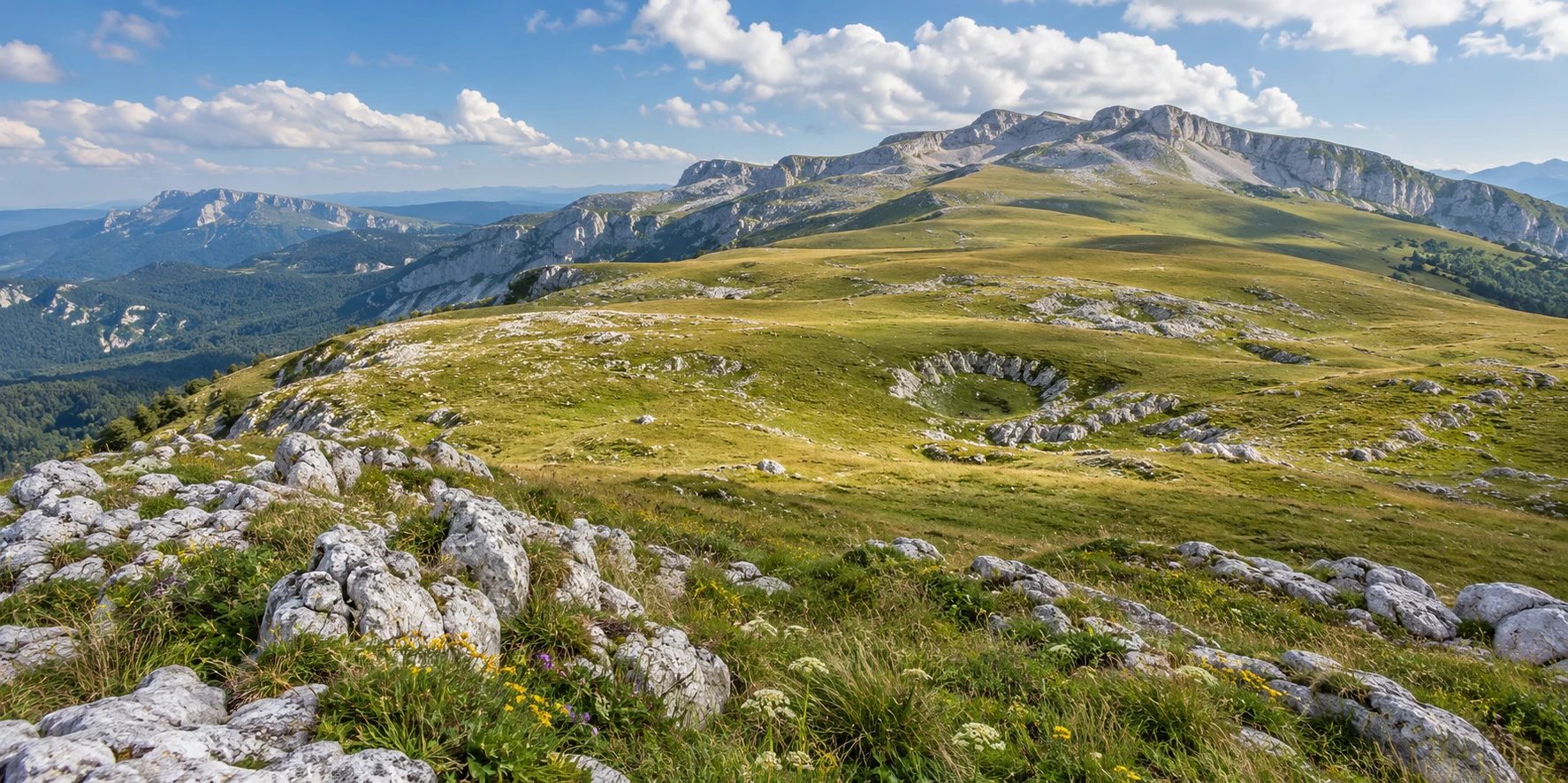
High-mountain meadows with limestone outcrops and karst depressions
Lagonaki Highlands: a landscape inspired by natural scenery · illustration · Artistic illustration

500.7 thousand

residents as of 1 January 2025, a rounded Rosstat estimate in the profile of the Bank of Russia

7.8 thousand

square kilometres, the rounded area of the republic

2

state languages: Adyghe and Russian

Geography in Detail

Cities, villages and districts

Adygea comprises seven administrative districts and two cities of republican significance. The districts unite rural settlements, auls, stanitsas and settlements.

Settlements
233
Territories
9

List of populated places as of 8 September 2026. Populated places with the same name in different municipal formations are shown separately. Small populated places without permanent population are also included; population figures are not given here.

Urban okrugMaykopCenter: Maykop
Urban okrugAdygeyskCenter: Adygeysk
DistrictGiaginsky DistrictCenter: stanitsa Giaginskaya
DistrictKoshekhablsky DistrictCenter: Koshekhabl aul
DistrictKrasnogvardeysky DistrictCenter: Krasnogvardeyskoye village
DistrictMaykopsky DistrictCenter: Tulsky settlement
DistrictTakhtamukaysky DistrictCenter: Aul Takhtamukay
DistrictTeuchezhsky DistrictCenter: Ponezhukay aul
DistrictShovgenovsky DistrictCenter: Khakurinokhabl aul

Geography and population

Adygea is located in the north-western part of the Caucasus. The north of the republic is occupied by the flat Kuban region, while foothills and slopes of the Greater Caucasus lie further south. Maykop stands on the Belaya, one of the rivers of the Kuban basin. Natural landscapes include cultivated plains, mountain forests and alpine meadows. According to Rosstat data cited by the Bank of Russia, as of 1 January 2025 the republic had a population of 500.7 thousand people. The area of the territory is about 7.8 thousand km². The figures are rounded, and the population estimate date is retained next to the number. Agriculture and industry coexist with a developing service sector. The natural complexes of the mountainous part of the republic are of touristic importance; its economy should not be reduced to tourist routes alone.

Peoples and related materials

Adyghe societies and linguistic traditions

The Temirgoy tradition
The Temirgoy, or Chemguy, dialect is linked to the formation of the literary Adyghe language. Historical societies and modern linguistic groups do not fully coincide.
The Bzhedug tradition
Bzhedug is one of the main dialects of the Adyghe language that are preserved in the republic.
The Shapsug and the Abadzekh
The Shapsug tradition is also represented on the Black Sea coast of Krasnodar Krai. The Abadzekh dialect is preserved mainly in the diaspora abroad.
The common Adyghe cultural world
The Adyghe, Kabardians, Circassians and Shapsug are linked by the self-designation "Adyge" and by their cultural heritage. The geography of the Adyghe world is considerably wider than the borders of the Republic of Adygea.

Languages: status and everyday life

Adyghe

Adyghe belongs to the Abkhaz-Adyghe language family. The main dialect traditions include Temirgoy, Bzhedug and Shapsug; Abadzekh is represented primarily in the diaspora. There are phonetic and other differences between them. Adyghe and Kabardian-Circassian have separate literary norms.

Russian and its state status

The state languages of the Republic of Adygea are Adyghe and Russian. Russian is widely used in interethnic communication, education and urban life. The republic guarantees the preservation and development of the languages of the peoples living in it.

The language in the republic and in the diaspora

Adyghe is used not only in Russia but also in communities abroad, including in Turkey and the countries of the Middle East. Preserving the transmission of the language to children is a separate task. The 2010 census data cited in the linguistic references should not be read as today's number of speakers.

Population and cultural diversity

Population estimates refer to all permanent residents of the republic. Ethnic composition is established by census, not by the annual estimate of total population.
The Adyghe
Part of the Adyghe cultural world and one of the main peoples of the republic. The number of Adyghe throughout the world is not equal to the number of residents of Adygea.
Russians
The largest population group in the republic. Urban and rural communities have their own history of settlement.
Armenians and other residents
Alongside the Adyghe and Russians, representatives of other peoples live in the republic. Ethnicity, native language and religious affiliation are treated as different characteristics.

History of Adygea

Text size
Text size: 100%

Chapter 1 · 4th millennium BCE

The Maikop culture and the Oshad kurgan

In 1897, N. I. Veselovsky investigated the Maikop kurgan, also known as Oshad. The rich burial with metal vessels, ornaments and other objects gave its name to the Maikop archaeological culture of the Early Bronze Age.
Yu. Yu. Piotrovsky's study re-examines the archival excavation materials, the first publications and the construction of the burial complex. The finds show wide connections between the cultures of the Caucasus and neighbouring regions. They do not allow the entire Bronze Age population to be attributed to a single modern people without additional evidence.
Page 1 of 1in chapter 1

A historical overview with references to research and documents. Modern administrative borders are not projected onto ancient cultures and historical Circassian lands.

Nature and archaeological heritage

The Lagonaki highlands and the Fisht-Oshten massif are known for their limestone landscapes, karst landforms, mountain meadows and rich flora. Fisht, Oshten and Pshekha-Su form a recognisable group of peaks of the Western Caucasus. The westernmost glaciers of the Greater Caucasus survive on the massif. The Caucasus State Nature Biosphere Reserve was founded on 12 May 1924. It is located in three federal subjects: Adygea, Krasnodar Krai and Karachay-Cherkessia. The reserve has a nature-protection regime; the availability of routes and the current rules should be checked with the administration. The "Western Caucasus" site was inscribed on the UNESCO World Heritage List in 1999 for the diversity of its natural complexes and the preservation of its ecosystems. This is a natural site with defined boundaries, not a status covering the entire territory of Adygea or all of its archaeological monuments. The Maykop kurgan and the dolmens represent different lines of Bronze Age study. Archaeological photographs, plans and reconstructions are available in scholarly publications; they make it possible to distinguish a surviving monument from a modern recreation.

Religious traditions

In the history of Circassian societies, local beliefs, Christian influences and Islam interacted. The spread of Islam occurred gradually and not simultaneously; ties with the Crimean Khanate and the Ottoman Empire played an important role. Sunni Islam became established among the Adyghe. The religious life of the republic is diverse and also includes Orthodox and other communities. Adyghe Khabze refers to a system of social and ethical norms and is not identical to a particular religion. Ethnicity in itself does not determine personal faith.

Epic, literature and crafts

Adyghe Nart sagas belong to the shared world of the Nart epic of the Caucasus. The 1974 academic edition "Narty" brings together texts, translations and commentaries. The works of Asker Gadagatl are devoted to the study of the epic of the Adyghe peoples. Oral tradition preserves artistic images and cultural memory, rather than a literal chronicle of events. The National Museum of Adygea holds archaeological and ethnographic collections, and materials on history and culture. Its official website also presents the Literary Museum of Tembot Kerashev. Museum objects and attributed photographs make it possible to study clothing, everyday life and literary heritage. Gold and silver embroidery was used in decorating clothing and household items. The research of Madina Ivanokova is devoted to the techniques, antique examples and terminology of this art. The works also examine materials from the Black Sea Shapsugia, which belong to the broader Adyghe cultural heritage.

Cuisine and dining culture

The combination of shchyps-pIaste occupies a notable place in Adyghe cuisine. PIaste is a thick porridge made from millet, and later also from corn; it is served with shchyps sauce, meat, dairy or other dishes. Sauce recipes vary by locality and family. Ethnographic descriptions link food to the household, hospitality and family events. The names of foods, kitchen items and rules of hospitality are also preserved in the language, proverbs and sayings. A. A. Kuvaeva examines this side of Adyghe culture in a study of gastronomic vocabulary. This approach supplements the description of recipes with information about how food participates in everyday communication.

Media

Landscapes of mountainous Adygea

A landscape inspired by the limestone highlands of Lago-Naki. This is an artistic interpretation without reference to an exact shooting location. Documentary photographs of nature and monuments are available in the materials below.

Anthem

State Anthem of the Republic of Adygea

Adyghe and Russian poetic version

Words by Iskhak Mashbash, music by Umar Tkhabisimov. The texts and the procedure for their use are established by Law of the Republic of Adygea No. 90 of 7 June 2007 on state symbols.

The approved versions of the anthem and the provisions on its performance are available in the electronic copy of the law at the "Official text" link.

Timeline

Events: 15 / 15

4th millennium BCE
Maykop archaeological culture of the Early Bronze Age.
Late 4th-2nd millennia BC
The main chronological range of dolmen monuments of the Western Caucasus in the review by the Institute of Archaeology of the Russian Academy of Sciences.
May 1857
Founding of the Maykop military fortification.
1864
The final phase of the Caucasian War in the North-Western Caucasus; the mass forced resettlement of the Circassians.
1870
Maykop received city status.
1897
N. I. Veselovsky investigated the Maykop Oshad kurgan.
27 July 1922
Formation of the Circassian (Adygea) Autonomous Oblast.
1925
Founding of the Adygea Museum of History and Ethnography in Krasnodar.
10 April 1936
Maykop was included in the autonomous oblast and became its administrative centre.
9 August 1942
Beginning of the German occupation of Maykop.
29 January 1943
Liberation of Maykop.
18 February 1943
Completion of the liberation of the territory of the Adygea Autonomous Oblast.
3 July 1991
Law of the RSFSR on transforming the autonomous oblast into a republic.
10 March 1995
Adoption of the Constitution of the Republic of Adygea.
1999
Inscription of the "Western Caucasus" site on the UNESCO World Heritage List.