

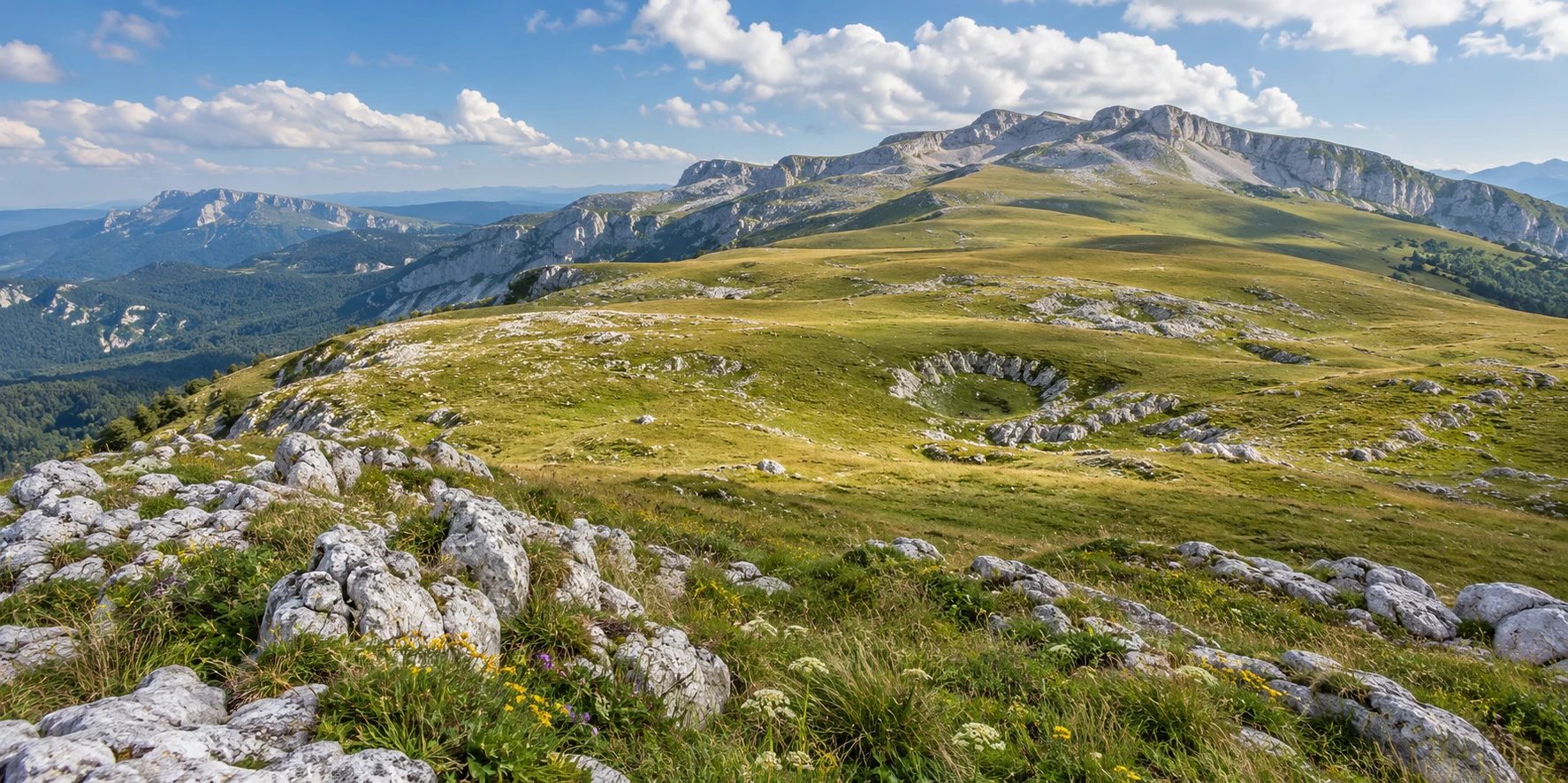
High-mountain meadows with limestone outcrops and karst depressions
← All peoples

North Caucasus · Adygea

Adyghe (Circassians)

Adyghe

Adyghe, Circassians: the history, languages and culture of the Adyghe, Kabardians and Shapsugs. Historical tribes, religious traditions, the Caucasian War, the diaspora and a detailed chronology with materials.
Lagonaki Highlands: a landscape inspired by natural scenery · illustration

Language

Adyghe and Kabardian-Circassian

Family

Abkhazo-Adyghean family, Adyghe branch

Population

Separate census categories; there is no single worldwide total

History

Common name and modern names. Adyghe is the common self-designation of the Adyghe, also known as Circassians. The modern names Adygheans, Kabardians, Cherkess and Shapsugs reflect related but not fully coinciding levels of identity. A 2022 academic monograph examines them together. This page is devoted to the broad Adyghe community, not only to the population of the Republic of Adygea.
Western and Eastern Circassia. The historical societies of the North-Western Caucasus were linked by language, exchange and culture, but did not form a permanently unified state. Kabarda represented the eastern part of the Adyghe world; the western societies had their own political associations. Historical borders cannot be mechanically transferred to modern republics.
Tribes and social structure. The names of the Abadzekhs, Bzhedugs, Shapsugs and other groups denote historical communities, not a single lineage. Princely domains and societies with a strong role of assemblies coexisted. The conventional terms "aristocratic" and "democratic" do not describe modern democracy and do not eliminate differences within each group.
Relations with neighbours. The diplomacy of the 16th and 18th centuries linked Adyghe rulers with the Muscovite state, Crimea and the Ottoman Empire. Alliances changed; an agreement of an individual prince did not mean a simultaneous decision by all Adyghe societies.
War and forced expulsion. In the 19th century the Russian conquest of the Caucasus was accompanied by the destruction of settlements and the displacement of inhabitants. The end of the war in the North-Western Caucasus in 1864 is associated with a mass exodus to the Ottoman Empire, loss of life and loss of homeland. These events cannot be reduced to ordinary voluntary migration.
Diaspora and return. Adyghe communities formed in Turkey and the Middle East, and later in other countries. Documents show that already in the late 19th and early 20th centuries settlers tried to return to the Caucasus, encountering administrative obstacles. No single reliable figure for the size of the entire worldwide diaspora is given here.
The 20th century and the present. Soviet autonomies, school education, literature and cultural institutions changed the forms of public life. The preservation of the language today depends on family transmission, school and the environment of communication, including in the diaspora. Ethnicity, citizenship, language and religious choice are considered separately.

Historical tribes and groups

How to understand the word "tribe". In historical literature this is the name given to territorial and subethnic groups of the Adyghe. Their composition, unions and names changed; a tribe is not the same as a surname, a clan or a modern republic. The number of groups differs across sources, so a single fixed list cannot be presented as the only possible one. Abadzekhs. One of the large West Adyghe groups; the Abadzekh dialect tradition is preserved, in particular, in the diaspora. Bzhedugs. A West Adyghe group with a living dialect tradition in Adygea. Shapsugs. Associated with the Black Sea coast and the Kuban region. The Shapsug dialect is preserved in the Caucasus; modern identity is not limited to the historical political union. Natukhais. A significant West Adyghe community, distinguished by historians alongside the Abadzekhs and Shapsugs. Temirgoys, or Chemguis. The formation of the Adyghe literary language is associated primarily with their dialect. Besleneys. One of the historical Adyghe groups; in the sources it is considered separately from neighboring associations. Kabardians. An eastern Adyghe community associated with historical Kabarda. The modern name and the historical political domains are not fully identical. Khatukais, Zhaneevs, Mamkhegs and Makhoshevs. They are mentioned independently in historical lists; the reduction or transformation of a community does not mean the disappearance of family memory of it. Yegerukhais, Adamievs, Shegaks and Khakuchis. They show why real lists are broader than the popular scheme of twelve names. The level at which a group is distinguished depends on the period and the author. Ubykhs: a special note. They are closely linked to the Adyghe culturally and historically, but had their own language. Their inclusion in general Circassian lists should not obscure this independence.

Language

Adyghe and Kabardian-Cherkess are closely related languages of the Adyghe branch of the Abkhazo-Adyghean family. The Adyghe literary language is based predominantly on the Temirgoy dialect. Bzhedug and Shapsug retain living use; Abadzekh speech is better represented in the diaspora than in the historical territory.
Kabardian-Cherkess has its own literary norm and history of writing. The modern Cyrillic alphabet was introduced in 1936, and for Adyghe in 1938. Before that, other graphic systems were used, including Arabic and Latin.
Ubykh was a separate language, although many Ubykhs also spoke Adyghe languages. Historical cultural closeness does not turn it into a Kabardian or Shapsug dialect. The old terminology of Lavrov's monograph on language classification must be considered in light of the time when it was written.
The number of speakers of a language and ethnic population size are different indicators. The statistics of the Institute of Linguistics here refer to the 2010 census.

Faith and history of religions

Local beliefs. Before the spread of world religions, local cults and rites connected with nature, economy and social life existed. Later ethnographic records do not provide grounds for reconstructing a single unchanging religion of all groups over thousands of years. Christianity in the Middle Ages. Christian ties formed through the Black Sea region and neighbouring Caucasus centres. Byzantine, Abkhaz and Alan influence, and later contacts with Genoese colonies, operated in different periods and in different territories. The spread of church institutions did not mean the disappearance of local rites. Coexistence of traditions. Travellers of the same period described the faith of Adyghe societies differently. This is explained by the unequal religious situation and by the combination of local ideas with Christian and Muslim practices. This picture is more complex than a sequential succession of three strictly separated eras. Paths of the spread of Islam. In the early modern period, contacts with the Crimean Khanate and the Ottoman Empire, preachers, trade and ties among the local nobility played an important role. The adoption of Islam proceeded gradually: a ruler's political decision did not equal the immediate conversion of every village. The 18th and 19th centuries. Islam strengthened at different rates. During the Caucasian War, Muslim norms acquired an additional unifying significance. The religious history of the western societies and of Kabarda should not be dated by a single common date. The Sunni tradition. The main historical Islamic tradition of the Adyghe is Sunni, predominantly of the Hanafi madhhab. This affiliation cannot automatically be transferred to every individual. Mosques, religious education and family rites constitute different sides of religious life. Khabze and religion. Adyghe khabze encompasses customs, norms of communication, respect and social behaviour. It is not identical to sharia and is not the precise name of a single religion of all Adyghe. In scholarly literature, the ethics of adygag'e and the etiquette forms of its expression are also distinguished. Orthodox Adyghe. The history of Orthodox Kabardian communities is connected, in particular, with Mozdok and the migrations of the 18th century. The existence of such communities shows that Adyghe identity is not reducible to a single confession. The Soviet period. Soviet anti-religious policy restricted religious institutions and public practice. Family and local traditions were preserved unevenly; secular culture became an important part of the lives of several generations. After the collapse of the USSR. Religious activity and discussion of the relationship between faith and customs resumed. Field research records Muslims, Christians of various denominations and secular positions. Local surveys of past years are not presented as contemporary statistics of all Adyghe and the diaspora.

Verified information

Language

  • Adyghe and Kabardian-Cherkess belong to the Adyghe branch of the Abkhazo-Adyghean family.
  • The Adyghe Cyrillic alphabet was introduced in 1938; the Kabardian-Cherkess one in 1936.

Settlement and population

  • Adyghe communities live in the Caucasus and in the diaspora abroad. The resettlement of the 19th century was largely forced.

Culture and daily life

  • The heritage register documents the making of the shichepshin and the weaving of mats.

History

  • Historical lists of Adyghe groups differ in time and in the principle of classification.
  • The Caucasian War in the North-Western Caucasus ended in 1864.

Detailed chronology

  1. Middle Ages

    Christian connections of the Black Sea region
    Church influences spread through various neighbouring centres; local rites continued to exist.
  2. Thirteenth to fifteenth century

    Contacts with the Genoese colonies
    Catholic missions became one of the channels of Christian presence on the coast.
  3. 16th–18th centuries

    Unions of Western Circassia and Kabarda
    The materials describe several territorial groups with different forms of governance.
  4. 16th century

    Multilateral diplomacy
    Adyghe rulers interacted with Moscow, Crimea and the Ottoman Empire.
  5. The early modern period

    The gradual spread of Islam
    Preaching and external contacts changed the religious environment without the simultaneous conversion of all societies.
  6. 18th century

    Changes in the religious life of Kabarda
    Islamic institutions grew stronger; local customs and Christian communities persisted.
  7. 1763

    The founding of the Mozdok fortress
    In this area the history of Orthodox Kabardian settlers and of a new border centre took shape.
  8. Late 18th and early 19th centuries

    Various forms of public governance
    Princely domains and societies with a strong role for assemblies had different trajectories of development.
  9. First half of the 19th century

    Nogmov collects legends and studies the language
    His educational work created an early written basis for the study of his own history.
  10. 19th century

    Caucasian War
    The military advance of the empire changed the settlement patterns and economy of Adyghe societies.
  11. 1858–1864

    The final stage of the conquest
    The war and the forced displacement of inhabitants led to a catastrophic decline in population on the historical territory.
  12. 1861

    Publication of "The History of the Adyghe People"
    Shora Nogmov's work was published posthumously; reissues with editorial additions followed.
  13. 1864

    The end of the war in the North-Western Caucasus
    Mass expulsion and loss of life became the central trauma of historical memory.
  14. Second half of the 19th century

    Formation of communities abroad
    The settlers established their lives in the Ottoman Empire; enduring diaspora centres emerged.
  15. Late 19th and early 20th centuries

    Attempts to return to the Caucasus
    Archives record settlers' petitions to return and administrative obstacles.
  16. 1891

    Reissue of Nogmov's work
    The edition with notes and a biography reflects the development of Adyghe historiography.
  17. 1910

    Museum collecting of mats
    A. A. Miller's expedition acquired items from the auls of the Kuban Oblast.
  18. 1921–1922

    Formation of the Kabardian autonomy
    The administrative structure changed; in 1922 the Kabardino-Balkarian Autonomous Oblast was created.
  19. 27 July 1922

    Formation of the Adyghe autonomy
    This date is connected with a new administrative structure, not with the emergence of the people.
  20. 1920s

    Schooling and new alphabets
    Instruction in native languages expanded, and the press and written culture developed.
  21. 1923

    The newspaper "Adyghe Maq"
    The periodical press became an important space for the Adyghe literary language.
  22. 1924

    Kabardian Latin script
    Educational and literary publications began to appear in the new script.
  23. 1936

    Cyrillic for Kabardian-Circassian
    The new alphabet replaced the Latin basis; it was later amended.
  24. 1937

    Adyghe Drama Theatre
    The professional stage became one of the means of developing the literary language.
  25. 1938

    Adyghe Cyrillic
    A Cyrillic-based script was introduced and, with changes, has remained in use to the present day.
  26. Soviet period

    Restrictions on religious life
    Anti-religious policy changed social practice; family traditions were preserved unevenly.
  27. 1948

    Recognition of Tem bot Kerashev's prose
    The writer received a state prize for the novel "The Road to Happiness".
  28. 1974

    Academic edition of the Nart epic
    Texts and translations of the Adyghe heroic epic with scholarly commentaries were published.
  29. 1990

    A book on the art of the Adyghe mat
    Zamudin Guchev's work became part of documenting and transmitting the craft.
  30. 3 July 1991

    Transformation of Adygea into a republic
    The law changed the status of the autonomous oblast within the RSFSR.
  31. 10 March 1995

    Constitution of the Republic of Adygea
    The republican legal status was enshrined, including provisions on state languages.
  32. 2010s

    Studies of contemporary religiosity
    Field materials show various combinations of faith, ethnic culture and secular life.
  33. 2022

    The academic monograph "The Adyghe"
    A joint publication of research institutes examines the Adyghe, Kabardians, Circassians and Shapsugs.
  34. Since 2023

    Mat weaving training
    The Center for Folk Culture organizes courses to pass on craft skills.

Cuisine

  • Shchips and paste

    Shchips represents a family of sauces with local variations of preparation. Paste, a thick porridge, serves as a customary accompaniment. There is no single recipe for the Adyghe, Kabardians and Shapsugs.
  • Dairy culture

    Cheese and fermented dairy products occupy an important place in nutrition. The historical diet depended on the household and the season; the festive table does not reflect the everyday menu of all families.
  • Khalyuzh and family recipes

    Dough products, including those with cheese filling, are prepared in various local variations. Modern restaurant presentation differs from the historical home table.

Adats and traditions

  • Adygag'e and khabze

    Scholarship highlights humanity, respectfulness, reason, courage and honour. This is an ethical ideal, not a claim that every person behaves identically.
  • Guests and communication between generations

    Hospitality, the order of greeting and respectful address regulate relations between people. Etiquette changes together with the social environment; its historical descriptions do not replace modern law.
  • Wedding communication

    A wedding combined family negotiations, guest etiquette, music and the dance jegu. The forms and sequence of actions differed between groups.

Clothing

The men's cherkeska with gazyr pouches, the beshmet, the belt and the headwear form a well-known clothing complex. Its elements spread to neighbours as well: the cherkeska is not a sufficient marker of a person's ethnicity in an old photograph.
Women's festive clothing included a long dress, a belt, jewellery and a headdress; the details depended on locality, age and wealth. A museum object must be described with its provenance and date, and a modern stage costume must be distinguished from the everyday clothing of the past.

Dances

  • Zafak

    The paired dance is known in the wedding jegu of the Western Adyghe. Its performance is governed by the rules of interaction between the partners and of the space of the circle.
  • Uj

    The circle dance occupies a special place in festive communication. Descriptions of weddings give various versions of its place in the sequence of dances.
  • Islamey and local variations

    Distinctive combinations of dances have been recorded for Shapsug weddings. It is wrong to reduce all Adyghe dances to a single number under the common stage name "lezginka".

Music

The shichepshin is a traditional bowed instrument. Horsehair was historically used for the strings and bow; making it requires knowledge of wood, tension and tuning. The heritage register documents craftsmen, recordings of performance and the transmission of skills.
The Nart epic combines narrative, poetry and a performance tradition. Sosruko, Sataney and other characters belong to the epic world. The epic is important for the study of culture, but it is not read as a literal chronicle.

Crafts

  • Publa mats

    Ornamental mats are woven from plant material on a thread base. They were used in the dwelling and in rituals; the craft is passed from master to pupil.
  • Clothing and decorative work

    Sewing, the finishing of clothing and the making of jewellery are connected with the history of costume. Attributing an object requires a museum description, not merely a similarity of ornament.
  • Making musical instruments

    The shichepshin maker's work includes preparing the body, the strings and the bow. Modern workshops and recordings of performers help to preserve this technology.

Memorable Places

  • National Museum of the Republic of Adygea

    Maykop, Sovetskaya, 229. The museum collections make it possible to study history and material culture with object attributions.
  • Tembot Kerashev Literary Museum

    The memorial apartment in Maykop is devoted to the writer and to the history of Adyghe literature.
  • Kabarda and the Kuban region

    The historical areas of settlement are connected with different stages of Adyghe history. Their borders and political unions changed over time.
  • The Black Sea coast

    The coastal Adyghe societies preserved their own local traditions. The Shapsug language continues to exist in the villages of Krasnodar Krai.

Names

Men's

  • Pshimaf (Adyghe; happy prince)
  • Shumaf (Adyghe; happy horseman)
  • Tuguzh (Adyghe; wolf)
  • Sausryko (Adyghe, Nart)
  • Totresh (Adyghe, Nart)
  • Tkhaishau (Adyghe)
  • Afamgot (Adyghe; desired child)
  • Abrég (Adyghe)

Women's

  • Goshmáf (Adyghe)
  • Goshdákh (Adyghe)
  • Goshnág (Adyghe)
  • Mazág (Adyghe)
  • Mezguash (Adyghe)
  • Nago (Adyghe)
  • Nakhdakha (Adyghe)
  • Nadakh (Adyghe)

People and cultural memory

  • Shora Nogmov

    Enlightener, collector of legends and researcher of the language. His "History of the Adyghe People" is an important monument of historiography; the information in the legends requires comparison with independent materials.
  • Tembot Kerashev

    A writer who combined the development of national prose with an interest in folklore. His historical novels and novellas remain works of fiction.
  • Zamudin Guchev

    Master and researcher of mats, maker of musical instruments. The heritage register documents his contribution to teaching and preserving the craft.

Media

Photo gallery

The illustrations were created for the portal and are not documentary photographs.