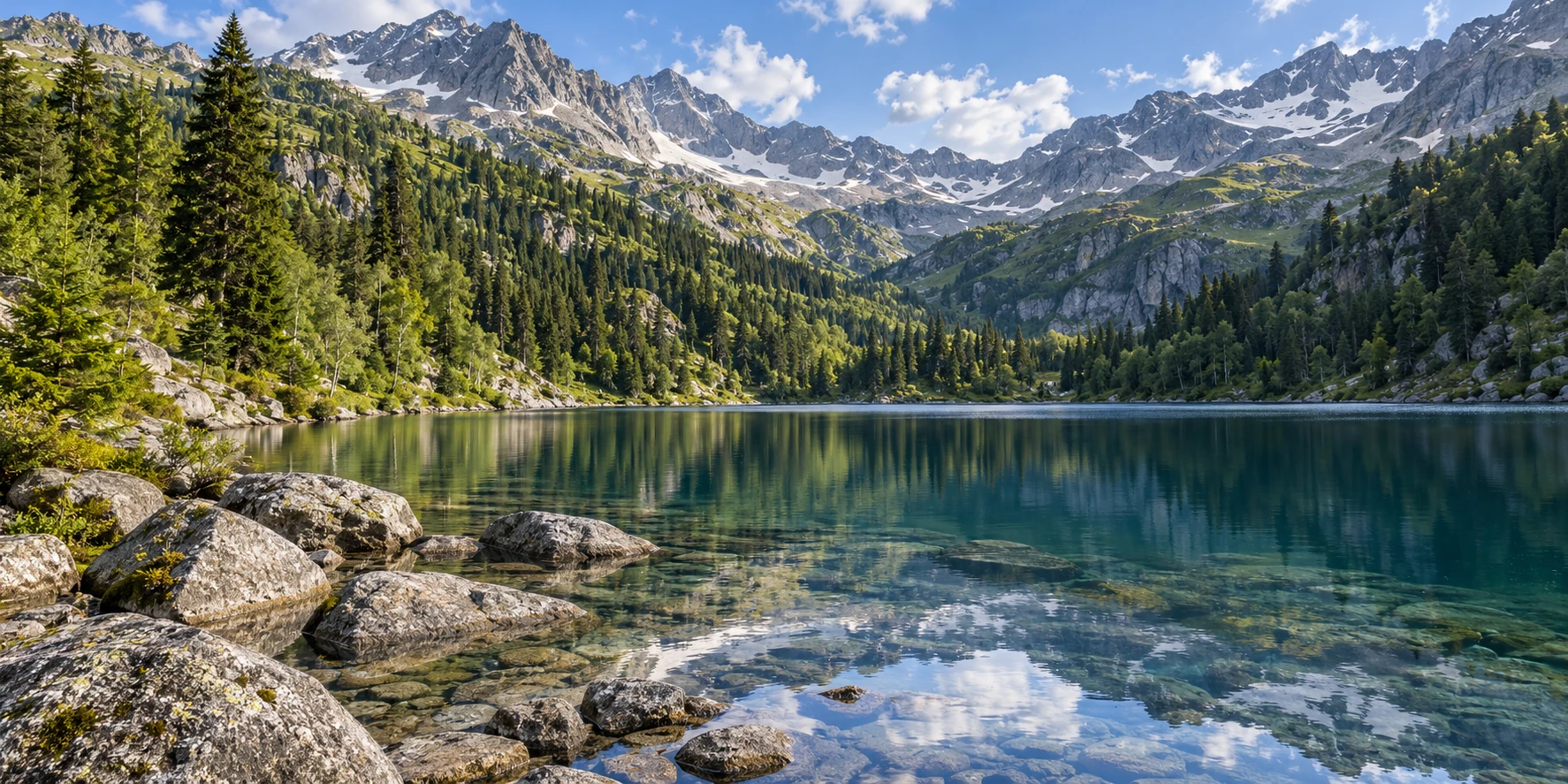
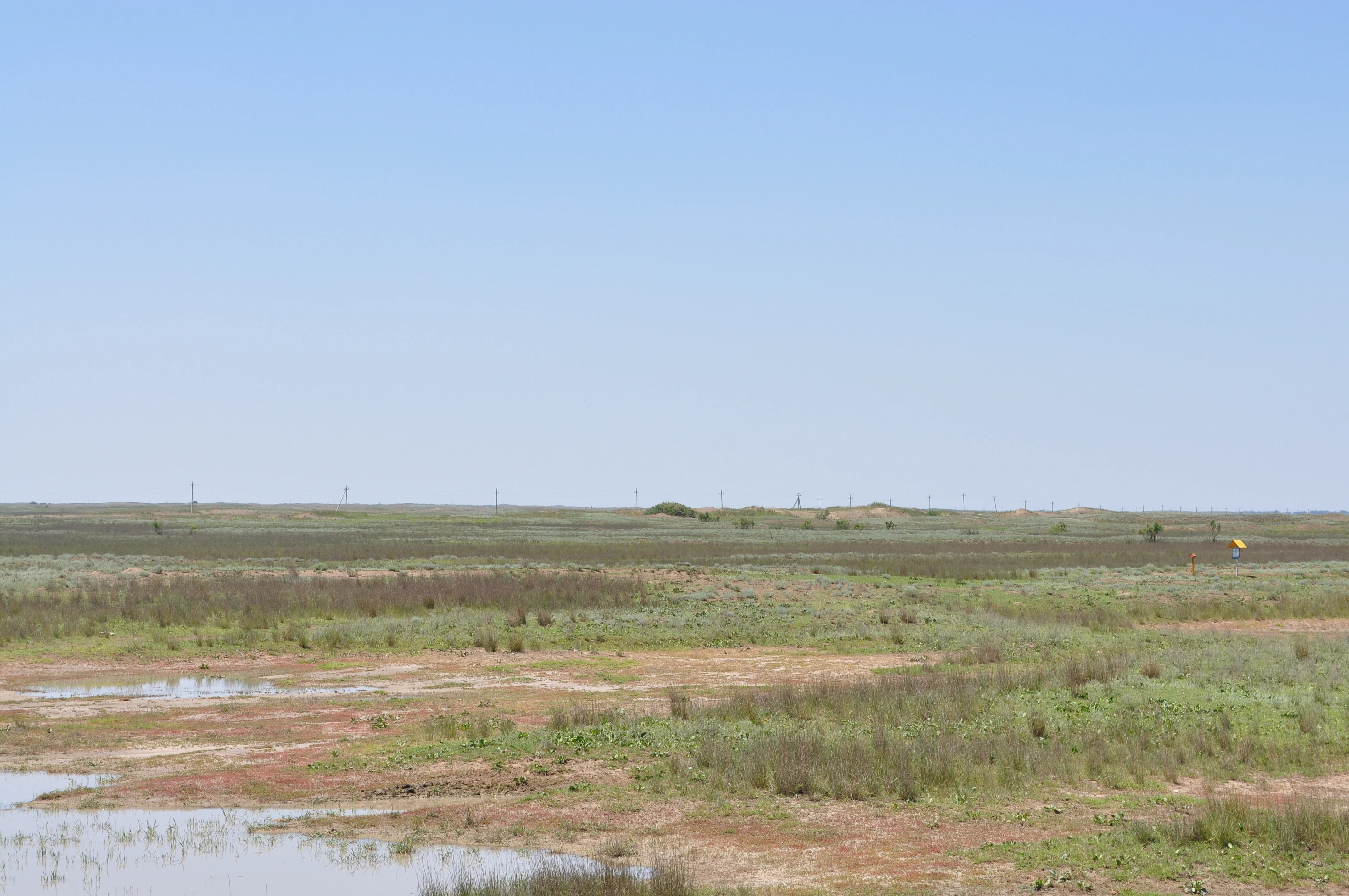
A landscape inspired by the lakes and mountain forests of the Teberda district.
A landscape inspired by the lakes and mountain forests of the Teberda district. This is an artistic interpretation, not an illustration of a specific lake. · Artistic illustration

468.6 thousand

residents as of 1 January 2025, a rounded Rosstat estimate in the profile of the Bank of Russia

14.3 thousand

square kilometres, the rounded area of the territory

5

state languages: Abaza, Karachay, Nogai, Russian and Cherkess

Geography in Detail

Cities, villages and districts

Karachay-Cherkessia is divided into ten districts. Cherkessk and Karachayevsk form separate urban okrugs; the town of Teberda is part of the Karachayevsk urban okrug.

Settlements
148
Territories
12

List of populated places as of 8 September 2026. Populated places with the same name in different municipal formations are shown separately. Small populated places without permanent population are also included; population figures are not given here.

Urban okrugCherkesskCenter: Cherkessk
Urban okrugKarachayevskCenter: Karachayevsk
DistrictAbazinsky DistrictCenter: Inzhich-Chukun
DistrictAdyge-Khablsky DistrictCenter: Aul Adyge-Khabl
DistrictZelenchuksky DistrictCenter: Zelenchukskaya stanitsa
DistrictKarachayevsky DistrictCenter: Karachayevsk
DistrictMalokarachayevsky DistrictCenter: Uchkeken village
DistrictNogaysky DistrictCenter: Erken-Shakhar settlement
DistrictPrikubansky DistrictCenter: Kavkazsky settlement
DistrictUrupsky DistrictCenter: Pregradnaya stanitsa
DistrictUst-Dzhegutinsky DistrictCenter: Ust-Dzheguta
DistrictKhabezsky DistrictCenter: Khabez aul

Geography and population

Karachay-Cherkessia is located on the northern slopes of the Greater Caucasus and in the adjoining foothills. Its landscapes include plains, forested valleys, meadows and high mountains. Among the important river valleys are the Kuban, Teberda and Bolshoy Zelenchuk. Cherkessk is the capital of the republic. According to rounded Rosstat data in the Bank of Russia profile, the population as of 1 January 2025 was 468.6 thousand people. The area of the territory is about 14.3 thousand km². The date of the estimate and the rounding are preserved alongside the figures. Livestock farming and crop cultivation, including horticulture and greenhouse farming, complement industry and the service sector. Tourism is an important area of development, but it does not exhaust the region's economy.

Related articles about peoples

Peoples and cultural traditions

Karachays
A Turkic-speaking people. Karachay is the regional name of the Karachay-Balkar language; cultural ties with the Balkars do not negate their own self-designation.
Cherkess
Part of the Adyghe cultural world, with the self-designation "Adyge". The Cherkess literary tradition is linked to the Kabardian-Cherkess language.
Abazins
Abaza belongs to the Abkhazo-Adyghean languages. The main dialect traditions are Tapanta and Ashkhar; the literary norm is based on the Tapanta dialects.
Nogais
A Turkic-speaking people with its own linguistic and folklore tradition. Communities are present in Karachay-Cherkessia and other regions.
Russians and other residents
Urban, rural and Cossack communities are part of the republic's history. Its population is not limited to the list of five main cultural traditions.

Five state languages

Karachay

Karachay-Balkar belongs to the Kipchak group of Turkic languages. In Karachay-Cherkessia the name "Karachay" is used, in Kabardino-Balkaria "Balkar". Dialectal features and separate ethnic self-designations coexist with a common linguistic tradition.

Cherkess

In linguistics the name "Kabardian-Cherkess language" is accepted, belonging to the Abkhazo-Adyghean family. The Cherkess variant of the literary language functions in Karachay-Cherkessia, the Kabardian one in Kabardino-Balkaria. Modern writing is based on the Cyrillic alphabet.

Abaza

The Abaza language belongs to the Abkhazo-Adyghean family and is close to Abkhaz. The literary norm is based on the Tapanta dialect; the Ashkhar tradition has its own features. Speakers live both in the republic and in the diaspora.

Nogai

Nogai belongs to the Turkic languages and is used in several regions of Russia, including Karachay-Cherkessia. It has its own literary norm, dictionaries and collections of folklore texts.

Russian and its state status

Article 11 of the Constitution establishes five state languages: Abaza, Karachay, Nogai, Russian and Cherkess. Russian is the language of interethnic communication and official record-keeping.

Population and cultural diversity

The links to articles reflect the materials available on the portal, not a complete list of the peoples of the republic. The list of the main communities is also given in the preamble to the Constitution.
Karachays, Cherkess, Abazins, Nogais
Distinct peoples with their own linguistic, literary and historical traditions. The closeness of individual languages does not mean the identity of peoples.
Russian and Cossack communities
The history of stanitsas, towns, trade and agriculture forms part of the common history of the region.
Other residents of the republic
People of many ethnic groups live in Karachay-Cherkessia. The total population and the ethnic composition according to the census are counted separately.

History of Karachay-Cherkessia

Text size
Text size: 100%

Chapter 1 · Middle Ages

Alania and Nizhny Arkhyz

The Nizhne-Arkhyz settlement in the Bolshoy Zelenchuk valley is one of the most important centres of medieval Alania. Three Christian churches and traces of urban development have survived here. Archaeological research examines the system of fortified settlements and the links between the valleys.
The role of Nizhny Arkhyz as an ecclesiastical and political centre, as well as the name of the medieval town, are discussed in scholarly works. A 2026 study by I. A. Druzhinina and V. N. Chkhaidze compares Arabic materials with archaeological data. The archaeological sites of Alania cannot automatically be equated with the borders or the exclusive heritage of one modern people.
Page 1 of 1in chapter 1

A historical overview based on scholarly and archival materials. Medieval Alania, historical societies and the modern republic have different geographies and chronologies.

Nizhny Arkhyz and the Sentinsky Church

The Nizhny Arkhyz complex preserves the Christian churches of medieval Alania and traces of an urban settlement. Its significance is studied through architecture, archaeological finds and written materials. Assumptions about the name and political status of the city should be distinguished from the structures that have actually survived. The Sentinsky Church is located above the Teberda valley near the aul of Nizhnyaya Teberda. An HSE research project describes the architecture of the monument, the adjoining mausoleum and the results of excavations. The church and surrounding structures had several phases of use and later reconstructions. Authentic plans, photographs and scholarly descriptions are important for studying the churches and fortifications. Modern restorations, artistic reconstructions and legends do not replace documentary evidence.

Dombay, Arkhyz and Teberda National Park

Dombay and Arkhyz are different mountain areas of the republic. Teberda National Park includes sections in the Karachay, Zelenchuk and Urup districts. Not all tourist sites in the republic lie within its boundaries. On 16 August 2021, Resolution No. 1350 of the Government of the Russian Federation was adopted on transforming the Teberda State Nature Biosphere Reserve into a national park. This is a change of legal status, not the beginning of the history of protecting the territory. Mountain forests, glaciers, valleys and lakes form diverse natural complexes. The park's official website publishes descriptions of routes, seasonal restrictions and visiting rules. These should be checked before travelling: the accessibility of a particular area may change.

Religious heritage

The religious history of the region includes medieval Christianity, local ritual traditions and the spread of Islam. Today Muslim, Orthodox and other communities are represented in the republic. Ethnicity does not automatically determine personal faith. Alan temples are monuments of medieval history. Their current museum or religious use represents a separate stage in the life of the monuments. When studying the complex, both the original architecture and later changes are taken into account.

Languages, Literature and Museums

The cultural life of the republic is multilingual. The Ministry of Culture presents Karachay, Circassian, Abaza, Nogai and Russian theatres, as well as a philharmonic society and dance ensembles. Such institutions develop stage speech, literature and performance traditions. The M. O. Baichorova Museum-Reserve preserves archaeological, historical and ethnographic materials. Among its branches are the house-museum of the enlightener and artist Islam Krymshamkhalov, the Khumara fortified settlement and memorial sites of the history of war. Academic research examines the culture of the Karachays, Circassians, Abazas and Nogais in their historical development. Oral creativity, costume and family rituals have local variants and change over time. A stage production is not an exact reproduction of every historical custom.

Cuisine and Hospitality

Khychiny with cheese, meat, potato or herbs, ayran and other dairy products are part of Karachay food culture. A study by S. I. Akkieva examines festive and guest meals, the order of serving and the role of the host. Traditional recipes differ by time, place and family. Hospitality maintained relations between neighbours, relatives and people from other societies. Respect for the guest, warmth and rules of communication were considered important. An abundance of food did not by itself replace these norms. The cuisine of the whole republic is broader than a single Karachay menu. Circassian, Abaza, Nogai, Russian and other family traditions preserve their own dishes and customs and interact in everyday life. For detailed study it is important to turn to the ethnography of specific peoples.

Science: BTA and RATAN-600

The Special Astrophysical Observatory of the Russian Academy of Sciences operates in Karachay-Cherkessia. It was established on 3 June 1966 and conducts ground-based research on objects of the Universe. Its main instruments include the BTA optical telescope with a six-metre mirror and the RATAN-600 radio telescope with a circular multi-element antenna. The BTA is located at the upper scientific site in the area of Nizhny Arkhyz, and the RATAN-600 near the village of Zelenchukskaya. These are active scientific facilities. Excursion conditions depend on observations and the operating regime; current information is published by the observatory.

Media

Lakes and forests of mountainous Karachay-Cherkessia

A landscape inspired by the lakes and mountain forests of the Teberda district. This is an artistic interpretation, not an illustration of a specific lake. Authentic photographs of nature and monuments are available in scholarly, museum and conservation materials.

Anthem

State Anthem of the Karachay-Cherkess Republic

Russian

Music by Aslan Daurov, words by Yusuf Sozarukov. The anthem was approved by a resolution of the People's Assembly on 26 March 1998; the Law on the anthem was signed on 9 April 1998, No. 410-XXII.

The approved text, musical notation and information about the state anthem are available in the electronic copy of the law at the link "Official text".

Timeline

Events: 16 / 16

Middle Ages
Nizhny Arkhyz was one of the ecclesiastical and political centres of Alania.
1825
The founding of the stanitsa of Batalpashinskaya, the predecessor of present-day Cherkessk.
1828
The Khasauka battle and the incorporation of Karachay into the Russian Empire.
12 January 1922
Formation of the Karachay-Cherkess Autonomous Oblast.
26 April 1926
Decision on the administrative division of the united autonomous oblast.
11 August 1942
Beginning of the German occupation of Cherkessk.
17 January 1943
Liberation of Cherkessk.
12 October 1943
Decree on the abolition of the Karachay Autonomous Oblast.
2 November 1943
Beginning of the forced deportation of the Karachay people.
9 January 1957
Decree on the restoration of Karachay autonomy and permission to return.
3 June 1966
Establishment of the Special Astrophysical Observatory of the Academy of Sciences of the USSR.
26 April 1991
Law of the RSFSR on the rehabilitation of repressed peoples.
3 July 1991
Law on transforming the autonomous oblast into a republic.
5 March 1996
Adoption of the Constitution of the Karachay-Cherkess Republic.
9 April 1998
Law on the State Anthem of the Karachay-Cherkess Republic.
16 August 2021
Resolution on transforming the Teberda Nature Reserve into a national park.