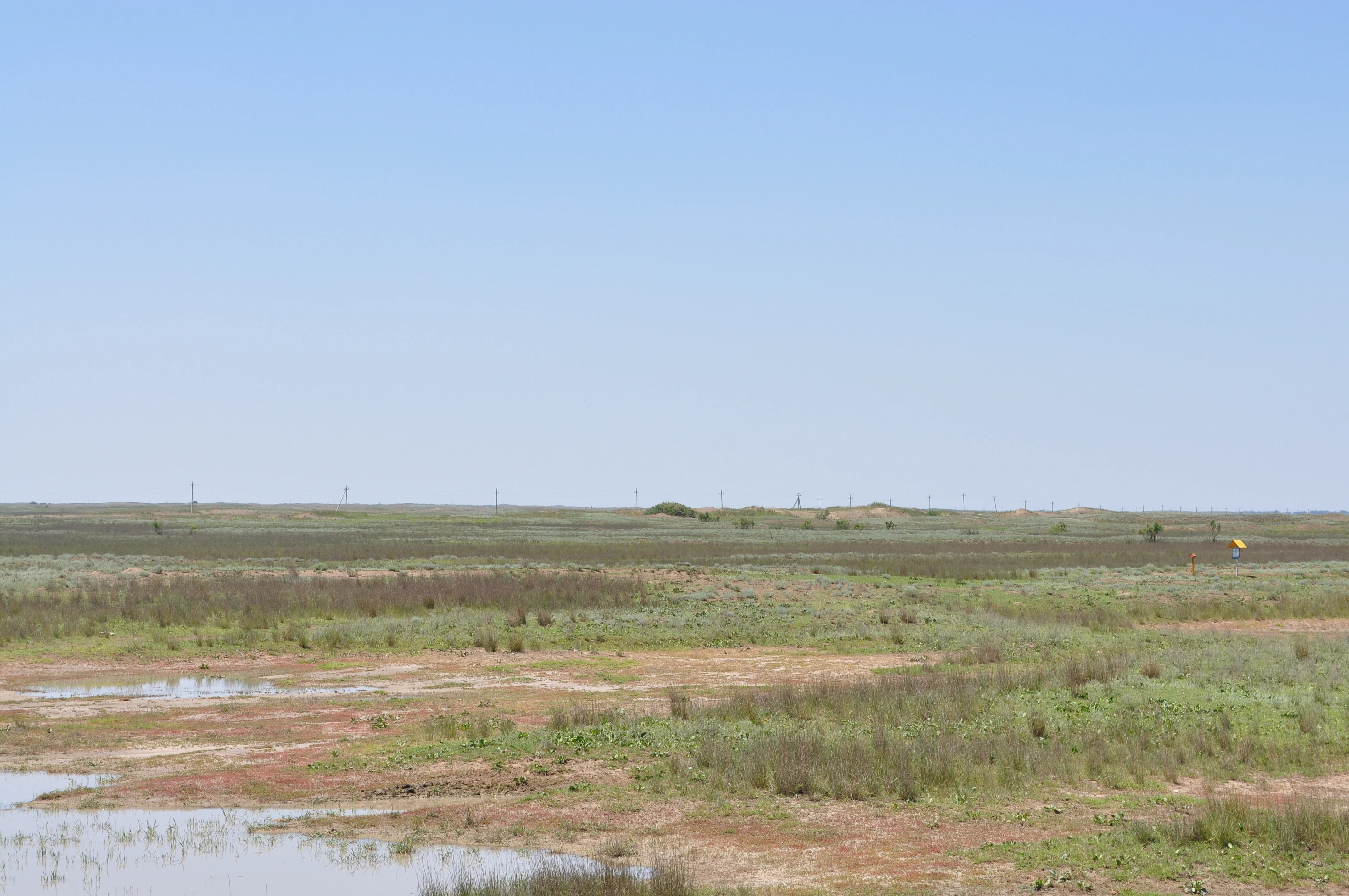
Flat steppe landscape of the Nogai Zakaznik with low vegetation and patches of water, photograph from 2012
← All peoples

North Caucasus · Dagestan

Nogais

Nogai · Nogailar

Nogais: the heritage of steppe Eurasia, the history of the Nogai Horde, settlement, language and culture. Former beliefs and the spread of Islam, the Hanafi tradition, a detailed chronology, literature and scholarly materials.
Nogai Zakaznik. Photo by Mmdocent, 2012 · CC BY-SA 4.0

Language

Nogai · Nogai tili

Family

Turkic family · Kipchak-Nogai subgroup

Population

109,042 in Russia (2021 census)

History

A people of steppe Eurasia. The Nogais are a Turkic-speaking people whose history is connected with the Lower Volga region, the Caspian region, the Kuban region and the Northern Black Sea region. The self-designation is "Nogai", plural "Nogailar". The modern people are not limited to one district of Dagestan.
From the Golden Horde to the Mangyt Yurt. Various groups of Turkic and Mongol origin from the Golden Horde world participated in the formation of the people. The name is associated with the tumen commander Nogai, but the emergence of the Nogai Horde and the modern people cannot be reduced to his personal ulus.
Edige and the formation of the state. V. V. Trepavlov distinguishes Edige, the ancestor of the ruling clan, from the formation of an independent power by his descendants. The Mangyt Yurt on the Yaik gradually separated from the late Golden Horde. An important center was Saraychik.
The Horde of the 15th–16th centuries. Biys and mirzas governed associations of nomadic communities. The Nogai state participated in diplomacy and trade with Moscow, Crimea and the Central Asian khanates. Its history included alliances, internal strife and struggles for pastures.
Disintegration and new associations. The crises of the 16th century led to the division of the Great and Lesser Nogais. In the first third of the 17th century the former state disintegrated. Migrations strengthened the presence of Nogai communities in the North Caucasus and the Black Sea region.
The tragedy of 1783. Plans for resettlement and armed resistance in the Kuban ended in punitive actions by Russian troops. In October, near Kermenchik, the Nogais suffered heavy losses; part of the population went beyond the Kuban and into Ottoman possessions. Estimates of the number of dead differ.
The 19th century and the diaspora. Sedentarization occurred gradually and differently in different areas, under the influence of government policy, the reduction of pastures and economic changes. Emigration waves from the late 18th to the early 20th century formed Nogai communities of the Ottoman Empire.
The Soviet 20th century. School education, a new writing system, collectivization and the transition to a settled life changed everyday life. Religious institutions came under pressure; the family transmission of knowledge and customs did not cease entirely.
Settlement and population. According to the census with a reference date of 1 October 2021, 109,042 Nogais were counted in Russia. In Dagestan there were 36,944, in Stavropol Krai 22,569, in Karachay-Cherkessia 17,368, in Chechnya 2,819. This is national self-identification, not the number of speakers of the language.

Settlement and local communities

Several settlement centers. Dagestan, Karachay-Cherkessia, Stavropol Krai, Chechnya and Astrakhan Oblast are part of the people's modern geography. Local communities preserve their own characteristics within the common Nogai culture. Groups and historical names. The Karanogais, the Kuban and Kum Nogais, and the historical associations of the Yedisans, Yedishkul and Dzhemboyluk belong to different levels of description. One must not turn every clan, dialect or horde into the same type of «tribe». Astrakhan groups. The Karagash, Yurt and other speech varieties have their own history. Their linguistic classification and ethnic self-identification are considered separately; a single census indicator does not resolve all questions of classification. Communities outside Russia. The Nogai diaspora in Turkey took shape as a result of several migration waves. There is no documented single modern worldwide population figure; the Russian census does not replace a count of the diaspora.

Language

The Nogai language belongs to the Turkic family and the Kipchak-Nogai subgroup. It is close to Kazakh and Karakalpak, while preserving an independent literary norm and local speech features.
Usually the Karanogai dialect, the Aknogai dialect of Karachay-Cherkessia and the proper Nogai dialect of Stavropol are distinguished. The status of the speech varieties of the Astrakhan groups is discussed separately; they cannot be mechanically combined under one name.
After the Arabic script, a Latin alphabet was introduced in 1928, and a Cyrillic one in 1938. In 1950 the modern alphabet was approved. The history of the written language is connected with textbooks, the press and the work of enlighteners.
The language is taught as a subject and used in literature, periodicals, radio, television and theater. Proficiency and family transmission vary by region; the figure for the size of the people is not equal to the number of speakers.
The set of spelling rules of 1938 was prepared by A. Dzhanibekov, M. Kurmanaliev, A. Niyazov and E. Dzhanibekov. The bibliographic record makes it possible to verify the authorship and year of a specific edition.

Faith and history of religions

Early beliefs and materials. The pre-Islamic heritage is studied through myths, folklore, rituals and vocabulary. Materials from different eras and groups reflect changes in tradition, so a single unchanging "ancient Nogai religion" cannot be reconstructed. Tengri, the sky and natural forces. Ideas about Tengri, the sun, the moon and the spirits of natural places survived in tradition. After the spread of Islam, former names and images could receive a new Muslim interpretation. Ancestors and patrons. The memory of ancestors and veneration of the graves of outstanding people occupied an important place in religious culture. Researchers examine how such practices combined with ideas about Muslim saints. How Islam came. The main historical context of the conversion of the Nogais' ancestors is connected with the Golden Horde and the steppe's Muslim ties with the cities of Central Asia and the Volga region. This is a different path from the Arab campaigns into mountainous Dagestan. Berke and early Muslim ties. Muslim rulers and communities existed in the Ulus of Jochi before Uzbeg. The adoption of Islam by Khan Berke in the 13th century does not mean the simultaneous conversion of all nomads or an already formed Nogai people. The era of Uzbeg. The first half of the 14th century, associated with the reign of Khan Uzbeg, became an important stage in the expansion of Islam in Desht-i Kipchak. The spread of the faith continued through preaching, political ties and local communities. Edige and subsequent generations. At the turn of the 14th–15th centuries, Edige supported Muslim religious life. By the time of the Nogai Horde, Islam already formed an important part of its political and cultural world. Sunnism and the Hanafi madhhab. The Hanafi legal school of Sunni Islam is historically characteristic of the Nogais. It differs from the Shafi'i school widespread among a number of neighbouring peoples of Dagestan; both belong to Sunnism. Religion of a nomadic society. Yarlykapov shows that the absence of settled forms familiar to an observer does not indicate an absence of faith. Mosques, mullahs, education, prayer and family rituals existed under various local conditions. Sufi connections. The encyclopedic article examines the Yasawiyya and Naqshbandiyya traditions and subsequent ties with Muslim centres. Their spread varied by time and group; it cannot be reduced to a single brotherhood for the whole people. Mythological figures. Folklore records albasly, azdaa, pari and other characters. Their later descriptions interact with Islamic ideas about jinn and shaytan. A folklore figure is not equal to the creed of every contemporary person. Holidays and calendar. Alongside Oraza-bayram and Kurman-bayram, the spring festival of Navruz is known. Islamic holidays follow the lunar calendar, while the spring festival is connected with the solar annual cycle. These are different calendar traditions. Soviet restrictions. The closure of mosques and persecution of the clergy restricted education and public practice. Some rituals and knowledge were preserved in families. Yarlykapov's monograph treats this life as the history of a single Muslim culture with different levels of practice. Revival and contemporary life. Since the late 1980s, open religious activity and discussion of the Hanafi heritage have resumed. Today the degree of participation in rituals and personal beliefs vary. The researcher's observations from the 1990s are not used as an unchanging description of 2026.

Verified information

Language

  • Nogai belongs to the Turkic family; regional dialect groups are distinguished.

Settlement and population

  • According to the 2021 census, there are 109,042 Nogais in Russia. The size of the people and the number of speakers of the language differ.

Culture and daily life

  • A decoration of a Nogai yurt from the early 20th century, REM 8762-15073, is made of felt, fabric and woolen threads.

History

  • The Nogai Muslim tradition is characterized by Sunnism of the Hanafi madhhab.

Detailed chronology

  1. 13th century

    The Golden Horde environment of formation
    In the Ulus of Jochi, groups interacted that took part in the subsequent formation of the Nogais.
  2. Second half of the 13th century

    The tümen commander Nogai
    The ethnonym is associated with his name; this is not identical to the founding of the later Nogai Horde.
  3. 13th century

    Islam before the era of Öz Beg
    Muslim ties of the Ulus of Jochi develop before the mass spread of the faith among the nomads.
  4. First half of the 14th century

    Islamization under Khan Öz Beg
    The strengthening of Muslim institutions becomes an important stage in the religious history of the steppe.
  5. Late 14th–early 15th century

    Edige and the Mangyt Yurt
    The clan rises whose descendants will lead the Nogai Horde.
  6. 15th century

    Formation of an independent Horde
    The Mangyt Yurt gradually separates from the late Golden Horde political system.
  7. 15th–16th centuries

    Saray-Jük and steppe diplomacy
    The Horde participates in political and trade ties between the Volga region, the Caucasus and Central Asia.
  8. 1550s

    Internal strife and division
    The political crisis contributes to the separation of the Great and Lesser Nogais.
  9. 1557

    The oath of Ismail and Ivan IV
    Trepavlov considers the agreement in the context of personal ties between rulers, not as a single date for the inclusion of all Nogais in Russia.
  10. First third of the 17th century

    Collapse of the former power
    Migrations and political changes transform the Nogai associations.
  11. 17th–18th centuries

    Nogai societies of the Black Sea region and the Caucasus
    New conditions of nomadism and relations with neighbouring powers change the political geography.
  12. 11 June 1783

    Military correspondence on nomadism
    Suvorov's report documents control over the movements of Nogai societies in the Kuban region.
  13. 1 September 1783

    Document on settlement on the Don
    The archival report records one episode of resettlement policy.
  14. October 1783

    Punitive campaign and heavy losses
    The defeat at Kermenchik and the subsequent displacements become a tragic turning point in history.
  15. 1783–1812

    Continuation of resistance
    Pylypchuk's study examines the Nogai societies of Budjak and the Trans-Kuban region under conditions of Russian expansion.
  16. Late 18th–19th century

    Gradual sedentarization
    The reduction of nomadic territories and economic reforms change the way of life of various communities.
  17. 1850s–1860s

    Mass emigration
    Migration waves to the Ottoman Empire expand the Nogai diaspora abroad.
  18. 1879

    Birth of A.-Kh. Dzhanibekov
    The biography of the enlightener and language researcher begins.
  19. Late 19th century

    Karanogai women's headdress
    The REM 333-2 hat is dated to this time.
  20. Early 20th century

    Textiles of the portable dwelling
    The museum's yurt doorframe preserves information about materials and decorative work.
  21. 1912

    Photographing Makhmud-Mekteb
    A. N. Samoilovich photographs the residents, dwellings and mosque.
  22. 1920s–1930s

    Change of lifestyle
    Sedentarization, schooling and restrictions on religious institutions transform everyday life.
  23. 1925

    Arrival of photographs at the museum
    Samoilovich's 1912 Nogai photographs enter the museum collection.
  24. 1928

    Latin script
    A new alphabet is introduced in place of the Arabic script.
  25. 1938

    Cyrillic and orthography
    The transition to Cyrillic is accompanied by the publication of a Code of Orthographic Rules.
  26. 1948

    Birth of Kadriya Temirbulatova
    The future poetess is born in Terekli-Mekteb.
  27. 1950

    Approval of the modern alphabet
    Library material with a report by M. A. Bulgarova records a stage in the development of the written language.
  28. 1965

    Kadriya's first publications
    The poetess's poems appear on the pages of the newspaper «Stepnoy Mayak».
  29. 1970

    «Mountains Begin with the Plain»
    The Dagestan Book Publishing House releases Kadriya's first book in her native language.
  30. 1972

    The collection «Tropinka»
    The book is published by the Karachay-Cherkess Book Publishing House.
  31. 1975

    «The Smile of the Moon»
    A book of Kadriya's poems in Russian translation is published in Moscow.
  32. 1978

    End of Kadriya's life
    The poetess's work becomes part of the people's literary memory.
  33. Late 1980s–1990s

    Revival of open religious life
    Communities restore institutions and discuss ways to preserve the Hanafi heritage.
  34. 2000s

    Professional national stage
    The drama theater develops its repertoire and touring ties among Nogai communities.
  35. 2014

    Nogai Theater tour in Tatarstan
    The theater presents the play «You Are My Mother».
  36. 2015

    Theater festival in Konya
    The company takes part in an international festival of Turkic-language theaters.
  37. 2021

    Population census
    109,042 Nogais are counted in Russia.

Cuisine

  • Meat and dairy products

    Cattle breeding determined an important part of the diet, but it was not limited to meat and milk. Locality, wealth and the transition to a settled life changed the set of products.
  • Beshbarmak and flour dishes

    Gadzhieva describes beshbarmak and other dishes made from meat and dough. Names, methods of cutting and serving differed among local groups.
  • Kumys and ayran

    Fermented milk drinks and methods of processing milk were connected with animal husbandry and food storage. Their composition depended on available raw materials and local practice.
  • Katlama and baursak

    Layered bread and fried dough products are part of the festive table. In field materials they are mentioned among the treats at the spring festival.
  • Nogai tea

    Tea became an important part of receiving guests and everyday meals. Historical research shows the diversity of the diet and changes in food habits, rather than a single obligatory recipe for the whole people.

Adats and traditions

  • Hospitality

    Receiving a guest and sharing a meal maintained kinship and neighbourly ties. Rules of seating and hospitality depended on age, status and occasion.
  • Clan and community

    Kinship ties, clan names and tamgas preserved the memory of origin. Their historical role changed with migrations and administrative reforms.
  • Wedding and yurt

    Wedding life is connected with dwelling, textiles and age-related differences in costume. The historical wedding yurt differs from a modern stage decoration.
  • Holidays and competitions

    Public holidays were accompanied by songs, games and competitions. Pan-steppe forms had local variants and changed together with the way of life.

Clothing

The men's ensemble included a shirt, trousers, a beshmet, outer clothing, a belt and headwear. F. Yu. Kanokova traces the differences between eras and local groups, including fur hats and skullcaps.
The women's cap of the Karangais, REM 333-2, is dated to the end of the 19th century and made of fur, cloth and fabric. This is a specific museum object; the entire women's costume cannot be reconstructed from it without additional materials.
Clothing combined home-made materials and imported fabrics and reflected age, wealth and ties with neighbours. A modern concert costume should be distinguished from a documented historical ensemble.

Dances

  • Dance at a celebration

    Dance and song forms were part of public and family festivities. Their modern performance continues the tradition while at the same time changing it.
  • Stage development

    The national theatre brings together drama, music and movement. Its touring work connects communities in Dagestan, Stavropol, Karachay-Cherkessia and other places of settlement.

Music

The heroic epic about Edige and his descendants belongs to the common Nogai cycle of Turkic peoples. Its variants preserve historical memory but are not literal records of events.
Songs, epic storytelling and poetic improvisation were transmitted orally. The work of folklore collectors and enlighteners helped bring this heritage into print culture and education.
The modern stage turns to national and world drama: the repertoire of the Nogai Theatre includes "Shora Batyr" by R. Kereytov and works by Molière, Chekhov and Lorca.

Crafts

  • Felt and the yurt

    Felt served as the covering of the portable dwelling and as material for household utensils. The museum decoration of a yurt, REM 8762-15073, combines felt, cotton fabric and woolen threads.
  • Leather, wood and horse equipment

    Crafts served cattle breeding, movement and daily life: the making of utensils, parts of the dwelling, footwear and equipment. Household production interacted with trade.
  • Sewing and finishing of clothing

    Headwear and outer clothing required different materials and techniques. Their forms changed under the influence of local conditions and neighbouring craft traditions.

Memorable Places

  • The Nogai steppe

    The steppe landscapes of the Caspian region are linked to the history of nomadism and to present-day auls. The cover shows the Nogai Nature Reserve in Dagestan, not a reconstruction of a medieval camp.
  • Terekli-Mekteb

    One of the cultural centres of the Nogais of Dagestan, the birthplace of the poetess Kadriya Temirbulatova. The history of the people, however, covers a considerably wider territory.
  • Saray-Jük

    The historical centre of the Nogai Horde on the Ural River, in present-day Kazakhstan. It is linked to the wider steppe history of the people beyond the North Caucasus.
  • Auls of Karachay-Cherkessia and Stavropol

    Independent local centres of settlement, language and cultural life. They cannot be regarded merely as an offshoot of a single Dagestani community.

Names: examples of contemporary usage

Men's

  • Edige (Nogai, Turkic)
  • Aydar (Nogai, Turkic)
  • Aytugan (Nogai, Turkic)
  • Batyr (Nogai, Turkic)
  • Temir (Nogai, Turkic)
  • Toktar (Nogai, Turkic)
  • Altai (Nogai, Turkic)

Women's

  • Altynay (Nogai, Turkic)
  • Kumis (Nogai, Turkic)
  • Sholpan (Nogai, Turkic)
  • Karashash (Nogai, Turkic)
  • Karlygash (Nogai, Turkic)
  • Yuldyz (Nogai, Turkic)
  • Tansyluv (Nogai, Turkic)
  • Kunsylu (Nogai, Turkic)

People and cultural memory

  • Edige

    A political figure of the late Golden Horde and the ancestor of the clan of Nogai biys. The historical biography should be distinguished from the heroic epic known to several peoples.
  • A.-Kh. Sh. Dzhanibekov (1879–1955)

    An enlightener and one of the creators of modern Nogai written culture. His name is among the compilers of the 1938 Code of Orthographic Rules.
  • Kadriya Temirbulatova (1948–1978)

    A Nogai poetess born in Terekli-Mekteb. Her poetry combines personal experience with the image of the native steppe and the cultural memory of the people.

Media

Photo gallery

Authorship and licenses are indicated in the image captions.