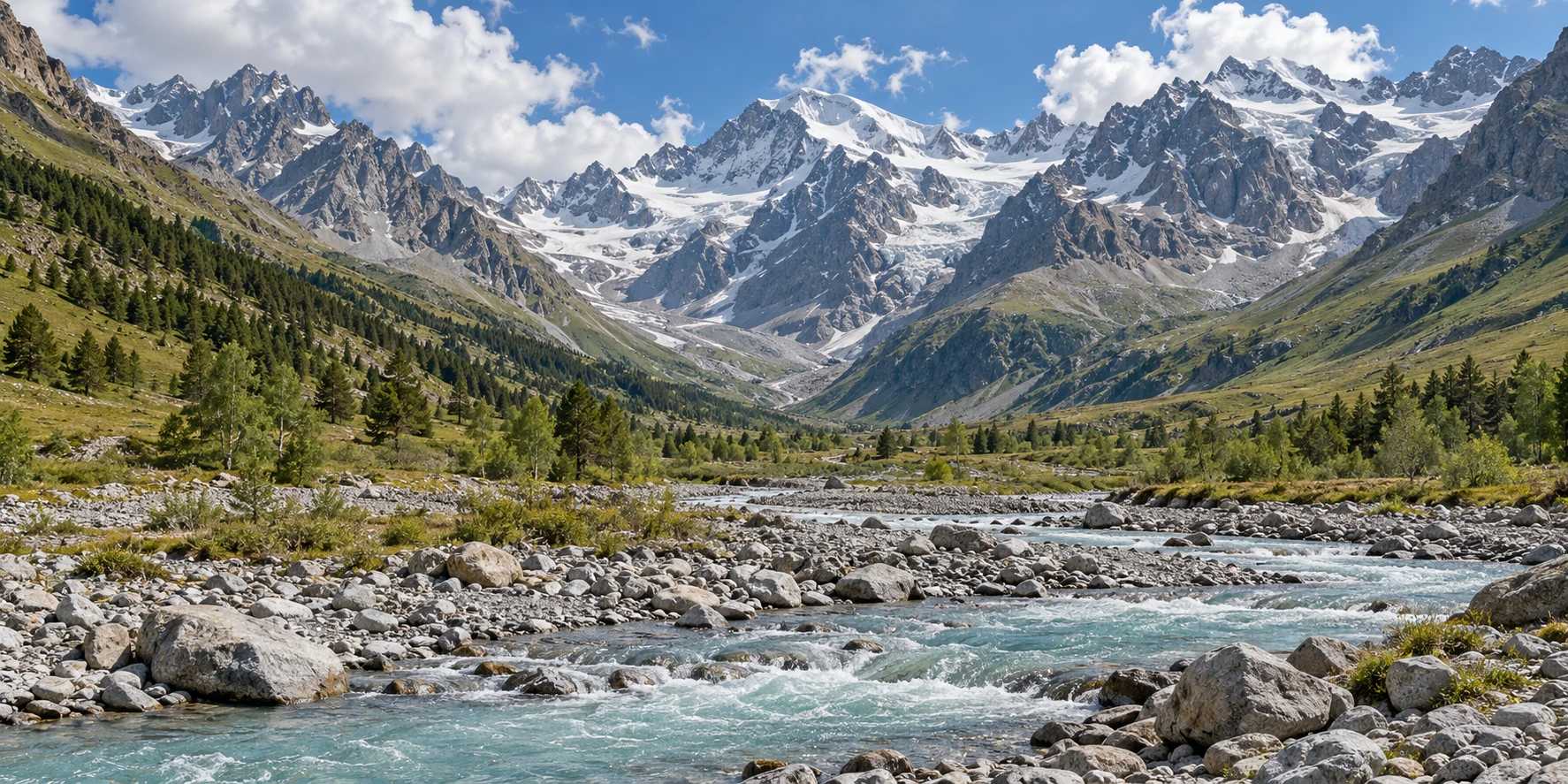
A mountain river with rocky banks, forested slopes and glaciers on distant ridges
Elbrus region: landscape inspired by the upper Baksan · illustration · Artistic illustration

908.2 thousand

residents as of 1 January 2025, a rounded Rosstat estimate in the profile of the Bank of Russia

12.5 thousand

square kilometres, the rounded area of the territory

3

state languages: Kabardian, Balkar and Russian

Geography in Detail

Cities, villages and districts

Kabardino-Balkaria comprises ten districts and three urban okrugs. Nalchik is the capital; Baksan and Prokhladny form separate urban okrugs.

Settlements
180
Territories
13

List of populated places as of 8 September 2026. Populated places with the same name in different municipal formations are shown separately. Small populated places without permanent population are also included; population figures are not given here.

Urban okrugNalchikCenter: Nalchik
Urban okrugBaksanCenter: Baksan
Urban okrugProkhladnyCenter: Prokhladny
DistrictBaksansky DistrictCenter: Baksan
DistrictZolsky DistrictCenter: Zalukokoazhe settlement
DistrictLeskensky DistrictCenter: Anzorey village
DistrictMaysky DistrictCenter: Maysky
DistrictProkhladnensky DistrictCenter: Prokhladny
DistrictTersky DistrictCenter: Terek
DistrictUrvansky DistrictCenter: Nartkala
DistrictChegemsky DistrictCenter: Chegem
DistrictChereksky DistrictCenter: Kashkhatau settlement
DistrictElbrussky DistrictCenter: Tyrnyauz

Geography and population

Kabardino-Balkaria is located in the central part of the North Caucasus. Plain territories give way to foothills, forest belts and high mountains. The historical territory of Balkaria is associated with the valleys of the Baksan, Chegem, Cherek Balkarsky and Cherek Bezengiysky. According to rounded Rosstat data presented by the Bank of Russia, as of 1 January 2025 the republic had a population of 908.2 thousand people. The area is about 12.5 thousand km². These figures refer to the territory and all its inhabitants regardless of nationality. Horticulture, other branches of agriculture, industry and trade complement the resort and recreational complex. The Bank of Russia notes the production of medical equipment and abrasive tools, as well as the potential of winter sports, mountaineering and health tourism.

Related articles about peoples

Peoples and historical societies

Kabardians
Part of the Adyghe cultural world with the self-designation "Adyghe". The Kabardian literary tradition is linked to the Kabardian-Circassian language.
Balkars
A Turkic-speaking people whose historical territory is linked to the valleys of the Baksan, Chegem and Cherek. The Balkar language is a regional name for Karachay-Balkar.
Societies of the mountain valleys
The Baksan, Chegem, Khulamo-Bezengi and Malkar traditions are linked to specific valleys and villages. Historical societies do not coincide with modern administrative districts.
Russians and other residents
Urban, rural and Cossack communities are part of the multinational history of the republic. Cultural belonging is not determined by a single place of residence.

Three state languages

Kabardian

In linguistics the name "Kabardian-Circassian language" is used. It belongs to the Abkhaz-Adyghe family; the Kabardian variant of the literary language is widespread in the KBR, the Circassian variant in Karachay-Cherkessia. Modern writing uses the Cyrillic alphabet, introduced in 1936.

Balkar

Karachay-Balkar belongs to the Kipchak group of Turkic languages. In Kabardino-Balkaria the name "Balkar" is accepted, in Karachay-Cherkessia "Karachay". The commonality of language does not abolish separate ethnic self-designations and local traditions.

Russian and its state status

Article 76 of the Constitution establishes three state languages: Kabardian, Balkar and Russian. The republic ensures their equal rights to use and development. Russian also serves as a means of interethnic communication.

Dictionaries and language resources

The Kabardino-Balkarian Scientific Center of the Russian Academy of Sciences presents electronic Kabardian-Russian and Balkar-Russian dictionaries in both directions. Such resources help in studying vocabulary and written norms.

Population and cultural diversity

The cards of related articles reflect the portal's materials, not a complete list of the republic's inhabitants. The population of the region includes representatives of all peoples.
Kabardians and Balkars
The two titular peoples of the republic belong to different language families. They have their own literary traditions and close historical ties.
Russian and Cossack communities
Their history is presented in towns and rural settlements. The Prokhladny Museum of History and Local Lore preserves materials about the Terek Cossacks.
Other residents of the republic
Kabardino-Balkaria is multinational. The annual estimate of the total population and the national composition according to the census are different statistical indicators.

History of Kabardino-Balkaria

Text size
Text size: 100%

Chapter 1 · Antiquity and the early Middle Ages

Zayukovo-3 and the archaeology of the Central Caucasus

The Zayukovo-3 burial ground is located near the Baksan. According to the State Historical Museum, it was used from the 10th century BCE to the 9th century CE. Monuments of the western Koban culture, complexes of the Sarmatian period and early medieval burials have been studied here.
Bronze ornaments, ceramics and imported objects show the craft traditions and the ties of the Caucasus population with neighbouring regions. An archaeological culture is not equal to a modern people. Joint research by the SHM and scientific institutions of the Russian Academy of Sciences refines the chronology and layout of the site.
Page 1 of 1in chapter 1

A historical overview based on scholarly and archival materials. The modern borders of the republic differ from the geography of historical societies and ancient cultures.

Elbrus, Bezengi and nature conservation

The western summit of Elbrus reaches 5642 m, the eastern 5621 m. Elbrus is the highest mountain in Russia and is located on the Side Range of the Greater Caucasus. Prielbrusye includes high-mountain landscapes, glaciers, forests and mountain river valleys. The Prielbrusye National Park was created on 22 September 1986 to preserve natural complexes and organize regulated recreation. Its territory should be distinguished from that of the Kabardino-Balkarian High-Mountain Reserve, which has its own protection regime. The Bezengi section of the reserve covers the high-mountain part of the Central Caucasus. Here are located the Bezengi glacier and the peaks of the Bezengi Wall. The directorate publishes descriptions of sections and routes; accessibility and visiting rules should be checked before travelling. The archaeological heritage of the region is represented, in particular, by the Zayukovo-3 burial ground. Photographs from scholarly publications show bronze costume details, ceramics and jewellery items with an established find location.

Religion and social traditions

Sunni Islam occupies a significant place in the history of the Kabardians and Balkars. Orthodox and other religious communities are also represented in the republic. The history of the region includes earlier beliefs and Christian monuments, and then complex processes of the spread of Islam. Modern religious life changed after the Soviet period. A study by A. A. Tatarov examines relations between the state and Islamic institutions from the end of the 20th century. Social customs, ethnic self-awareness and personal faith are connected but not identical.

Literature, epic and museums

Kabardian and Balkar literatures have their own written traditions. The museum network preserves the heritage of Alim Shogentsukov, Bekmurza Pachev and Kaisyn Kuliev. The National Museum presents both Kuliev's memorial house-museum and the ancient saklya house in which he was born. The Adyghe Nart epic has been published in academic collections with texts, translations and commentaries. Nart tales are also known among the Balkars and other peoples of the Caucasus. The epic helps to study artistic images and cultural ties, and does not replace dated historical documents. The collection of the National Museum of the KBR began to be formed in 1921. It preserves archaeological and ethnographic materials. The history of clothing, jewellery and crafts is studied through the provenance of objects; stage costumes and modern reconstructions require separate designation. S. I. Akkieva's study is devoted to hospitality and kunachestvo among the Karachays and Balkars. The reception of a guest maintained ties between families and neighbouring peoples. Respect, cordiality and the order of communication formed an important part of these relations.

Kabardian and Balkar cuisine

Traditional food included flour, meat and dairy dishes. Millet, barley, wheat and later maize were used in porridges and baked goods. The Kabardian tradition is known for the combination of paste with sauces and meat dishes; local methods of preparation differ. Balkar khychiny are made with cheese, meat, potato and herbs. S. I. Akkieva's ethnographic description notes their place in festive and guest hospitality. Ayran, cheese and other livestock products are also part of the food culture. The meal was accompanied by rules of seating, seniority and serving the guest. At the same time, hospitality was judged not only by the quantity of food but also by the hosts' attitude. Modern family recipes and restaurant versions may differ from descriptions of specific historical rituals.

Media

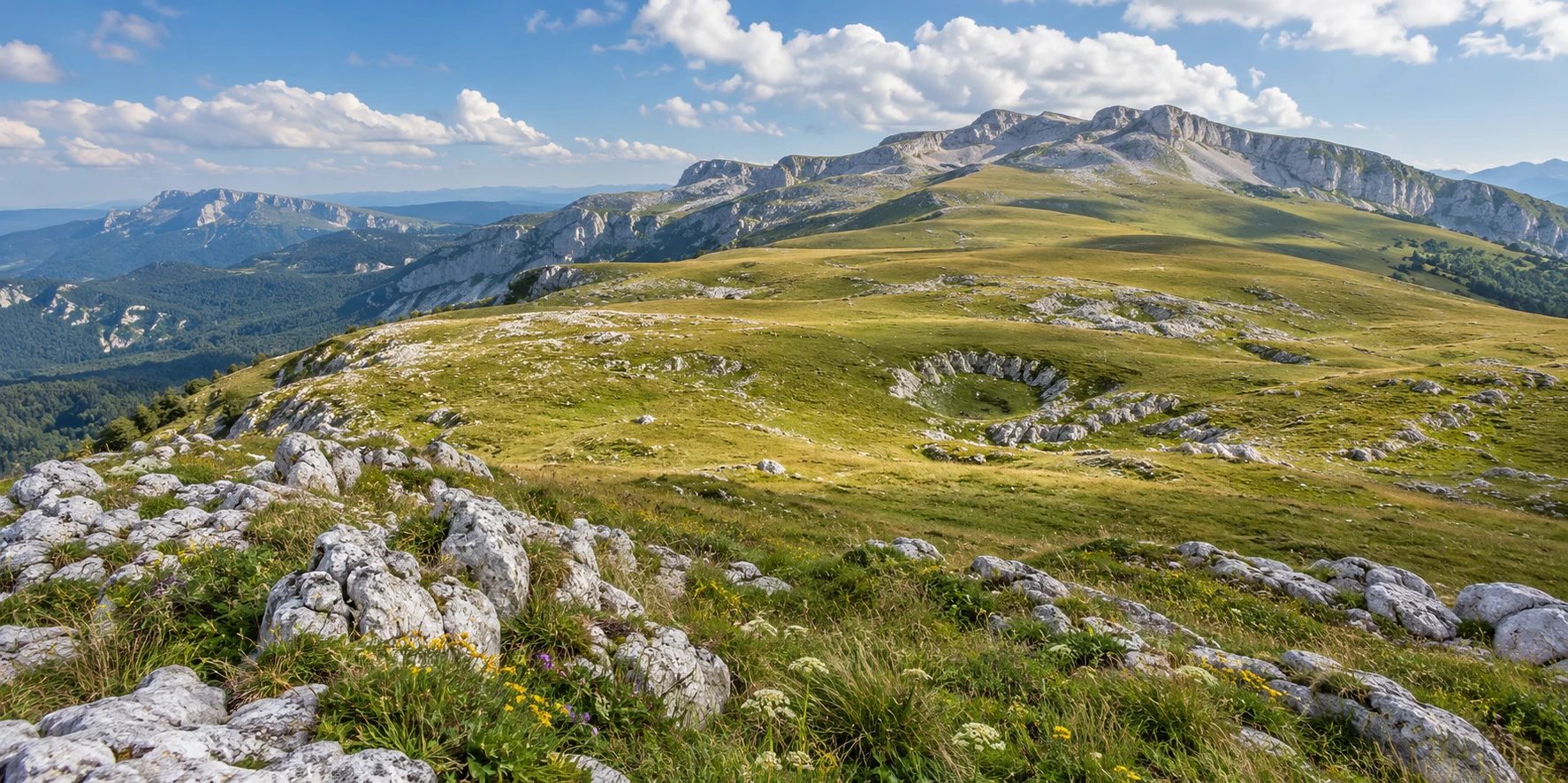
Mountain landscapes of Kabardino-Balkaria

A landscape inspired by the upper reaches of the Baksan and the Central Caucasus. It does not reproduce an exact shooting location or a specific peak. Authentic images of monuments and objects are available in museum and scholarly materials.

Anthem

State Anthem of the Kabardino-Balkarian Republic

A solemn musical work

The composer is Khasan Kardanov. According to the official reference of the Parliament, the anthem uses the intonations of Kabardian, Balkar and Russian folk songs.

Information about the anthem and state symbols is available on the official page of the Parliament. Unverified song texts are not presented as the approved words of the anthem.

Timeline

Events: 14 / 14

10th century BCE - 9th century CE
Chronological range of use of the Zayukovo-3 burial ground according to the State Historical Museum.
1557
Kabardian embassy to Moscow: a stage in the development of political relations.
19th century
The development of Nalchik as a fortification and administrative settlement; the dates of the beginning of the fortress stage are debated by historians.
1 September 1921
Formation of the Kabardian Autonomous Oblast.
16 January 1922
Decision to form the united Kabardino-Balkarian Autonomous Oblast.
1936
Transformation of the autonomous oblast into the Kabardino-Balkarian ASSR.
1942-1943
Fighting on the territory of the republic, partial German occupation and liberation.
5 March 1944
Secret State Defence Committee resolution No. 5309ss on the deportation of the Balkars.
8 March 1944
Beginning of the forced deportation of the Balkar people.
8 April 1944
Decree on the deportation of the Balkars and the renaming of the republic as the Kabardian ASSR.
9 January 1957
Decree on the restoration of the Kabardino-Balkarian ASSR.
22 September 1986
Creation of the Prielbrusye National Park.
1 September 1997
Adoption of the Constitution of the Kabardino-Balkarian Republic.
13-14 October 2005
Armed attack on Nalchik, with casualties among law enforcement officers and civilians.