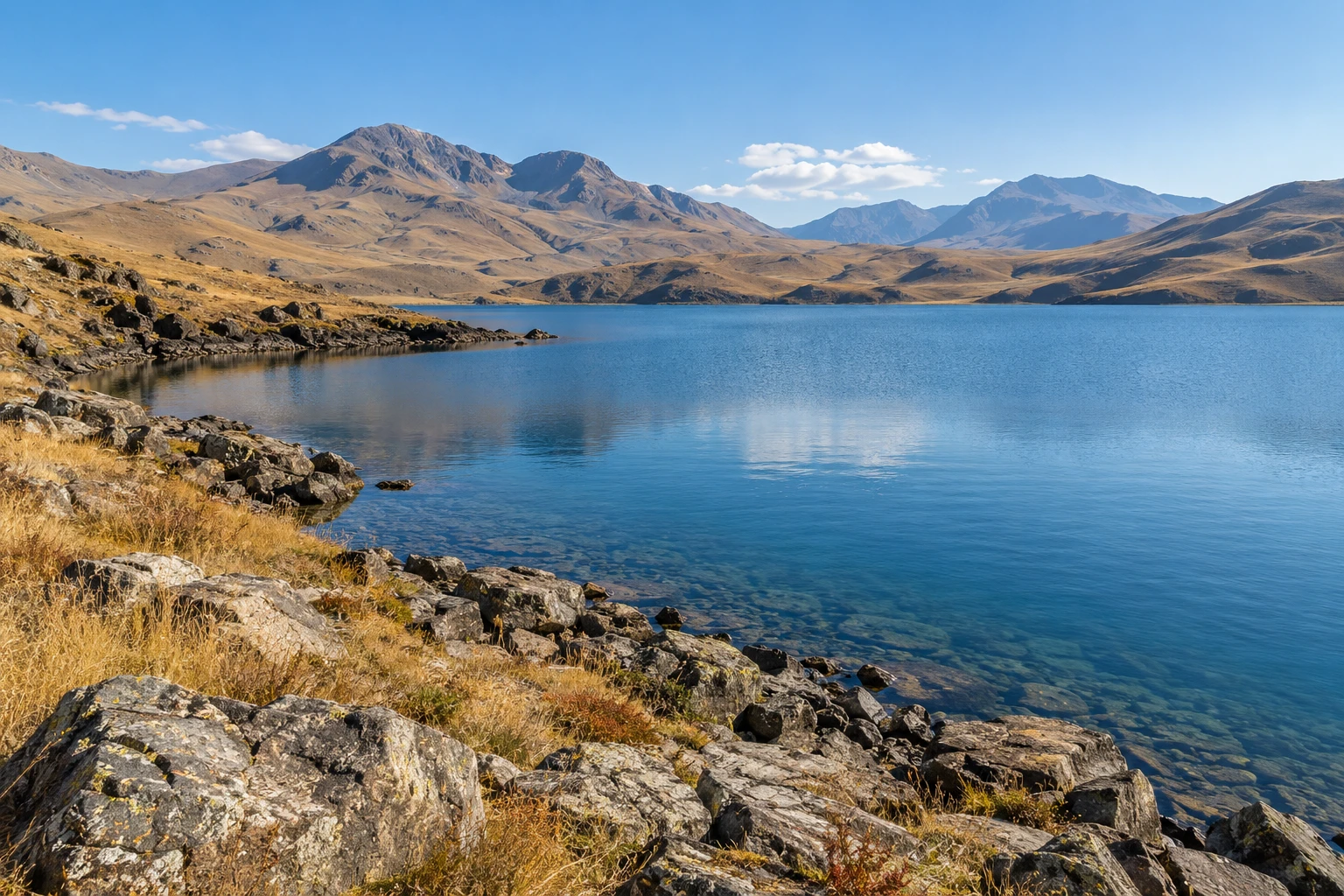
Landscape inspired by the high-mountain lakes of Armenia · illustration
Landscape inspired by the high-mountain lakes of Armenia · illustration · Artistic illustration

3.1039 million

permanent residents as of 1 July 2026 according to Armstat, counted on the basis of the 2022 census

29,743 km²

area of the Republic of Armenia according to the official state certificate

3

UNESCO World Heritage sites on the territory of Armenia

Geography in Detail

Regions and settlements

Armenia is divided into ten marzes. Yerevan has a separate status. Each marz contains consolidated communities, towns and rural settlements.

Settlements
1003
Territories
11

The reference book lists 1,003 settlements according to the 2025 register. Small settlements are included without selection by population size. The national spelling is preserved in parentheses; the Russian rendering helps in searching for names. Clarifications about communities correspond to this version of the register.

Capital, separate communityYerevanCenter: Yerevan
MarzAragatsotnCenter: Ashtarak
MarzAraratCenter: Artashat
MarzArmavirCenter: Armavir
MarzGegharkunikCenter: Gavar
MarzLoriCenter: Vanadzor
MarzKotaykCenter: Hrazdan
MarzShirakCenter: Gyumri
MarzSyunikCenter: Kapan
MarzVayots DzorCenter: Yeghegnadzor
MarzTavushCenter: Ijevan

Geography and population

The Republic of Armenia is located in the South Caucasus and has no access to the sea. The state reference gives an area of 29,743 km². The country includes highlands, volcanic massifs and river valleys. The Armenian Highland as a historical-geographical concept is broader than the territory of the present republic. According to the Armstat bulletin, as of 1 July 2026 the permanent population was 3,103.9 thousand people, including 1,149.5 thousand in Yerevan. This is a current count based on the 2022 census, not the number of all Armenians in the world. The republic has 10 provinces and a separate municipality of Yerevan with 12 administrative districts. Dated data on the permanent population, ethnicity by census and diaspora residents describe different aggregates. They cannot be added together or compared without taking methodology into account. The UN table on ethnic composition refers to the 2022 census. Neighbouring countries: Georgia, Azerbaijan, Iran and Turkey. The highest point of the Republic of Armenia: Aragats, 4,090 metres. The geographical names Aragats and Ararat designate different mountain massifs.

Related articles about peoples

Provinces and the capital

Yerevan
The capital and a separate community consisting of 12 administrative districts. As of 1 July 2026, Armstat counts 1,149.5 thousand permanent residents.
Aragatsotn, Ararat and Armavir
Three separate provinces in the western and central parts of the country. The name of Ararat Province does not mean that Mount Ararat itself is located in the Republic of Armenia.
Gegharkunik and Kotayk
Provinces with varied mountain and valley landscapes; Lake Sevan is located in Gegharkunik.
Lori, Shirak and Tavush
The northern provinces of the country. Gyumri is the centre of Shirak, Vanadzor the centre of Lori, and Ijevan the centre of Tavush.
Vayots Dzor and Syunik
Southern provinces with distinct historical and natural features. Areni is located in Vayots Dzor. Modern provinces should not be equated with the borders of ancient kingdoms.

Language and written traditions

Armenian: the state language

Armenian belongs to the Indo-European languages and has its own written tradition. Its state status is enshrined in Article 20 of the Constitution. The presence of Iranian loanwords does not mean that Armenian belongs to the Iranian language group.

Eastern Armenian and Western Armenian traditions

Modern Armenian includes the Eastern Armenian and Western Armenian literary traditions. Eastern Armenian is used in Armenia and in a number of diaspora communities, while Western Armenian is historically linked to Ottoman Armenian communities and is today widespread in various diaspora countries. These differences relate to language history, not to the division of citizens into categories.

Grabar and the history of writing

Classical Armenian, or Grabar, is attested from the 5th century and is associated with early literature and ecclesiastical book culture. The creation of the alphabet by Mesrop Mashtots is usually dated to the beginning of the 5th century; in Armenian museum and cultural tradition the year 405 is accepted.

Languages and self-identification of communities

In addition to Armenians, the 2022 census records Yezidis, Russians, Assyrians, Kurds, Ukrainians, Greeks and other groups. Nationality, native language, citizenship and religion are different attributes: the composition of the population cannot automatically be regarded as a distribution by language or religion.

Other communities of the country

The links show available articles on the portal, not a complete list of the country's inhabitants. The 2026 demographic estimate and the national composition according to the 2022 census have different dates.
Yezidis
2022 census: 31,079 people. A separate accounting category that cannot automatically be combined with Kurds.
Russians, Assyrians and Kurds
2022 census: 14,076, 2,755 and 1,663 people respectively. These are figures as of the census date, not estimates for 2026.
Ukrainians, Greeks and other communities
The census also identifies other groups and refusals to answer. The full composition is given in the official table of the United Nations Statistics Division.

History of Armenia

Text size
Text size: 100%

Chapter 1 · 9th–6th centuries BC

Urartu and Erebuni

In the 9th–6th centuries BC, the kingdom of Van, known as Urartu, existed on the territory of the Armenian Highlands. Its material heritage includes fortresses, cuneiform inscriptions, metalwork and wall paintings. Modern archaeological sites make it possible to study economy and administration without reducing the ancient population to the categories of the present-day census.
The founding of the fortress of Erebuni by King Argishti I is dated to 782 BC on the basis of a cuneiform inscription. This date is used in the history of Yerevan. The archaeological complex and the modern city should be distinguished: they belong to different stages in the history of one space.
Page 1 of 1in chapter 1

The overview distinguishes the Armenian Highlands, ancient and medieval states, the diaspora and the modern Republic of Armenia. Their territories and political borders do not coincide.

Archaeology: Areni and Erebuni

In the Areni-1 cave complex, installations and vessels associated with wine production around 4000 BCE have been discovered. A 2011 article in the Journal of Archaeological Science examines the archaeological context and chemical evidence. The winemaking installation should be distinguished from older traces of wine consumption elsewhere. Erebuni, Karmir Blur and other monuments reflect different stages of ancient history. The History Museum of Armenia holds metalwork, ceramics, paintings and Urartian cuneiform inscriptions. The scholarly value of an object is determined by its provenance and context, not only by its striking appearance.

Three UNESCO World Heritage sites

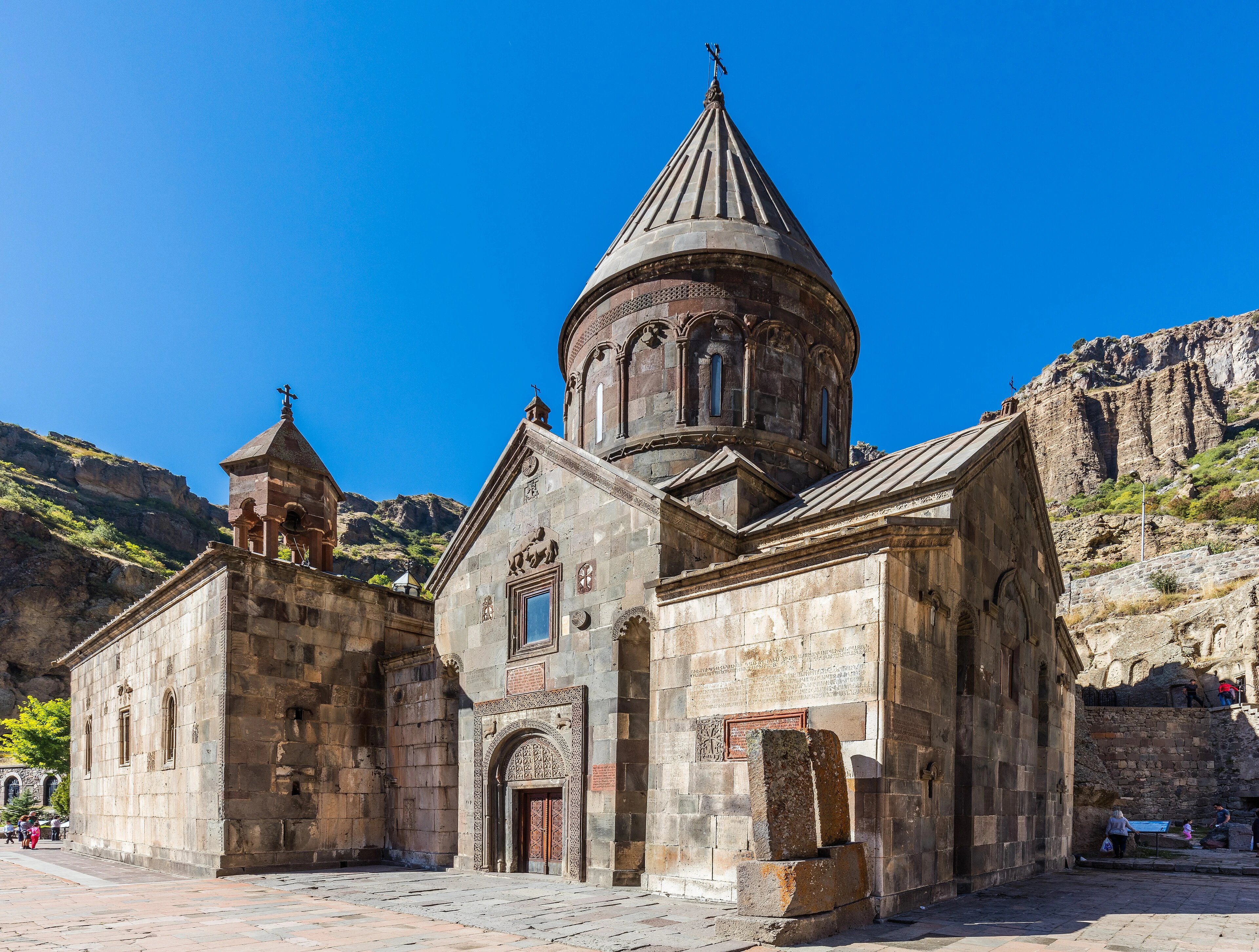
Three cultural sites in Armenia are included on the World Heritage list. The first combines the monasteries of Haghpat and Sanahin; the initial inscription took place in 1996, with an extension in 2000. The ensembles of Lori are known for their combination of church, educational and economic buildings. The second site: the monastery of Geghard and the upper reaches of the Azat River. Some of the churches and burial chambers are carved into the rock. The third combines the cathedral and churches of Echmiadzin with the archaeological site of Zvartnots. Both sites were inscribed in 2000. Garni, Tatev and other well-known monuments should not automatically be called inscribed on the main list: the tentative list has a different status. Armenian monuments outside the republic also belong to separate geographical sites.

Sevan and nature conservation tasks

Sevan is located in Gegharkunik at an altitude of about 1900 metres. The lake and its catchment area have water management, nature conservation and cultural significance. The Ramsar site includes not only the water surface but also the surrounding hydrological system. The lowering of the water level in the 20th century and subsequent restoration measures changed the state of the shores and ecosystems. The area of the lake and the water level are not constant values: the State Centre for Hydrometeorology and Monitoring publishes dated observations. Old reference values must not be presented as measurements of the present day. The protection of the lake requires taking into account water quality, the state of fish resources and coastal habitats. Visits to protected areas and the availability of specific routes should be checked against the current rules of the territory's administration.

Christianity and religious communities

The Armenian Apostolic Church occupies a special place in the history of culture and letters. The Constitution recognises its national historical mission; at the same time, religious organisations are separate from the state, and their freedom of activity is guaranteed. A person's ethnicity does not automatically determine their faith. In the museum tradition, the adoption of Christianity is associated with the year 301; a broader historical formulation places the conversion of the royal authority at the beginning of the 4th century. Echmiadzin, Zvartnots and the monastic complexes preserve buildings from various eras, including later changes and restorations. Religious diversity cannot be described through only one church tradition. Yazidi, Assyrian, Russian and other communities also live in Armenia. Data on national composition are not in themselves a count of religious adherents.

Alphabet, manuscripts and epic

The Armenian script emerged at the beginning of the 5th century. The art of the letters includes calligraphy, ornamental forms and their use in crafts; as a living tradition it was inscribed on the UNESCO intangible heritage list in 2019. Both the early manuscripts and the modern transmission of the craft are important. The Mesrop Mashtots Matenadaran preserves Armenian and foreign-language manuscripts, fragments and other materials. Its description of the collections covers history, philosophy, medicine, grammar and religious literature. Not all items belong to a single era or are written only in Armenian. The performance of the epic "Sasna Tsrer", also known as "David of Sassoun", was inscribed on the UNESCO list in 2012. This concerns an oral performance tradition with various versions, not a single unchanging written record of the text.

The duduk and the kochari dance

The duduk is a wind instrument with a double reed; apricot wood is traditionally used for its body. In an ensemble, one musician may sustain a drone while another leads the melody. The tradition accompanies various family and public events. UNESCO proclaimed it in 2005 and inscribed it on the Representative List in 2008. Kochari is a traditional group dance with local variants. It is transmitted within families, communities and through training in ensembles. It was inscribed on the intangible heritage list in 2017. The country's musical and dance traditions are broader than a single instrument or a single dance.

Khachkars and the blacksmithing of Gyumri

A khachkar is a stone stele with a carved cross and ornamental decoration. The monuments have memorial and religious functions, and the craft is transmitted from master to apprentice and within families. The symbolism and art of creating khachkars were inscribed on the UNESCO intangible heritage list in 2010. In 2023, the tradition of blacksmithing in Gyumri was inscribed on the list. The craft is associated with city gates, grilles, fences, lamps and other objects. Here it is important not to confuse blacksmithing with jewellery or goldsmithing: these are different craft traditions.

Lavash and regional cuisine

Lavash is baked from thinly rolled dough on the wall of a tonir. The joint work requires skill and coordination, and the transmission of knowledge unites generations. UNESCO inscribed the preparation and cultural significance of lavash in Armenia on the intangible heritage list in 2014. Recognition of the tradition is not a claim to exclusive ownership of all similar types of bread. Among the common dishes are khorovats, tolma, kyufte, harissa and ghapama. Kyufte has various local methods of preparation, harissa is associated with the long simmering of grain and meat, and ghapama is made from pumpkin with rice, dried fruit and other additions. Plant-based dishes, herbs, nuts and preserves also form a substantial part of the cuisine. Regional and family recipes differ. One festive table cannot be considered the obligatory menu of every inhabitant, nor should a person's religion be inferred from the dishes attributed to them.

Byurakan, the university and heritage research

The Byurakan Astrophysical Observatory was founded in 1946 on the initiative of Viktor Ambartsumian. It is located on the southern slope of Aragats; its research is connected with physical processes and non-stationary phenomena in the Universe. It is an active scientific center, not merely a tourist attraction. The decision to found Yerevan University was made on May 16, 1919, during the period of the First Republic. This date should be distinguished from the start of classes and subsequent organizational transformations. The History Museum of Armenia and the Matenadaran preserve different types of materials: archaeological objects, inscriptions, manuscripts and fragments. When studying heritage, it is necessary to distinguish the original, a scholarly reconstruction and a modern artistic interpretation.

Historical memory and the diaspora

The Armenian Genocide is a distinct historical topic that requires documents and precise attribution. Materials from the United States Holocaust Memorial Museum and the Armenian Genocide Museum-Institute examine the mass destruction, deportations and the fates of those who survived them. The Armenian diaspora took shape in different eras and is not limited to the consequences of a single event. The Constitution provides for ties with the diaspora and the preservation of cultural heritage abroad. Residents of the republic and Armenian communities around the world must be considered separately. According to UNHCR, in September 2023 more than 100,000 refugees from Karabakh arrived in Armenia within a short period. The material describes not only the moment of arrival but also long-term needs for housing, education and livelihoods.

Media

High-mountain lake landscapes of Armenia

Landscape inspired by the high-mountain lakes of Armenia · illustration Authentic images of the monuments are available via links to museums and UNESCO.

Anthem

Mer Hayrenik ("Our Homeland")

Armenian

Text based on words by Mikael Nalbandian, music by Barsegh Kanachyan. The information has been verified against the law on the anthem in its current 2025 version.

"Mer Hayrenik" is the state anthem of the Republic of Armenia. Law No. ՀՕ-42-Ն was adopted on March 5, 2025, and entered into force on April 6, 2025. The full and shortened musical and textual versions are established by the annexes to the law. The official text and musical annexes are available via the link to ARLIS.

Timeline

Events: 23 / 23

Around 4000 BCE
Areni-1 winemaking complex Study of installations and chemical traces of winemaking.
782 BCE
Foundation of Erebuni Dating based on the inscription of King Argishti I.
Early 4th century
Adoption of Christianity Traditional Armenian dating: 301.
Early 5th century
Armenian alphabet Created by Mesrop Mashtots; the accepted cultural date is 405.
10th-13th centuries
Haghpat and Sanahin Formation of monastic architectural ensembles.
1375
End of the Cilician Kingdom Cilicia was located outside the modern territory of Armenia.
1828
Treaty of Turkmenchay Change in the affiliation of the territories of Eastern Armenia.
1915
April 24 and the memory of the genocide The arrests in Constantinople became one of the key commemorative dates.
1918-1920
The First Republic A brief period of independent statehood.
1919
Foundation of Yerevan University The decision was adopted on May 16.
1920
Establishment of Soviet power The People's Commissariat for Foreign Affairs was created in December.
1936
A separate union republic The Armenian SSR became one of the union republics of the USSR.
1946
Byurakan Observatory Founded on the initiative of Viktor Ambartsumian.
1991
Independence referendum Held on September 21.
1996 and 2000
Haghpat and Sanahin on the UNESCO list Initial inscription and extension of the site.
2000
Geghard, Echmiadzin and Zvartnots Inscription of two more World Heritage sites.
2010
The art of khachkars Inscribed on the UNESCO Intangible Heritage list.
2014
The lavash tradition UNESCO recognized the preparation and cultural significance of lavash in Armenia.
2017
Kochari The traditional group dance is inscribed on the UNESCO list.
2019
The art of Armenian letter-writing Inscribed on the UNESCO Intangible Heritage list.
2023
Refugees from Karabakh More than 100,000 people arrived in Armenia in September.
2023
Gyumri blacksmithing Inscribed on the UNESCO Intangible Heritage list.
2025
Updated annexes to the law on the anthem The amendments are in force from April 6.