

South Caucasus · Armenia
Armenians
Հայեր · Hayer
Language
Armenian: the Eastern Armenian and Western Armenian literary standards
Family
Indo-European family, independent Armenian branch
Population
2,875,697 in Armenia (2022 census)
History
Regional culture and diaspora
Language
Faith and history of religions
Verified information
Language
- Armenian is an independent branch of the Indo-European family.
Settlement and population
- According to the 2022 census, 2,875,697 ethnic Armenians were recorded in Armenia.
Culture and daily life
- Kochari was inscribed on the UNESCO list in 2017.
- The art of Armenian writing was recognized by UNESCO in 2019.
History
- The adoption of Christianity by the royal authority dates to the beginning of the 4th century; the year 301 is the traditional date.
- The Armenian alphabet was created at the beginning of the 5th century by Mesrop Mashtots.
- The Armenian recension of Agathangelos dates to the second half of the 5th century and requires critical treatment as material about the conversion at the beginning of the 4th century.
Detailed chronology
9th–6th centuries BCE
The kingdom of Van, UrartuAn important stage in the history of the Armenian Highland; Urartian and Armenian are different languages.Second half of the 6th century BCE
Early written mentionsUnambiguous mentions of Armenia and Armenians appear in Persian and Greek materials.95–55 BCE
The reign of Tigranes IIThe Armenian kingdom becomes a significant power of the Hellenistic world.1st–3rd centuries AD
Between Rome and ParthiaThe political history of the kingdom is bound up with the rivalry of neighboring powers and local dynasties.2nd–3rd centuries
Early spread of ChristianityChristian preaching and communities precede the conversion of the royal court.Early 4th century
Conversion of the royal authorityThe traditional date is 301; scholarly debate includes 314–315. What is at issue is the beginning of a long process of Christianization.325
Aristakes' participation in the Council of NicaeaThe successor of Gregory the Illuminator takes part in the council; this episode is examined in critical study of the Agathangelos tradition.Around 405–406
The Armenian alphabetMesrop Mashtots creates the script; translations and original literature develop.428
Dvin as the center of Persian ArmeniaAfter the abolition of the Arsacid kingdom, the marzpan's administration is established here; later Dvin also becomes an ecclesiastical center.5th century
Christian authors on earlier cultsWritten testimonies preserve the names of pre-Christian deities and descriptions of sanctuaries.451
The Battle of AvarayrThe religious resistance is connected with the policy of the Sasanian state; the event becomes an important part of historical memory.451
The Council of ChalcedonThe Armenian Church does not accept its doctrinal definition; the subsequent formulation of its position takes time.Second half of the 5th century
The Armenian recension of AgathangelosThe known text about the conversion of Armenia takes shape substantially later than the events it describes.505/506
The Council of DvinThe first council belongs to one of the stages in the formation of the church's position; the dating and subsequent decisions are studied separately.552–555
The Second Council of DvinThe scholarly literature gives the dates 552, 554 and 555; the condemnation of the Chalcedonian definition is associated with the council.Middle Ages
Communities and ties with IranMigrations, trade networks and cultural contacts broaden the geography of Armenian life.10th–13th centuries
The monastic culture of LoriHaghpat and Sanahin become significant centers of architecture, learning and religious life.13th century
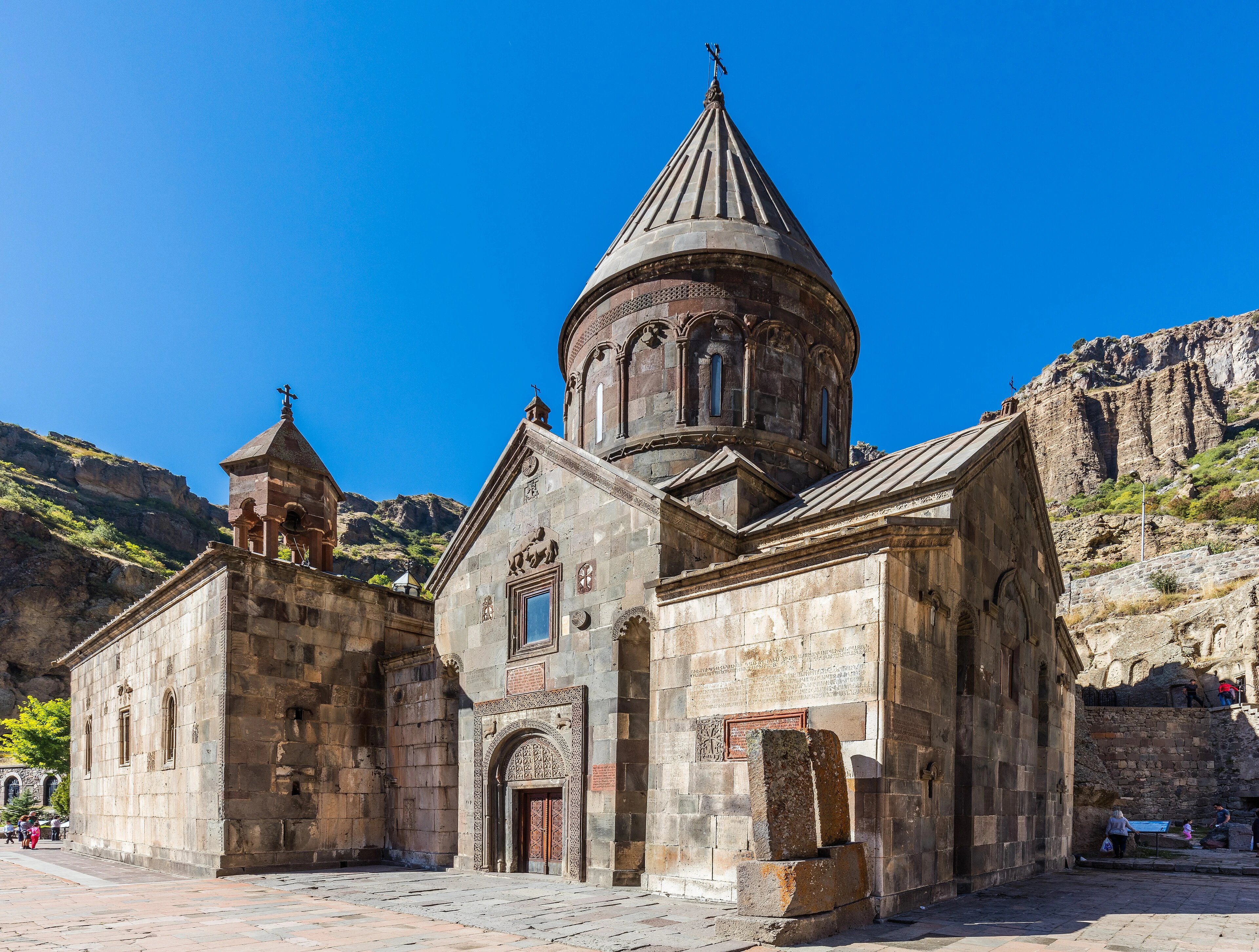
The flourishing of the Geghard complexSignificant parts of the monastic ensemble are created, including the rock-cut chambers.1375
The fall of the Cilician kingdomThe end of the kingdom is accompanied by further movement of Armenian communities.1441
The Catholicosate at EtchmiadzinThe Catholicosate at Etchmiadzin is restored; the Cilician Catholicosate continues to exist.1512
The first Armenian printed bookThe Urbatagirk is published in Venice; the history of the Armenian printed book begins.1666
The first complete printed Armenian BibleThe Amsterdam edition by Voskan Yerevantsi is represented in the collections of the Library of Congress.1717
The Mekhitarists on San LazzaroThe Armenian Catholic monastery in Venice develops as a center of the book and of learning.1733
The Bible of Mekhitar of SebastiaA new Armenian edition appears in Venice, continuing the printing tradition.1742
The Armenian Catholic PatriarchateThe Pope confirms the patriarchal ministry of Abraham Ardzivian; Catholic communities had existed earlier as well.1794
The journal AzdararThe first Armenian periodical is published in Madras.19th century
New literary normsThe Eastern Armenian and Western Armenian norms become established in print, school and literature.1846
The Armenian Evangelical ChurchA new Armenian Evangelical community takes shape in Constantinople.Late 19th century
Regional costume in photographyF. Orden photographs an Armenian girl from Shamakhi; the portrait captures a specific local image.1899
Komitas completes his studies in BerlinScholarly and performance work combines the study of folk music with professional training.1907
Komitas's musical work in EuropePublications and performances introduce a new audience to the Armenian musical tradition.1915–1916
The Armenian GenocideMass killings, deportations and the destruction of communities in the Ottoman Empire change the fate of the people and the diaspora.1918
The First Republic of ArmeniaState and diplomatic institutions of the new republic are established.16 May 1919
The founding of Yerevan UniversityA decision is adopted to establish a university important for higher education and science.1920
The establishment of Soviet powerThe period of the First Republic ends; a new stage of state history begins.1946
The Byurakan ObservatoryAn astrophysical research center associated with the development of Armenian and world science is founded.1991
The Independent Republic of ArmeniaAfter the collapse of the USSR, an internationally recognized independent statehood takes shape.1996
Haghpat in World HeritageUNESCO adds the monastery to its list of protected monuments.2000
Expanding recognition of architectural heritageSanahin is added to the Haghpat site; Geghard and the Echmiadzin complex with Zvartnots are also included.2005
The duduk receives UNESCO recognitionThe duduk and its music are proclaimed a masterpiece of the oral and intangible heritage.2008
The duduk on the Representative ListThe tradition is inscribed on the new Representative List of the Intangible Cultural Heritage.2010
The craft of khachkar makingUNESCO recognizes the symbolism, carving skills and transmission of the craft.2012
The epic "Sasna Tsrer" on the UNESCO listThe living performance tradition of the Armenian epic is recognized.2014
The cultural practice of lavashThe preparation, meaning and use of lavash in Armenia are included on the UNESCO list.2 October 2016
Documentary photograph of GeghardA photograph by Diego Delso is used on the page with attribution and license.2017
International recognition of kochariThe collective dance is included on the list of intangible heritage.2019
The art of the Armenian scriptUNESCO recognizes the living cultural practice of designing and using letters.2022
Census of the population of Armenia2,875,697 ethnic Armenians are counted; the figure refers to the country and the census year.September 2023
Arrival of refugees from KarabakhMass forced displacement requires humanitarian aid and support for families.2023
The blacksmithing tradition of GyumriUNESCO includes the craftsmanship of local blacksmiths on the Representative List.
Cuisine
Lavash and tonir
The preparation of thin bread in a clay oven is connected with the division of labor, family events and the transmission of skills. In 2014, UNESCO recognized the cultural practice of preparing and using lavash in Armenia.Harissa
The lengthy cooking of wheat and meat produces a thick dish. Both the recipe and the shared meal matter; family variants differ.Tolma and seasonal products
Fillings, leaves, vegetables, greens and methods of preserving food vary by locality and season. Armenian cuisine shares features with neighboring cuisines and has its own local combinations.Knowledge of food
Food is studied together with the household, family life, holidays and changes in urban life. A modern restaurant menu does not exhaust historical diversity.
Adats and traditions
Family and community
Family relations, mutual assistance and hospitality had various local forms. Ethnography examines them in a specific social environment, not as obligatory rules of behavior for all Armenians.Vardavar
The holiday combines the church Transfiguration with folk customs of pouring water and local rites. Contemporary descriptions also record the flower traditions of Tavush.Memory and commemoration
April 24 is connected with the memory of the victims of the genocide. Family testimonies, museum work and public ceremonies help preserve the names and experiences of those who survived the catastrophe.Oral performance of the epic
"Sasna tsrer," also known as "David of Sasun," was transmitted by storytellers. The performance sustains a shared cultural memory; the epic plot cannot be read as an exact chronicle.
Clothing
Traditional costume
Dances
Kochari
The collective dance is performed at holidays and public events. Knowledge of the steps and interaction is transmitted through participation and instruction; in 2017 the tradition was inscribed on the UNESCO list.Transmission of dance culture
The family, the local community and organized classes sustain the tradition. A stage production is one of the forms of presenting the dance and does not replace its social practice.
Music
Crafts
Khachkars
Stone steles with a cross combine carving, ornament, inscriptions and memorial significance. In 2010, UNESCO recognized the craftsmanship and symbolism of their making.The manuscript book
Scribes, artists and binders participated in creating manuscripts. The Matenadaran preserves monuments of various eras and disciplines, including history, medicine, philosophy and theology.The blacksmiths of Gyumri
The living tradition includes training, the making of household and artistic items and family continuity. It was inscribed on the UNESCO list in 2023.The letter as art
Calligraphy and decorative writing are used in manuscripts, architecture, craft and contemporary culture. Forms and materials change while preserving the significance of writing as a cultural skill.
Memorable Places
Etchmiadzin and Zvartnots
The cathedral and churches of Etchmiadzin, together with the archaeological site of Zvartnots, were inscribed on the World Heritage list in 2000. They represent different stages of early Christian architecture.Haghpat and Sanahin
The medieval monasteries are known for their architecture and their role in spiritual and educational life. The World Heritage property was formed by the inclusion of Haghpat in 1996 and its extension with Sanahin in 2000.Geghard and the Azat Valley
The monastic complex combines above-ground and rock-cut spaces. Its cultural landscape has been protected as a World Heritage property since 2000.The Matenadaran
The manuscript repository and research institute in Yerevan makes it possible to become acquainted with centuries-old written culture. An individual manuscript has its own history of creation and movement.Sites of memory of the genocide
The Armenian Genocide Museum-Institute preserves documents, testimonies and research materials. Turning to the archive helps distinguish family recollection, document and later interpretation.
Names
Men's
- Areg (Armenian)
- Arevshad (Armenian)
- Hayk (Armenian)
- Hrayr (Armenian)
- Mkhitar (Armenian)
- Harutyun (Armenian)
- Hambardzum (Armenian)
- Martik (Armenian)
Women's
- Lusine (Armenian)
- Arevik (Armenian)
- Astghik (Armenian)
- Knarik (Armenian)
- Azniv (Armenian)
- Armenui (Armenian)
- Arshaluys (Armenian)
People and cultural memory
Mesrop Mashtots
The creator of the Armenian alphabet at the beginning of the 5th century. His work is connected with the circle of translators, Catholicos Sahak and the support of King Vramshapuh.Gregory the Illuminator
A church figure with whom the conversion of Tiridates III and the formation of the early Armenian church organization are connected. The hagiographic image should be distinguished from a reconstruction of the historical biography.Komitas
A clergyman, composer and researcher of folk music. His legacy is important for understanding the interrelation of oral tradition, musical scholarship and choral culture.David of Sasun
An epic hero, part of the "Sasna tsrer" cycle. He belongs to the world of oral narrative and cultural memory, not to a list of historically documented persons.
Media
Photo gallery
Authorship and licenses are indicated in the image captions.