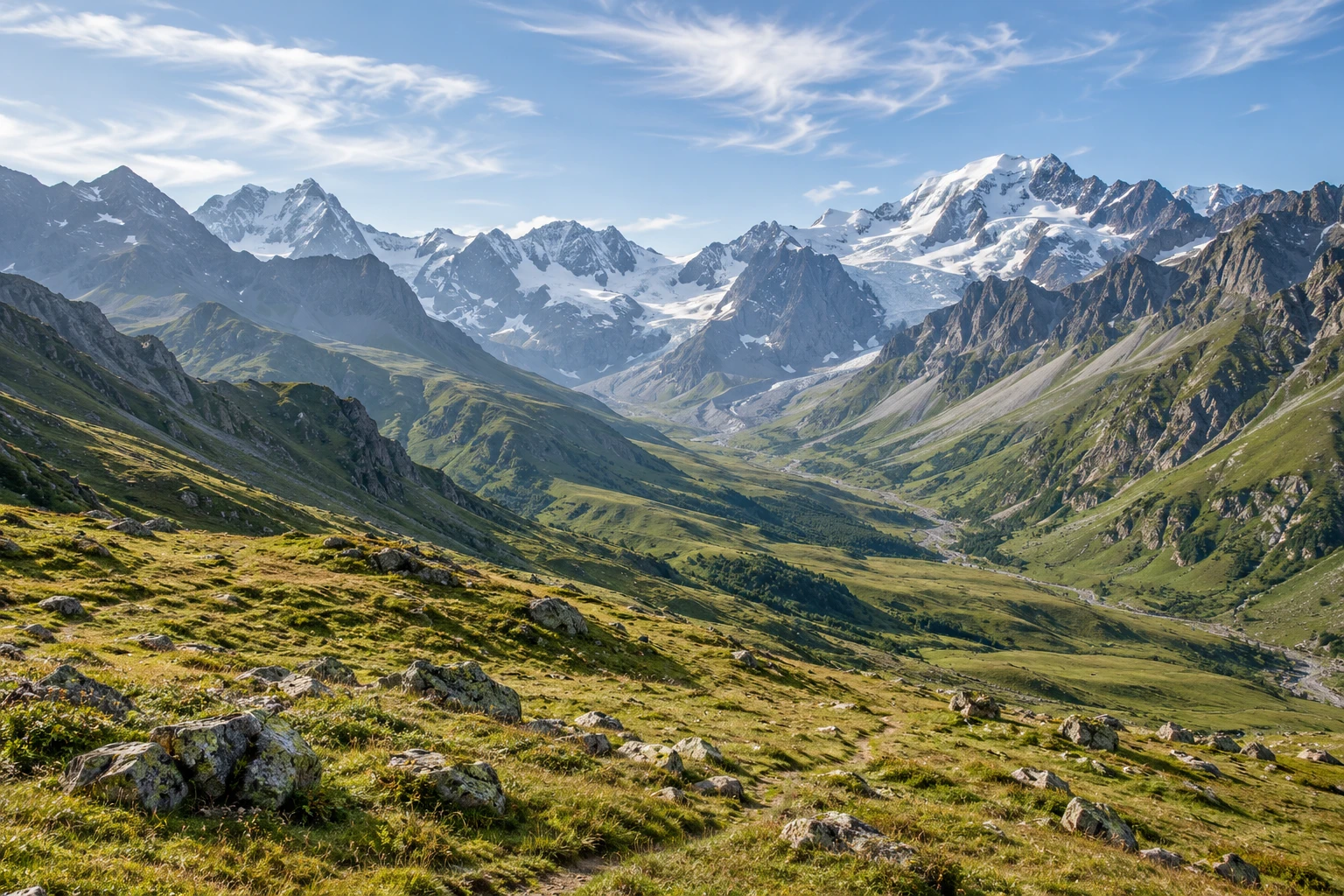
Landscape inspired by the high-mountain valleys of Georgia · illustration
Landscape inspired by the high-mountain valleys of Georgia · illustration · Artistic illustration

3.9411 million

residents as of 1 January 2026 according to Geostat; excluding Abkhazia and South Ossetia

69,700 km²

area within internationally recognized borders; coverage differs from population statistics

4

UNESCO World Heritage sites: three cultural and one natural

Geography in Detail

Regions and settlements

Georgia's territorial organisation comprises nine regions, two autonomous republics and the capital Tbilisi. The internal municipalities and settlements are listed separately below. South Ossetia (Tskhinvali region) is presented in a separate card with an explanation of its status and de facto administration.

Settlements
4398
Territories
13

The reference work lists 4,398 settlements. The list was verified on 28 October 2026; small settlements are also included without selection by population size. The national spelling is preserved in parentheses, and the municipality is indicated after a full stop. The Russian rendering of the names aids searching.

Capital, separate municipalityTbilisiCenter: Tbilisi
Autonomous republicAdjaraCenter: Batumi
RegionGuriaCenter: Ozurgeti
RegionImeretiCenter: Kutaisi
RegionKakhetiCenter: Telavi
RegionKvemo KartliCenter: Rustavi
RegionMtskheta-MtianetiCenter: Mtskheta
RegionRacha-Lechkhumi and Kvemo SvanetiCenter: Ambrolauri
RegionSamegrelo-Zemo SvanetiCenter: Zugdidi
RegionSamtskhe-JavakhetiCenter: Akhaltsikhe
RegionShida KartliCenter: Gori
Autonomous republic under Georgian lawAbkhaziaCenter: Sukhumi
Territory with disputed statusSouth Ossetia (Tskhinvali region)Center: Tskhinvali (Tskhinvali)

Geography and population

Georgia is located in the South Caucasus, on the eastern coast of the Black Sea. The Greater Caucasus lies to the north, and the mountain systems of the Lesser Caucasus to the south. The west has more humid conditions, while the east has a drier climate; elevation substantially changes the natural environment. The country borders Russia, Azerbaijan, Armenia and Turkey. The area of 69,700 km² refers to the country's internationally recognized borders. Geostat's population estimate as of 1 January 2026 is 3,941.1 thousand people and does not cover Abkhazia and South Ossetia. Therefore, dividing these figures to obtain a comparable population density is incorrect. Geostat's release of 24 April 2026 takes into account the results of the 2024 census; the estimate for the beginning of 2025 was also recalculated. The census count and the annual estimate as of 1 January refer to different dates. Tbilisi was estimated to have 1,369.4 thousand inhabitants at the beginning of 2026.

The state and the territorial context

Official name of the country in the Constitution: Georgia, in Georgian საქართველო. Capital Tbilisi. The constitutional status of Abkhazia and its de facto administration should be distinguished. Abkhazia and South Ossetia are outside the effective control of Georgia's central authorities. A 2025 UN report links this to the armed conflicts of the 1990s and 2008; it also notes Russian recognition of the independence of these territories and the presence of Russian troops. The country's internationally recognized borders and the actual coverage of statistics on the page are indicated separately.

Related articles about peoples

Regional cultural traditions

Kartli and Kakheti
Eastern Georgia: Mtskheta, Tbilisi and Kakhetian winemaking traditions. Historical regions are not identical to modern administrative units.
Imereti and Guria
Western Georgia: the heritage of Kutaisi and Gelati, regional forms of singing and cuisine.
Samegrelo and Svaneti
Mingrelian and Svan are independent related Kartvelian languages. Regional and linguistic affiliation does not override personal self-identification.
Adjara
The Black Sea and mountainous parts of southwestern Georgia; Batumi, local culinary and musical traditions.
Northeastern mountainous areas
Tusheti, Khevsureti, Pshavi and neighboring valleys preserve local forms of settlement and ritual culture. The context of a specific community is important for their study.

Languages and writing

Georgian: the state and literary language

Georgian belongs to the Kartvelian family and has its own script. Modern general education and everyday written practice use Mkhedruli. The state status of the language is enshrined in the Constitution.

Mingrelian and Svan

Mingrelian and Svan are Kartvelian languages related to Georgian, not merely names for local varieties of literary Georgian. Mingrelian is spoken mainly in the west, while Svan is associated with historical Svaneti. Linguistic classification should be distinguished from ethnic self-identification.

Laz and Kartvelian kinship

Laz is especially close to Mingrelian. Most of its speakers live in northeastern Turkey; small communities exist on the Black Sea coast of Georgia. Therefore, four Kartvelian languages do not mean four state languages of Georgia.

Abkhaz and other community languages

Under Article 2 of the Constitution of Georgia, the state language is Georgian, and in the Autonomous Republic of Abkhazia also Abkhaz. This constitutional provision does not describe the actual governance of the territory. Armenian, Azerbaijani, Russian, Ossetian and other community languages are also used in the country.

Communities and statistical coverage

Georgia is multinational. The list of links reflects the portal's available articles, not the full composition of the population. Information about communities is not an assessment of any individual's views or religiosity.
Azerbaijanis and Armenians
Large communities of the country with their own linguistic, educational and religious traditions.
Russians, Ossetians, Yazidis and other residents
Nationality, citizenship, native language and religion are different characteristics of a person.
Territorial coverage of the census
The data published by Geostat do not cover Abkhazia and South Ossetia. They cannot be used as an estimate of the total Abkhaz or Ossetian population.

History of Georgia

Text size
Text size: 100%

Chapter 1 · About 1.8 million years ago and the Neolithic

Dmanisi and early winemaking

The Dmanisi finds include the remains of ancient humans and animals, as well as stone tools about 1.8 million years old. They are important for the study of the early dispersal of humans beyond Africa; calling them modern Georgians would be an anachronism.
Another line of research concerns the Neolithic settlements of Shulaveris Gora and Gadachrili Gora. Chemical analysis of pottery and dating of the contexts allowed the authors of a 2017 PNAS article to link the vessels to grape wine around 6000-5800 BCE. This is archaeological evidence, not proof that modern recipes have remained unchanged for eight millennia.
Page 1 of 1in chapter 1

The overview distinguishes ancient kingdoms, the medieval unified state and modern Georgia. The borders and political names of different eras do not coincide.

Mtskheta, Gelati and Upper Svaneti

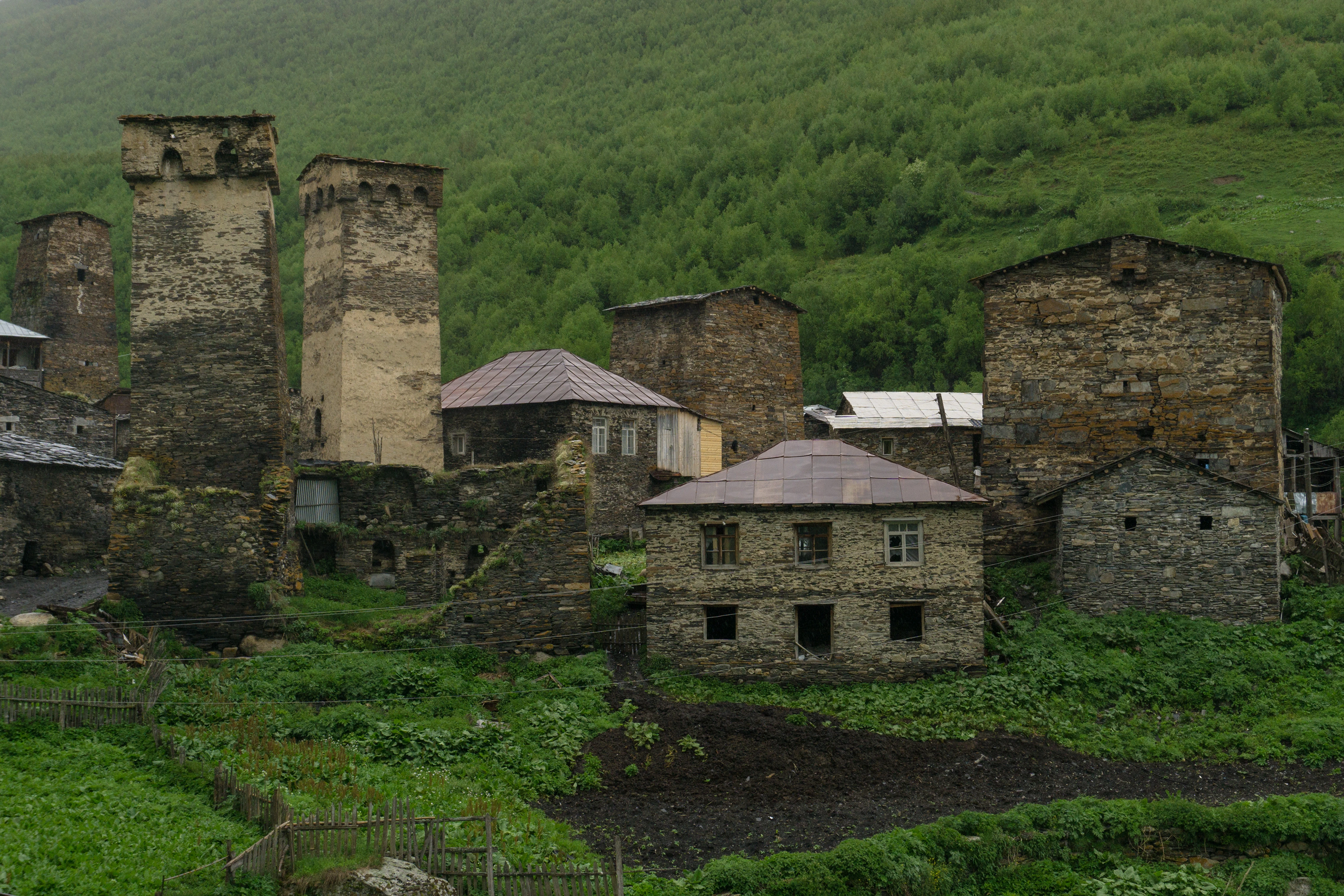
Georgia has four UNESCO World Heritage sites: the historical monuments of Mtskheta, Gelati Monastery, Upper Svaneti, and the Colchic rainforests and wetlands. They must not be confused with the Intangible Heritage list and the Memory of the World programme. The Mtskheta property includes Jvari, Svetitskhoveli and Samtavro. These are ensembles from different eras, not buildings from a single year. Gelati near Kutaisi was founded in 1106; the monastery is known for its architecture, mosaics, frescoes and the history of its academy. Upper Svaneti is represented by the protected cultural landscape of Chazhashi in the Ushguli community. The tower houses combined residential and defensive functions. The inscription of a specific property on the list does not mean that all of Svaneti has the same protection status.

Colchic forests and protected areas

The UNESCO natural property "Colchic Rainforests and Wetlands" comprises seven component parts on the humid eastern coast of the Black Sea. It includes forest and wetland ecosystems of Adjara, Guria and Samegrelo-Zemo Svaneti. These are not tropical jungles but temperate humid forests with relict and endemic species. Borjomi-Kharagauli protects the mountain-forest landscapes of the Lesser Caucasus; the national park was established in 1995. The protected areas of Tusheti combine the natural and cultural heritage of mountain valleys. The regimes of a strict nature reserve, a national park and a protected landscape differ. Seasonal accessibility, registration rules and the condition of mountain routes change. Current conditions should be checked with the administration of the specific area rather than treated as a permanent characteristic of the region.

Religions and cultural diversity

The Constitution recognises the special historical role of the Georgian Apostolic Autocephalous Orthodox Church and guarantees freedom of belief and religion. Ethnicity and personal faith are not interchangeable concepts. Among the country's religious communities are Orthodox Christians, Muslims, followers of the Armenian Apostolic Church, Catholics, Jews and other groups. The census records declared affiliation, not the degree of religious practice. The Public Broadcaster's publication of the detailed results of the 2024 census gives separate figures for religion, nationality and native language.

Writing and literature

There are three Georgian writing systems: Mrgvlovani, also known as Asomtavruli, Nuskhuri and Mkhedruli. Their functions differ: Mkhedruli is used in modern everyday and educational practice, while the earlier systems continue to live in ecclesiastical and craft settings. In 2016 this living culture was inscribed on the UNESCO Intangible Heritage list. Shota Rustaveli's poem "The Knight in the Panther's Skin" was created at the turn of the 12th-13th centuries. The manuscript collection of the poem was inscribed in the international Memory of the World register in 2013. The age of the work and the age of each surviving copy must be distinguished: the manuscript tradition developed over centuries.

Polyphonic singing

Georgian polyphonic singing includes various local traditions, not a single common musical template. UNESCO proclaimed it a masterpiece of the oral and intangible heritage in 2001; it was inscribed on the Representative List in 2008. The Research Centre for Traditional Polyphony distinguishes forms with a sustained bass, contrasting movement of voices and their combinations. Different ways of organising polyphony are widespread in the eastern and western regions; secular singing and church chant also have their own characteristics. The official UNESCO page provides material for becoming acquainted with the sound of the tradition.

Regional cuisine

Georgian cuisine is made up of local traditions. Imeretian khachapuri differs from the Adjarian boat-shaped version; the mountain varieties of khinkali do not exhaust all the ways of preparing this dish. In Samtskhe-Javakheti there are distinctive forms of preserving meat and of flour dishes. Among the widely known dishes are pkhali made from vegetables with a walnut dressing, lobio made from beans, and satsivi with a walnut sauce. The composition, serving and festive context vary by region and family. It would be wrong to describe a single menu as obligatory for every inhabitant of the country.

Qvevri and the history of winemaking

A qvevri is a large clay vessel used for the fermentation, ageing and storage of wine. The tradition includes the making of the vessels, the care of the grapes and the transmission of knowledge within the family and community. In 2013 the method was inscribed on the UNESCO Intangible Heritage list. A 2017 PNAS archaeological article examines chemical traces of grape wine in Neolithic pottery. The authors separately discuss the gaps between the Neolithic finds and later underground vessels. Therefore ancient evidence of winemaking should not automatically be called proof of the continuous use of the modern qvevri method since the 6th millennium BCE.

Universities, museums and heritage research

Tbilisi University opened in 1918 on the initiative of Ivane Javakhishvili and his associates. The official history gives 26 January according to the old calendar; the modern commemorative date falls on 8 February. Petre Melikishvili became the first rector. The Georgian National Museum researches archaeological heritage, including Dmanisi. The National Archives publishes documents and photographs of modern history, while university projects study the Kartvelian languages and polyphony. These institutions provide different types of material: physical finds, documents, linguistic descriptions and recordings of performance.

Media

Highland landscapes of Georgia

Landscape inspired by the highland valleys of Georgia · illustration Authentic images of monuments and archival photographs are available via links to the institutions.

Anthem

Tavisupleba ("Freedom")

Georgian

Words by David Magradze. Music by Zacharia Paliashvili, arranged for the anthem by Ioseb Kechakmadze. The anthem was adopted in 2004; the current legal basis is indicated separately.

The title "თავისუფლება" translates as "Freedom". The text and music are set out in Annexes No. 4 and No. 5 to Georgia's Organic Law on State Symbols of 14 November 2018. The official text and musical appendix are available via the link to the primary source.

Timeline

Events: 18 / 18

About 1.8 million years ago
Dmanisi finds Remains of early humans, animals and stone tools.
About 6000–5800 BC
Neolithic winemaking Dates of the studied archaeological contexts of Shulaveris Gora and Gadachrili Gora.
4th century
Christianity in Kartli The adoption of Christianity by the royal authority of the eastern Georgian kingdom.
The beginning of the 11th century
Unification under Bagrat III The formation of a unified medieval kingdom.
1106
Foundation of Gelati A monastery and future centre of education.
1783
Treaty of Georgievsk Russia's protectorate over Kartli-Kakheti.
1801
Incorporation of Kartli-Kakheti into the Russian Empire The end of the monarchy of the eastern Georgian kingdom.
1918
The university and the First Republic The opening of Tbilisi University; independence proclaimed on 26 May.
1921
The Constitution and the Soviet conquest The Constitution adopted on 21 February; the Red Army occupied Tbilisi on 25 February.
1937
Political repressions The executions of Sandro Akhmeteli and Petre Otskheli are reflected in the archival exhibition.
1991
Restoration of independence The referendum of 31 March and the act of 9 April.
1994
First World Heritage sites Mtskheta and the site now represented by Gelati Monastery.
1995
Constitution of Georgia Adopted on 24 August.
1996
Upper Svaneti on the UNESCO list Tower architecture and the cultural landscape of Chazhashi.
2008
War and displacement of the population Contemporary consequences are examined in the UN report.
2013
Recognition of living and manuscript traditions The qvevri method is inscribed on the intangible heritage list, and the Rustaveli manuscript collection on the Memory of the World register.
2016
Three writing systems The living culture of the Georgian script is inscribed on the UNESCO intangible heritage list.
2021
Colchic forests and wetlands The natural site is inscribed on the World Heritage list.