

South Caucasus · Azerbaijan
Azerbaijanis
Azərbaycanlılar · Azerbaijanis
Language
Azerbaijani: northern and southern varieties
Family
Turkic family, Oghuz group
Population
9,436.1 thousand in Azerbaijan (2019 census)
History
Settlement, local groups and identity
Language
Faith and history of religions
Verified information
Language
- Azerbaijani belongs to the Oghuz branch of the Turkic languages.
Settlement and population
- The official 2019 census table records 9,436.1 thousand Azerbaijanis in the territory of the country covered.
Culture and daily life
- The Yalli of Nakhchivan were included in the UNESCO Urgent Safeguarding List in 2018.
- Tandir-making and bread-baking were recognized by UNESCO in 2024.
History
- Shiism was proclaimed the official religion of the Safavid state in 1501; its spread continued over a long period.
- The Republic of Azerbaijan is a secular state.
Detailed chronology
Before the 7th century
The diversity of the pre-Islamic regionThe Christian written monuments of Caucasian Albania represent a distinct language and ecclesiastical environment.The Sasanian era
The Zoroastrian sanctuary of Adur GushnaspThe history of the sacred fire belongs to an area in present-day Iran.7th century
The Arab campaigns and the spread of IslamThe military establishment of caliphal power and the gradual conversion of the inhabitants were different processes.639–643
Dating the conquest of the historical regionBosworth gives various dates for the Arab conquest of the region south of the Araxes. This is not a single date for the conversion of all the ancestors of Azerbaijanis.Around 816/817–837
Babak's movementThe Khurramite uprising against the caliphate had religious and social preconditions. It cannot be equated with a modern national movement.11th–12th centuries
Oghuz speech in the regionMigrations and interaction with local societies extended the spread of Turkic languages.1136–1225
The Ildegizids and the Turkic-speaking populationThe growth of the Turkic-speaking population continued under the atabegs; the linguistic change was not instantaneous.Middle Ages
Ganja as a cultural centreThe city develops under changing political and linguistic conditions.12th–early 13th century
Nizami GanjaviThe work of the Persian-language poet becomes part of the literary heritage of Ganja and of the wider world.13th–14th centuries
Early Turkic-language written poetryA literary tradition takes shape in interaction with Persian models.1256–1349
The Ilkhans and linguistic changeUnder the Mongol Ilkhans the presence of Turkic military groups increased; Iranian dialects continued to exist.Around 1300
The Safavid order of ArdabilThe religious movement precedes the creation of the dynastic state.1334
The death of Safi al-DinThe shrine in Ardabil and the network of followers retain their significance after the master's death; leadership passes to his descendants.Around 1358
Compilation of the Safvat al-SafaIbn Bazzaz completes the hagiographic account of Safi al-Din; the text was later revised.15th century
Turkic literature under the Turkmen dynastiesPoetic forms and court patronage develop.1447–1448
Junayd's expulsion from ArdabilThe conflict over leadership of the order precedes his preaching in Anatolia and the further transformation of the movement.15th century
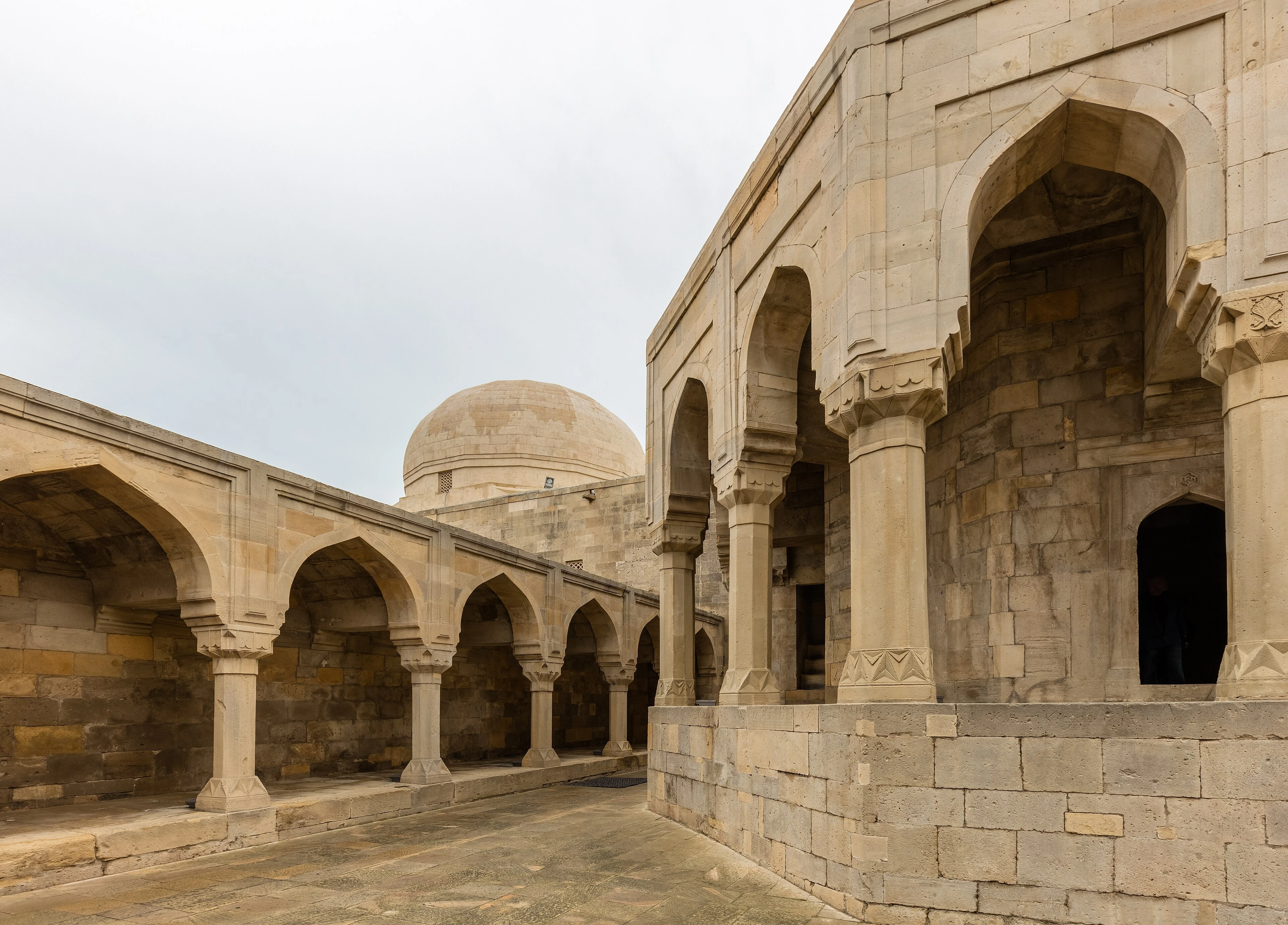
The Palace of the Shirvanshahs in BakuThe architectural ensemble represents an important part of the city's heritage; the dating is given according to the UNESCO description.1501
Shah Ismail in TabrizSafavid rule is established; Shiism is proclaimed the official religion of the state.16th century
The work of FuzuliMultilingual poetry receives a lasting literary and musical continuation.16th–18th centuries
The Ottoman-Safavid borderlandWars and confessional rivalry change social life and the economy.17th–18th centuries
Merchants and pilgrims in SurakhanyThe surviving Ateshgah complex, associated with various religious communities, takes shape.1813
The Treaty of GulistanAfter the war a new Russian-Iranian border is fixed; a number of territorial questions remain unresolved.1828
The consequences of the new Russo-Iranian warFurther concessions by Iran deepen the division of Turkic-speaking communities between the two empires.1850–1855
The comedies of AkhundzadeSatirical drama becomes a means of social criticism.1857
The alphabet reform projectAkhundzade proposes changes to the script; the discussion will continue among later generations.Second half of the 19th century
Photographic documentation of clothingA portrait of an Azerbaijani woman from Baku is attributed to N. K. Zeidlits.1873
A theatrical performance in BakuAkhundzade's play Haji Kara is staged in the Turkic language.1875
The newspaper EkinchiThe press becomes a forum for discussing education, language and social change.1879
The Nobel Brothers PartnershipBranobel becomes part of the history of the oil industry and of Baku.Late 19th–early 20th century
Religious and social debatesThe mourning rituals of Muharram become a subject of dispute among believers, the clergy and reformers.1908
Leyli and MajnunUzeyir Hajibeyli's opera combines mugham with musical theatre.28 May 1918
Proclamation of the RepublicAn independent Azerbaijani republic is established.1 September 1919
Founding of Baku UniversityA law establishing the university is adopted.1920
The establishment of Soviet powerThe Soviet phase of Azerbaijan's state history begins.1920s–1930s
Anti-religious campaignsOpen practice is restricted; rituals continue in altered forms.1939
Transition of Soviet Azerbaijani writing to the Cyrillic alphabetThe change of script belongs to Soviet language policy; Azerbaijani communities in Iran continued to use the Arabic script.18 October 1991
Restoration of independenceA constitutional act on state independence is adopted.1990s
War and forced displacementHumanitarian documents record the mass displacement of Azerbaijanis, Armenians and other residents of the region.12 November 1995
Adoption of the ConstitutionArticles 18 and 48 establish the separation of religion and state and freedom of conscience. The constitutional norm and everyday religiosity are different subjects of study.2000
The Old City of Baku on the World Heritage ListThe significance of the historical ensemble is internationally recognized.2003
Mugham receives UNESCO recognitionThe tradition is proclaimed a masterpiece of oral and intangible heritage.2008
Mugham on the Representative ListThe tradition is inscribed on the new intangible heritage list.2009
Ashiq art on the UNESCO listThe poetic, musical and storytelling practices are recognized.2010
Recognition of carpet weavingThe traditional craft is inscribed on the intangible heritage list.2012
Tar making and performanceUNESCO recognizes the related skills of craftspeople and musicians.2014
Kəlağayı on the UNESCO listThe making and wearing of silk scarves are recognized.2015
The copper craft of LahijInternational recognition of a local craft tradition.2017
Preparation and sharing of dolmaA family and community cultural practice is recognized.2018
Safeguarding of yalli dancesKochari and the tenzere of Nakhchivan are inscribed on the list requiring urgent safeguarding.2018
The heritage of Dede QorqudA joint nomination by Azerbaijan, Kazakhstan and Türkiye is inscribed on the UNESCO list.2019
Population censusIn the part of the country covered by the census, 9,436.1 thousand Azerbaijanis were counted according to the published table.2019
The historic centre of ShakiThe urban ensemble with the Khan's Palace is inscribed on the World Heritage List.2022
Tea cultureA joint nomination by Azerbaijan and Türkiye is recognized by UNESCO.2024
Tandir and bread bakingThe making of ovens and the family transmission of skills are inscribed on the UNESCO list.2024
Extended nomination of NovruzInternational safeguarding of the shared spring festive heritage continues.
Cuisine
Pilaf
Rice, separate preparation of components and various additions form many variants. The recipe depends on the region, the season and family tradition.Dolma
The preparation of fillings, the use of leaves or vegetables and the shared meal involve knowledge passed down within the family. UNESCO recognized this cultural practice in 2017.Tea
Tea drinking accompanies hospitality and socializing. Tea culture was inscribed on the UNESCO list in 2022 as a shared heritage of Azerbaijan and Turkey.Tandir and bread
The making of the clay oven, the baking, and the respectful attitude toward bread are passed on through observation and participation. The practice was recognized by UNESCO in 2024.
Adats and traditions
Novruz
Preparations for spring, family visits and the festive meal have local variations. This is a heritage shared by a number of countries, not the exclusive property of one people.Hospitality
Sharing tea, offering food and conversation sustain family and neighbourly ties. Everyday practice changes along with ways of life.Storytelling memory
The heritage of Dede Korkut brings together epic tales, music and ideas about life transitions. It was recognized by UNESCO in a joint nomination by Azerbaijan, Kazakhstan and Turkey.Oral transmission of craft
Ashugs combine performance, poetry and storytelling. Learning through listening and participation links different generations.
Clothing
Traditional costume
Dances
Yalli
The dancers form a chain, a line or a circle. Local forms include different movements and playful elements; collective participation matters alongside the steps themselves.Kochari and tenzere of Nakhchivan
These forms of yalli were inscribed on the UNESCO list in need of urgent safeguarding in 2018. The decision explicitly notes the shared nature of the dance heritage with other communities of the region.Living practice and the stage
The shift to a standardized staging can reduce local diversity. Documentation and training should preserve the participation of bearers of the tradition, not only the concert form.
Music
Crafts
Carpet weaving
The patterns, techniques, materials and purposes of carpets vary. Knowledge is passed on in families and workshops; the tradition was inscribed on the UNESCO list in 2010.Kelaghayi
Dyeing silk and applying patterns are bound up with the master's skills, local symbolism and the use of the scarf. The UNESCO recognition concerns the living practice of making and wearing it.The copper craft of Lahij
Copperworking includes preparing the metal, shaping and decorating. The local craft knowledge was recognized by UNESCO in 2015.Making musical instruments
For the tar, the master selects wood and other materials, assembles the body and neck, and tunes the sound. The instrumental tradition depends on both the craftsman and the musician.
Memorable Places
The old city of Baku
Icherisheher, the Palace of the Shirvanshahs and the Maiden Tower preserve different historical layers of urban life. The complex was inscribed on the World Heritage list in 2000.Sheki
The historic centre and the Khan's Palace are linked to the town's trade, crafts and architecture. A World Heritage property since 2019.Ganja
The city's history helps in examining medieval literature, craft and political change in a multilingual environment.Ateshgah
The temple complex of Surakhani is a museum and a monument of religious and commercial ties. It is on the UNESCO tentative list; this is not equivalent to inscription on the World Heritage list.Carpet Museum
Museum collections allow comparison of techniques, materials and regional forms. An exhibit must be considered together with its dating and provenance.
Names
Men's
- Elchin (Azerbaijani, Turkic)
- Tural (Azerbaijani, Turkic)
- Togrul (Azerbaijani, Turkic)
- Orkhan (Azerbaijani, Turkic)
- Elkhan (Azerbaijani, Turkic)
- Aydin (Azerbaijani, Turkic)
Women's
- Aygün (Azerbaijani, Turkic)
- Aybeniz (Azerbaijani, Turkic)
- Aytekin (Azerbaijani, Turkic)
- Günay (Azerbaijani, Turkic)
- Günel (Azerbaijani, Turkic)
- Sevinc (Azerbaijani, Turkic)
- Sevil (Azerbaijani, Turkic)
- Gönül (Azerbaijani, Turkic)
People and cultural memory
Fuzuli
A poet who wrote in Turkic, Persian and Arabic. His works had a lasting influence on literature and performance culture.Mirza Fatali Akhundzade
A 19th-century playwright and thinker, a participant in debates on enlightenment and the alphabet. His satirical plays are important for the history of theatre.Uzeyir Hajibeyli
Composer of the opera Leyli and Majnun. His work with mugham and theatrical action became part of a new professional musical culture.Dede Korkut
A legendary sage and storyteller of the epic world. His figure belongs to oral heritage; he cannot be described as a biographically established historical figure.
Media
Photo gallery
Authorship and licenses are indicated in the image captions.