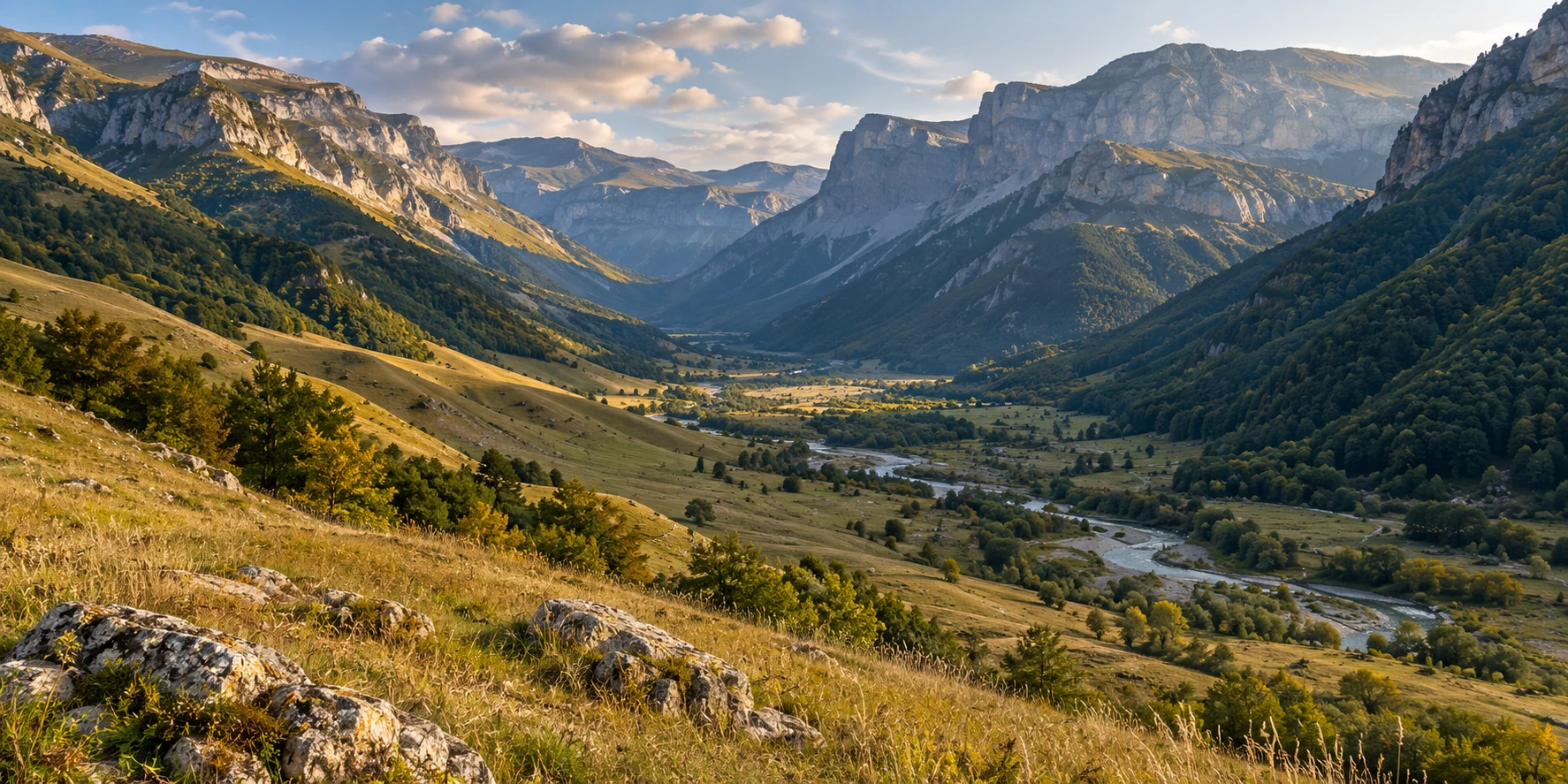
A mountain valley with a river, grassy slopes, forest and limestone ridges
Mountain landscape inspired by the valleys of Ingushetia · illustration · Artistic illustration

534.5 thousand

residents as of 1 January 2025, rounded Rosstat estimate

3.1 thousand

square kilometres, area according to Rosstat data

2

state languages: Ingush and Russian

Geography in Detail

Cities, villages and districts

Ingushetia consists of four districts and five towns. The mountainous part includes the Dzheyrakhsky District; plain and foothill settlements are also located in the Nazranovsky, Malgobeksky and Sunzhensky districts.

Settlements
122
Territories
9

List of populated places as of 8 September 2026. Populated places with the same name in different municipal formations are shown separately. Small populated places without permanent population are also included; population figures are not given here.

Urban okrugMagasCenter: Magas
Urban okrugNazranCenter: Nazran
Urban okrugMalgobekCenter: Malgobek
Urban okrugKarabulakCenter: Karabulak
Urban okrugSunzhaCenter: Sunzha
DistrictDzheyrakhsky DistrictCenter: Dzheyrakh village
DistrictNazranovsky DistrictCenter: Nazran
DistrictMalgobeksky DistrictCenter: Malgobek
DistrictSunzhensky DistrictCenter: Sunzha

Geography and population

The Republic of Ingushetia is part of the North Caucasian Federal District. Its natural landscape includes plains, foothills and mountain valleys of the northern slope of the Greater Caucasus. The mountainous part is linked to the Assa and Armkhi basins; the capital of the republic, Magas, is located in the plain part. According to Rosstat data cited by the Bank of Russia, the population as of 1 January 2025 was 534.5 thousand people. The area of the territory in the 2025 Rosstat collection is given as 3.1 thousand km². Both figures are rounded; the date of the population estimate is retained next to the indicator. ; . The modern economy includes trade, construction, agriculture and industrial production. The regional economy and the life of the cities complement the historical heritage of the mountain villages.

Peoples of the region

Local societies and kinship ties

Mountain and lowland villages
The history of the Ingush is connected both with mountain valleys and with the foothill plain. Resettlements, economic ties and changes in administrative borders linked these territories.
Family, clan and local community
Kinship ties, memory of ancestors and belonging to a village are important for the study of traditional society. Lists of historical societies and their names relate to specific periods and materials.
Ingush outside the republic
The Ingush language and cultural tradition are also present in North Ossetia and in the diaspora. The history of these communities cannot be limited to the present-day borders of the Republic of Ingushetia.

Languages

Ingush

The self-designation of the language: ghalghay mott. It belongs to the Nakh group of the Nakh-Dagestanian language family, together with Chechen and Batsbi. Modern writing uses the Cyrillic alphabet. ; .

Russian

Article 14 of the Constitution of the republic establishes the state status of the Ingush and Russian languages. The preservation and development of the Ingush language is among the duties of the state.

Writing and study

In the 20th century Ingush writing used various graphic systems; the transition to Cyrillic took place in 1938. The works of Z. K. Malsagov make it possible to study early language policy, and the modern grammar by Johanna Nichols describes the structure of the Ingush language in detail. ; .

Population and communities

The cards above lead to articles about peoples; their reference figures do not indicate the number of residents of Ingushetia. In the 2025 Rosstat collection, the ethnic composition is given according to the census as of 1 October 2021: among those who stated their nationality, Ingush made up 96.4%, Chechens 2.5%, Russians 0.7%, other nationalities 0.4%. This is a separate indicator with its own date and basis of calculation.
Ingush
The main people of the republic. A separate article on the portal is devoted to the Ingush language, history and cultural traditions.
Chechens
A neighbouring Nakh people, part of the inhabitants of present-day Ingushetia. A shared history of autonomy and population movements links the two republics.
Russians and other residents
People of various origins live in the republic. The history of the population is studied through censuses and migration documents, preserving the distinction between the number of residents and the total size of a people.

History

Text size
Text size: 100%

Chapter 1 · Antiquity

Valleys and archaeological sites

The Lugovoy burial ground near the village of Muzhichi in the Assa valley is among the important sites of the Early Iron Age. An archaeological publication of 1958 describes burials of the 6th-5th centuries BCE, stone structures and finds that make it possible to study the funerary rites and material culture of the ancient population.
Archaeological research shows a long history of settlement in the region. At the same time, the name of an archaeological culture, language and modern ethnic affiliation designate different phenomena. To describe antiquity it is more reliable to rely on specific sites and datings than to attribute to a modern people any antiquity found here.
Page 1 of 1in chapter 1

The historical essay is based on archaeological publications, archival documents and research. Modern borders are not projected onto ancient societies. The events of 1992 and the fates of civilians are considered separately from the history of the republic's formation.

Architectural heritage and nature

Among the well-known tower complexes of mountainous Ingushetia are also Vovnushki, Targim, Erzi and Khamkhi. Their comparison shows how stone settlements adapted to different terrain. Documentary photographs by Georgy Nastenko were published in a 2013 article on the republic's portal. . Egikal is located on the slope of the Assa valley and preserves a complex of historical buildings. Tower settlements included residential and defensive buildings; their mutual arrangement helps to understand the organization of local communities. Together with temples, sanctuaries and funerary monuments, they form the cultural landscape of mountainous Ingushetia. ; . For Tkhaba-Yerdy, researchers consider several stages of construction, rebuilding and use. Architectural details testify to the interaction of traditions from different regions of the Caucasus. The scholarly description of the monument separates the surviving early elements from later masonry and restoration. The Erzi State Nature Reserve was established by a decree of 21 December 2000 and began operating in 2001. It preserves the natural complexes of the northern slope of the Main Caucasus Range. Its territory covers 35,292 hectares. The Ingushsky federal zakaznik, administered by the same directorate, has a separate territory; adding up their areas and presenting the sum as the area of the reserve itself would be incorrect. The Dzheyrakh-Assa Museum-Reserve and the Erzi Nature Reserve have different names, tasks and governing bodies. The materials of the museum-reserve are devoted to research and protection of historical and cultural sites, while the nature conservation institution works with natural complexes. ; .

Religious heritage

The history of beliefs in Ingushetia includes local cults, Christian monuments and the spread of Islam. Tkhaba-Yerdy is an important testimony to Christian architecture. In subsequent eras, Islam established itself gradually and not simultaneously in different societies. Sunni Islam and Sufi traditions occupy a significant place in the religious life of the Ingush. M. B. Dolgiyeva views the spread of Islam as a long historical process rather than a one-time conversion of the entire population. The individual beliefs of modern residents are not derived solely from their origin. ; .

Crafts, costume and written culture

Stone construction, woodworking and metalworking, and the processing of wool and leather formed an important part of the economy. Blacksmiths made tools and items of equipment, woodworkers made household utensils, and wool processing was linked to the production of clothing and felt. The ethnography hall of the Ingush State Museum of Local Lore displays national costumes, silver jewellery, models of tower complexes and works of applied art. Museum attribution helps to distinguish historical objects, modern works and reconstructions. The development of Ingush writing was accompanied by the creation of textbooks, printed publications and discussion of the alphabet. Z. K. Malsagov's 1928 pamphlet is a primary document of this process. The modern language is studied in academic grammars and linguistic projects. ; .

Cuisine and dining culture

The traditional diet of the Ingush is linked to agriculture and animal husbandry, and to flour and dairy products. Among the well-known dishes are chapilgash, thin filled pies. In the ethnographic description by Z. M.-T. Dzharakhova, variants with cottage cheese, potato and herbs are named; after baking, the pies are greased with butter. The study of "khotor" pies considers not only their preparation but also the symbolic side of food. The meal is linked to family and social events, and recipes and rules of serving vary depending on time, place and family. The ethnographic description records a tradition, not a mandatory single recipe for all modern residents.

Media

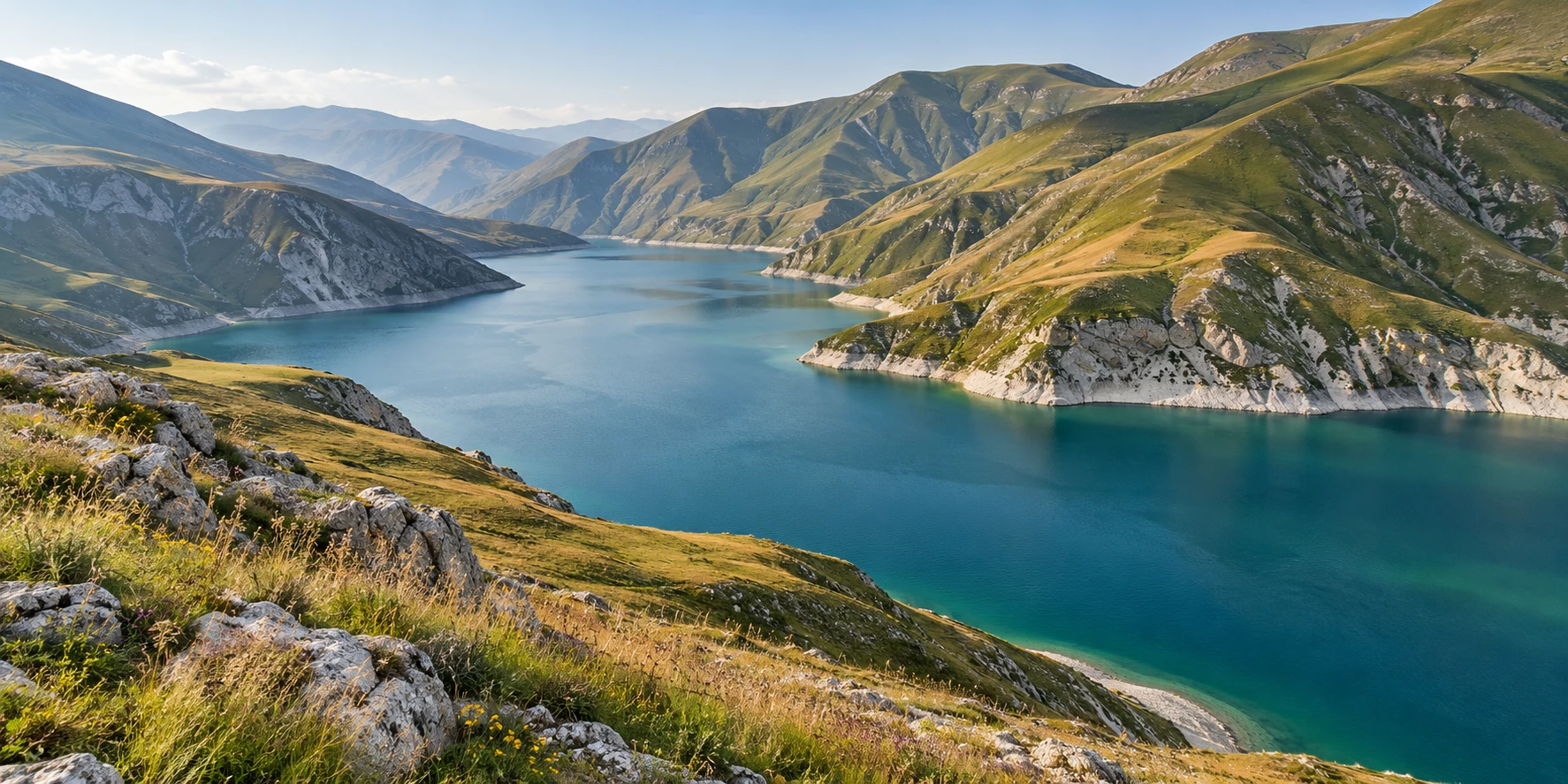
Mountain valleys of Ingushetia

A landscape inspired by the mountain valleys of Ingushetia. It is not a documentary photograph of a specific location. Authentic archival images and scholarly illustrations are available via the links below.

Anthem

State Anthem of the Republic of Ingushetia

Ingush

The State Anthem was established by Constitutional Law of the Republic of Ingushetia No. 57-RZ of 7 December 2010. An electronic copy was published by the Presidential Library from material of the People's Assembly.

The full approved text, musical edition and rules for use of the anthem can be opened via the link "Official text".

Timeline

Events: 13 / 13

6th–5th centuries BC
Burials of the Lugovoy burial ground near the village of Muzhichi, studied by archaeologists.
1770
Oath of representatives of Ingush societies to the Russian empress; a stage in the development of Russo-Ingush relations.
7 July 1924
Formation of the Ingush Autonomous Oblast upon the division of the Mountain ASSR.
1934
Unification of the Ingush and Chechen autonomous oblasts.
1936
Transformation of the united autonomy into the Chechen-Ingush ASSR.
23 February 1944
Beginning of the forced deportation of the Ingush and Chechens. In 1944 the autonomous republic was abolished.
9 January 1957
Decree on the restoration of the Chechen-Ingush ASSR and lifting of the ban on return.
4 June 1992
Law on the formation of the Ingush Republic within the Russian Federation.
October–November 1992
Armed Ossetian-Ingush conflict in the Prigorodny District, deaths and forced displacement of civilians.
27 February 1994
Adoption of the Constitution of the Republic of Ingushetia by popular vote.
1994
Start of construction of the new capital, Magas.
21 December 2000
Resolution establishing the Erzi State Nature Reserve.
26 December 2000
Federal law assigning the name Magas to the capital of the Republic of Ingushetia.