

North Caucasus · Dagestan
Kumyks
Qumuqlar
Language
Kumyk · qumuq til
Family
Turkic family, Kipchak group
Population
565,830 in Russia (2021 census)
History
Settlement and local groups
Language
Faith and history of religions
Verified information
Language
- Kumyk belongs to the Kipchak group of the Turkic languages.
Settlement and population
- According to the Russian census with a reference date of 2021, 565,830 Kumyks were recorded.
Culture and daily life
- The decision of the Council of People's Commissars of the Dagestan ASSR of 29 October 1930 became the milestone for the creation of the professional Kumyk Theatre.
History
- Islamization proceeded gradually, with differences by locality; there is no exact common date for the conversion of the people.
Detailed chronology
Middle Ages
Formation of the historical communityThe local population interacts with Turkic-speaking groups. The proportion of components remains a subject of scholarly debate.Middle Ages
Kipchak linguistic tiesKumyk takes shape within the Kipchak linguistic circle through contacts with neighbours. Linguistic classification is not an exact date of the people's birth.12th–14th centuries, research version
Different rates of IslamizationResearchers suggest an earlier process in the south and a later one in the north; there is no single date of conversion.1587
A report about EndireyCommentaries on the local chronicle cite an early Russian written mention of the settlement.Late 16th–17th centuries
Endirey and Sultan-MahmudThe settlement becomes a notable political centre; written testimonies require comparison.17th–19th centuries
Development of centres of Islamic scholarshipTarki, Aksay and Nizhneye Kazanishche participate in the religious education of the region.1666
A traveller's description of EndireyCommentaries on the chronicle refer to Evliya Çelebi's testimony about the settlement.1722
The battle at EndireyDuring Peter I's Persian campaign a military clash occurs and the village is devastated.1831
The siege of the Vnezapnaya fortressGhazi Muhammad acts near Endirey; the event is connected with the struggle for control of the lowland routes.1843–1844
Military clashes near EndireyThe local chronicle and commentaries describe the actions of Shamil's detachments and Russian troops.19th century
Adat and Sharia in public lifeLocal legal practices reflect a combination of customary law and Muslim norms.19th century
The poetry of Yyrchi KazakSong and literary memory preserve the poet's work.19th–early 20th century
Hospitality and kunachestvoEthnographic materials document the relations of hospitality and mutual support.1872
Birth of Abusupyan AkayevThe future theologian and enlightener is born in Nizhneye Kazanishche.1883
The collection of Magomed Efendi OsmanovNogai and Kumyk texts are published; printing expands the possibilities of preserving literature.Early 20th century
Akayev's educational workTranslation, teaching and book publishing become means of renewing education.1906–1916
The Tangcholpan drama circleThe official history of the theatre names the circle as one of the predecessors of the professional stage.20 January 1921
Formation of the Dagestan ASSRA decree of the All-Russian Central Executive Committee defines the republic's new autonomous status.1926
The theatre studio in Temir-Khan-ShuraStudio training is organized at the pedagogical technical school.1928
Introduction of the Latin scriptKumyk writing moves to a new alphabet as part of Soviet reforms.1929
Arrest of Abusupyan AkayevRepressions interrupt the enlightener's activity.29 October 1930
Decision on a national theatre studioThe Council of People's Commissars of the Dagestan ASSR adopts a decree with which the official theatre links its founding.1931
Death of Abusupyan AkayevThe life of the theologian and publisher, who was under repression, comes to an end.1938
Transition to CyrillicCyrillic script becomes the basis of modern Kumyk writing.1940
N. K. Dmitriyev's grammarThe academic edition systematically describes the Kumyk language.1950s
Ethnographic study of the KumyksField research and preparation of the "Peoples of the World" project expand the documentary base.1960
A book on material cultureS. Sh. Gadzhiyeva's monograph describes economy, housing, food and clothing.1960
Rehabilitation of AkayevA biographical note records the posthumous rehabilitation of the enlightener.1961
The monograph "Kumyks"S. Sh. Gadzhiyeva's historical and ethnographic study is published.1969
Kumyk-Russian dictionaryA. G. Magomedov's dictionary, edited by Z. Z. Bammatov, is published.1970s
Recording of the wedding repertoireB. M. Alimova collects materials among the southern Kumyks; some songs are recorded at weddings.From the early 1990s
Return of the religious pressIslamic literature is again published in Kumyk.2008
Publication of wedding songsA scholarly article introduces the texts and musical transcriptions of the South Kumyk repertoire.2010
A study of rain-calling ritesL. B. Gmyrya compares Kumyk materials with the traditions of neighbouring peoples.2021
Russian population censusThe country counts 565,830 people who indicated Kumyk nationality.2023
A study of the heritage of two writersThe National Library presents a book about Iyrchi Kazak and Magomed Efendi Osmanov.
Cuisine
Grain, meat and dairy products
Plains agriculture and animal husbandry determined the basis of nutrition. The season, prosperity and the household of the family influenced the composition of the table.Khinkal and flour dishes
Dough dishes, meat and broth are part of traditional nutrition. Forms of preparation differ by village and family; there is no single mandatory recipe for all Kumyks.Pies and fillings
Dough products with meat, dairy and plant fillings are part of the common Dagestan culinary circle. Their local variants do not require declaring one people the exclusive inventor of a dish.Guest table and tea
An ethnographic study notes the offering of food to a traveler and the serving of fresh tea to a guest. The custom is described for a certain era and locality, not as an unchanging rule of every modern home.
Adats and traditions
Hospitality and kunachestvo
Kunachestvo created stable relations of mutual support between people and families, including those belonging to different peoples.Family and property
The rights of spouses and relatives were regulated by a combination of custom and Sharia. Local records allow one to see differences in norms, rather than one universal formula.Wedding songs
South Kumyk materials include songs from different stages of the wedding. Field recordings of the 1970s distinguish performance in a living rite from the memories of informants.Calendar of the economy
Folk calendar ideas linked the change of seasons with agriculture and the life of the community. Field recordings help to clarify local names and dates.Bulqa: mutual aid
Neighbors and relatives took part in building a house, preparing materials and other labor-intensive work. An ethnographic monograph describes the organization of such aid and communal feasting.
Clothing
Dances
Wedding dance
The dance part of the wedding interacted with songs, instrumental music and the sequence of rites. B. M. Alimova's study is devoted specifically to the southern Kumyks, not to all settlements of the Caucasus.Ritual and stage performance
A home wedding and a professional staging are different environments. Theater develops stage culture and an authorial interpretation of tradition.
Music
Crafts
Textiles and domestic production
The processing of wool, the making of fabrics and household items were part of the economy. Domestic labour was combined with purchased goods and exchange.Wood, leather and utensils
Dwelling and economy required tools, vessels and objects made of various materials. Their form reflected the conditions of lowland and foothill settlements.The book and enlightenment
Written culture included manuscripts, translation and printing. Abusupyan Akayev's work linked local educational tasks with the publishing technologies of the early 20th century.
Memorable Places
Tarki
The historical centre of the shamkhalate and one of the centres of Muslim scholarship. Its past is connected with the Caspian routes and neighbouring societies.Endirey
An important centre of North Kumyk history. The chronicle, external reports and documents of the 1722 campaign allow different testimonies to be compared.Nizhneye Kazanishche
The birthplace of Abusupyan Akayev. The biography of the enlightener reveals the links of local education with the wider Muslim world.Ullubiyaul, historical Boynak
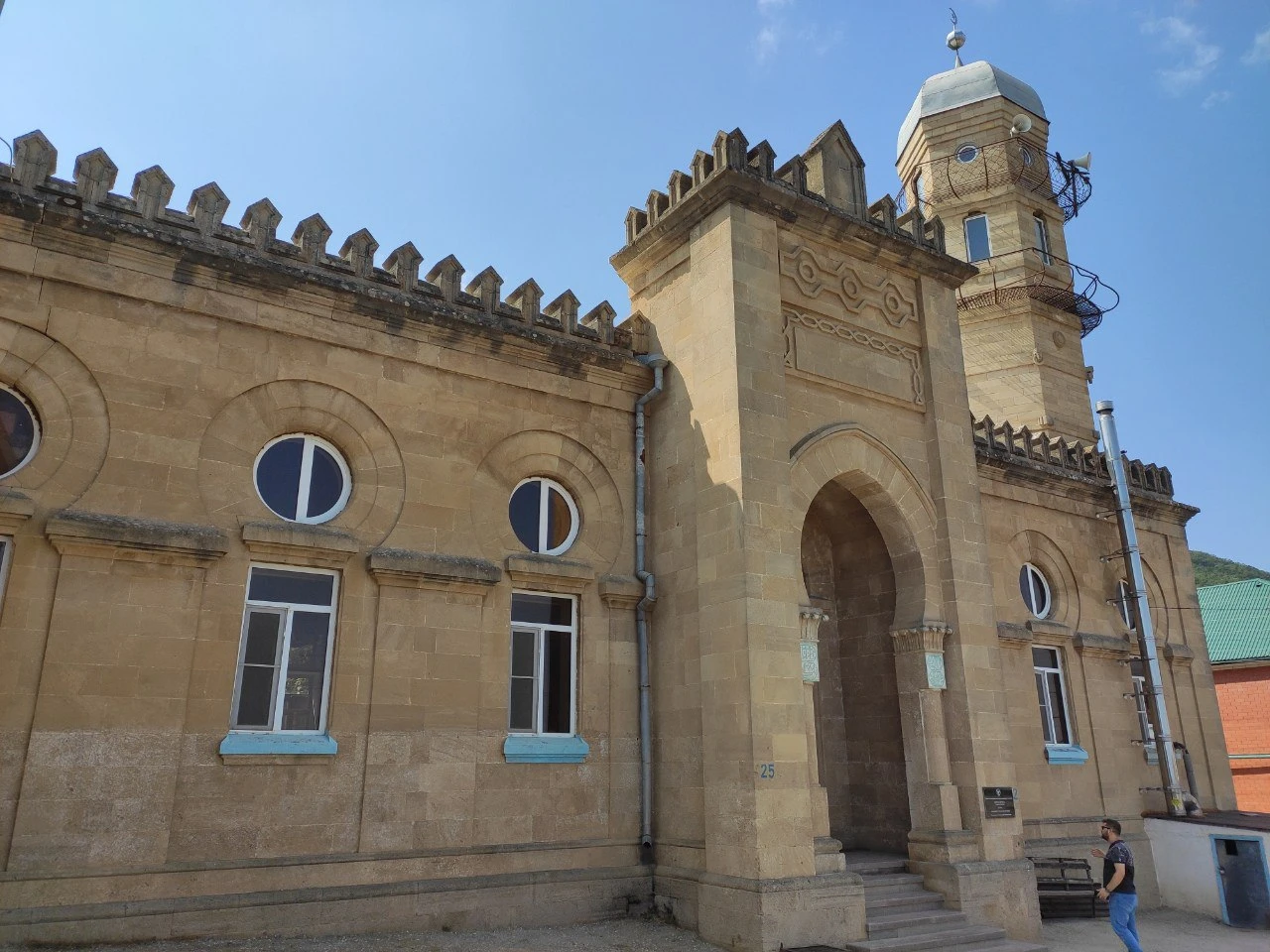
The page shows a documentary photograph of the local mosque taken in 2021. The file name and the Commons description disagree on the dating of the building, so no exact year of its construction is asserted here.
Names
Men's
- Arslan (Kumyk, Turkic)
- Batyr (Kumyk, Turkic)
- Temir (Kumyk, Turkic)
- Taymas (Kumyk, Turkic)
- Ertuvgan (Kumyk, Turkic)
- Aydemir (Kumyk, Turkic)
Women's
- Oybike (Kumyk, Turkic)
- Altynchach (Kumyk, Turkic)
- Yulduz (Kumyk, Turkic)
- Syuyum (Kumyk, Turkic)
- Syuygyulya (Kumyk, Turkic)
- Qarlyghach (Kumyk, Turkic)
- Almakiz (Kumyk, Turkic)
- Syuyunch (Kumyk, Turkic)
People and cultural memory
Yyrchi Kazak
One of the classics of Kumyk poetry. The history of his works is studied through records, editions and research papers.Magomed Efendi Osmanov
A collector and publisher of Nogai and Kumyk texts; his 1883 collection became an important event in written culture.Abusupyan Akayev
Theologian, educator, Turkologist, translator and enlightener. Born in Nizhneye Kazanishche in 1872, died in 1931 after repressions.Sakinat Gadzhiyeva
Ethnographer, author of fundamental works on the Kumyks and their material culture. Her research combined fieldwork and historical materials.
Media
Photo gallery
Authorship and licenses are indicated in the image captions.