North Caucasus · Dagestan
Lezgins
Lezgiyar
Language
Lezgin · Lezgi ch'al
Family
Nakh-Daghestanian family, Lezgic branch
Population
488,608 in Russia (2021); 167.6 thousand in Azerbaijan (2019)
History
Settlement and local groups
Language
Faith and history of religions
Verified information
Language
- The Lezgian language belongs to the Lezgic branch of the Nakh-Daghestanian family.
Settlement and population
- Russia: 488,608 Lezgians according to the 2021 census with a reference date.
- Azerbaijan: 167.6 thousand Lezgians according to the 2019 census.
Culture and daily life
- The REM holds a Lezgian carpet from Kasumkent, REM 12983-1, 1960s–1970s.
History
- The Miskindzha copy of "Ta'rikh Abu Muslim" is dated 1845–1846.
Detailed chronology
The early Middle Ages
The multi-confessional Eastern CaucasusChristianity and local cults coexist in the region; the affiliation of individual communities requires separate verification.738
Marwan's campaign into LakzThe Arab army besieges Bilistan in the Samur valley; the proposed localization of the fortress remains a scholarly conclusion.Middle Ages
The consolidation of IslamSouthern Dagestan enters the early zone of Islamization; the formation of religious institutions proceeds gradually.Middle Ages
Lakz in the written traditionThe materials describe a political and cultural space that is broader than the modern ethnic definition.13th century
Mongol campaignsMilitary invasions change the political conditions of the Eastern Caucasus and the ties of local societies.Before the 19th century
Unions of rural communitiesLocal societies and domains have different forms of governance and relations with their neighbors.1721
The capture of ShamakhiThe detachments of Haji-Davud and Surkhay Khan take the city; the war is accompanied by devastation and losses among the inhabitants.1741–1743
Nader Shah's campaignsThe war affects Dagestan; the testimonies of Hanway and Bazin require comparison and critical analysis.1771
The birth of Magomed YaragskyThe future Sufi mentor is born in Vini-Yarag.1806
The incorporation of the Quba Khanate into the Russian EmpireAdministrative changes affect the Lezgin settlements of the khanate.1812
The creation of the Kyura KhanateAslan Khan is appointed ruler under Russian protection.The first third of the 19th century
Yaragsky's religious mentorshipNaqshbandi ties and the theologian's influence on future imams develop.1837
The uprising in Quba provinceLocal inhabitants rise against imperial administration; the movement affects Lezgin communities.1838
Birth of Yetim EminThe life of the future classic of Lezgian poetry begins.1839
Construction of the Akhty FortressThe Russian fortification becomes part of the military presence in the Samur Valley.1845–1846
The Miskinja copy of the chronicle is transcribedThe date refers to the surviving manuscript, not to all the events of the narrative.1864
Abolition of the Kyura KhanateThe territory passes to a new administrative organization.1869
Birth of Suleyman StalskyThe future poet is associated with the village of Ashaga-Stal and the ashugh tradition.1871
An early Lezgian primerKazanfar-Beg's primer is published, based on P. K. Uslar's alphabet work.1877
Uprising in DagestanSouth Dagestani communities are drawn into protests against imperial administration.Late 19th–early 20th century
Photographic documentation of daily lifeMuseum collections preserve images of settlements, clothing and everyday life.1905–1906
Beginnings of the theatrical movementPerformances in Surakhany and Akhty are linked to the emergence of the Lezgian stage.20 January 1921
Formation of the Dagestan ASSRA decree of the All-Russian Central Executive Committee defines the republic's new autonomous status.1928
Transition to the Latin scriptThe new script enters school and publishing practice.1934
Stalsky at the All-Union Congress of WritersThe poet's participation increases the renown of Lezgian literature beyond Dagestan.1937
Death of Suleyman StalskyThe poet's works continue to be published and translated.1938
Transition to CyrillicThe Russian graphic basis of the modern alphabet is established.1949
The Akhty troupe moves to DerbentThe city becomes the center of professional Lezgian theatrical life.1970–1971
Museum collecting in AzerbaijanE. G. Torchinskaya and colleagues collect clothing, knitted footwear and household items.1978
S. S. Agashirinova's monographA study of the material culture of the Lezgians of the 19th and early 20th centuries is published.From the late 1980s to the 1990s
New conditions of religious lifePublic practices and education resume amid social change.The beginning of the 21st century
Digital study of the languageA corpus of the Lezgian literary language is created and grammatical research expands.2005
M. Sh. Rizakhanova's monographA historical and ethnographic study of the Lezgians of the 19th and early 20th centuries is published.2009 and 2014
Field recordings in the Samur ValleyEthnographers document mythological images and their contemporary interpretations.2014
Study of the Karchag ValleyMaterials are collected in Karchag, Zizik, Ekendil and Nyutyug.July 2015
Discovery of the copy of "Ta'rikh Abu Muslim"The manuscript from Miskinja becomes the subject of scholarly research.2016–2017
Museum expeditionHistorical photographs and contemporary life of villages on both sides of the border are compared.2018
The album "From the Kyurintsy to the Lezgians"The Russian Museum of Ethnography publishes a volume in the "Raznaya Zemlya" series.2018
Publication of the Miskinja ChronicleA scholarly translation and commentary bring the manuscript into research circulation.2019
Population census of Azerbaijan167,600 Lezgians within the country are officially recorded.2021
Russian population censusIn Russia, 488,608 people who indicated Lezgian identity are recorded.
Cuisine
Afarar
Pies filled with edible herbs and other local fillings. The composition varies by season and family tradition.Ts'iken
A layered pie with meat and potato filling; ethnographic descriptions also record nuts and spices.Khinkal and pich'ekar
Boiled dough, broth and meat form the customary range of dishes. Pich'ekar are prepared with a filling; local recipes differ.Bread and dairy products
Grain dishes and dairy food are connected with farming and herding in the mountain, foothill and lowland districts.Festive food
Shaped pastries, communal treats and the distribution of food are part of calendar and family rituals. The specific custom depends on the locality.
Adats and traditions
Jamaat
The village community united residents around economic, land and public affairs; decisions were made with the participation of the assembly and the elders.Mutual assistance
Joint labor helped in construction and agricultural work. The assistance of relatives and neighbors was part of communal life.Hospitality and kunachestvo
The reception of a guest and long-term relations of support linked families and villages. The custom changed together with living conditions.Yaran suvar
The spring holiday is connected with the equinox, the renewal of the economic year and communal feasting. The Karchag records make it possible to describe its local forms.Adat and religious norm
The historical organization of the community included customs and Muslim institutions. Their interaction must be considered by period and by specific society.
Clothing
Dances
Lezginka
The name covers a type of mountain dance widespread among many peoples of the Caucasus. Lezgin performances have their own local and stage history.The dance on stage
Musical-dramatic theatre develops professional stage culture. An authored production is not the same as an exact reproduction of an old village ritual.
Music
Crafts
Sumakh weaving
The pattern is formed by additional threads that wrap around the warp threads. The name of the technique is not proof that each carpet belongs exclusively to one people.Carpet from Kasumkent
The Lezgin flat-woven carpet REM 12983-1 is made of wool and dated to the 1960s–1970s. The museum card indicates the place, technique and collection number.Knitted footwear and household items
Expedition collections in the Qusar and Qutqashen districts of Azerbaijan preserve clothing, woolen items, carpet bags and copper utensils.
Memorable Places
Akhty
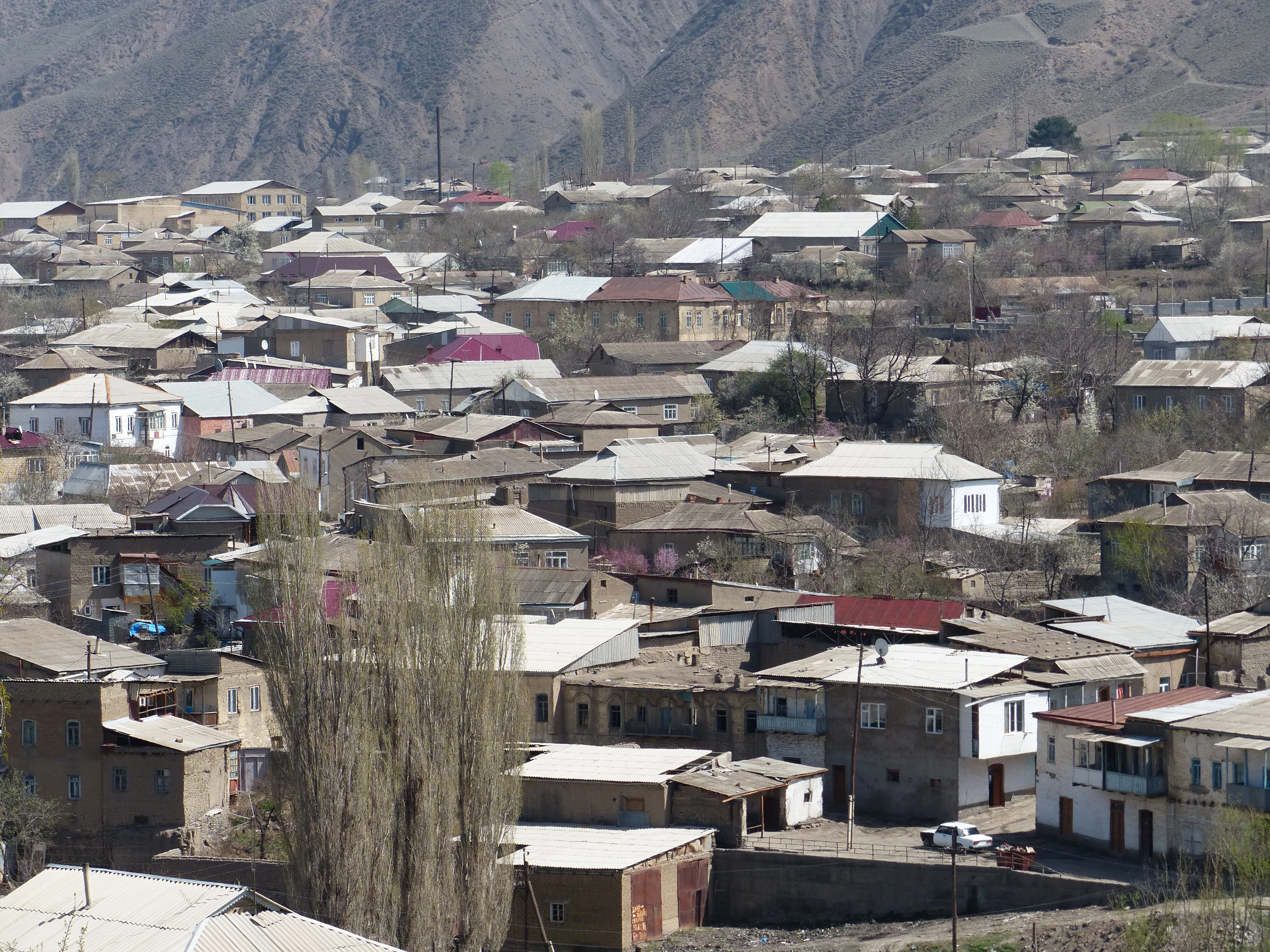
One of the most important historical and cultural centers of the Samur valley. The page shows a documentary photograph of the residential buildings of Akhty from 2013.Kurakh and Kyura
The history of the local societies and the Kyura Khanate reveals the features of South Dagestani governance in the 19th century.Miskindzha
A village with a Shia community and a significant manuscript heritage. A copy of "Ta'rikh Abu Muslim" was discovered here.Vini-Yarag
The birthplace of Magomed Yaragsky, a theologian and Sufi mentor of the early 19th century.Qusar and surroundings
An important part of the Lezgin cultural space of Azerbaijan. Museum expeditions documented the local everyday environment and cultural institutions.
Names
Men's
- Buba (Lezgian)
Women's
- Bade (Lezgian)
People and cultural memory
Yetim Emin
A classic of 19th-century Lezgin written poetry. His legacy is preserved in publications, translations and studies.Suleyman Stalsky
Poet and ashugh, 1869–1937. A participant in the literary life of Dagestan and the All-Union Congress of Writers of 1934.Magomed Yaragsky
Theologian and mentor of the Naqshbandi tariqa. His influence is linked to the religious history of Dagestan and Chechnya.Idris Shamkhalov
One of the founders of the Lezgin theatrical stage; the theatrical institution traces its history to productions in Akhty in 1906.Sharvili: hero of the epic
A heroic figure of Lezgin folklore. The legendary stories about him are cultural heritage, not a documented biography of a historical military commander.
Media
Photo gallery
Authorship and licenses are indicated in the image captions.