

North Caucasus · Dagestan
Rutuls
Mykhabir (Rutul); local self-designations
Language
Rutul
Family
Nakh-Daghestanian family · Lezgic branch
Population
34,259 in Russia (2021 census)
History
Settlement and local communities
Language
Faith and history of religions
Verified information
Language
- The Rutul language belongs to the Lezgic branch of the Nakh-Daghestanian family.
- The alphabet was approved by decree No. 128 of 10 August 1990.
Settlement and population
- According to the 2021 census: Russia 34,259 Rutuls; Daghestan 27,043.
Culture and daily life
- Ashugh poetry is connected with the development of Rutul written literature.
History
- An inscription of 545 AH reports a khanqah in Rutul in the 12th century.
- The Luchek dating of 745–746 is discussed in the literature as disputed.
Detailed chronology
The early Middle Ages
The Eastern Caucasus and Caucasian AlbaniaHistorical names and religious ties require the comparison of different kinds of materials.7th–10th centuries, scholarly periodization
The early stages of IslamizationSeferbekov places the Rutuls in the early zone of the spread of Islam in southern Dagestan.745–746 in a disputed inscription
The Luchek datingThe authenticity and interpretation of the early testimony have been disputed; the date is not accepted as a proven year of conversion.545 AH, 1150–1151
The khanaqa in RutulThe inscription documents an institution connected with Sufi life.1228
The building inscription of RutulThe evidence is used in studying the local community and the organization of construction.683 AH, 1284–1285
Work on the mosqueThe dated record helps trace the history of the monument.18th–early 19th century
The Rutul magalPolitical life is organized around rural communities and local rulers.The 1830s
The resistance of AgabekMilitary correspondence records assemblies of the Samur societies and ties with Shamil.1839
A new political dependencyThe Rutul magal is attached to the Ilisu Sultanate within the system of Russian administration.1844
The Ilisu okrugAdministrative reforms affect the Rutul lands.22 November 1928
The Rutul cantonA project of district division on the basis of the former Luchek section is approved.3 June 1929
Rutulsky DistrictThe canton is renamed a district by a decree of the All-Russian Central Executive Committee.1930s
Restrictions on religious lifeSoviet anti-religious policy changes the conditions of education and public practice.1 February 1963
A rural districtThe administrative name of the district changes.12 February 1965
The return of the name “district”The decision completes another stage of administrative reorganization.1978
G. Kh. Ibragimov’s description of the languageA fundamental grammatical work is published.1979
Museum photographyN. P. Soboleva documents Rutul villages, the landscape and transport.Late 1980s–1990s
An open religious revivalInstitutions and forms of public Muslim life are restored.10 August 1990
Approval of the alphabetDecree No. 128 of the Government of Dagestan establishes the Rutul alphabet.1998
A Russian–Rutul dictionaryK. E. Dzhamalov’s dictionary is published.The turn of the 20th–21st centuries
New resettlement communitiesA community of people from Dagestan and Azerbaijan forms in Tula Oblast.2004
“The Rutul Language: Synchrony and Diachrony”A study by G. Kh. Ibragimov is published.2006
Dictionary of the Ikhrek dialectThe Rutul-Russian dictionary by K. E. Dzhamalov and S. A. Semedov is published.2008
Research on folklore and ashug poetryA work by F. M. Ibragimova is published.2011
Russian-Rutul dictionary by E. I. IsmailovaThe lexicographic base of the language is being developed.2015–2019
Expeditions to KinaLanguage materials are collected for the BivalTyp typological database.2020
Publication of BivalTyp dataRutul materials from the village of Kina appear in the open database.2021
Russian population census34,259 Rutuls were counted, of whom 27,043 are in Dagestan.July 2022
Dialectological expeditionHSE University surveys twelve Rutul villages.
Cuisine
Khinkal
Pieces of dough of various shapes are served with meat, broth or dairy products. Local methods of preparation differ.Pies and seasonal greens
Flour dishes were prepared with herbs, cottage cheese and meat. Preserved dairy products and meat helped people survive the mountain winter.The family meal
In the studied Tula community, traditional dishes are preserved through the family transmission of recipes and hospitality. The authors note the resilience of festive cuisine after resettlement.
Adats and traditions
Kinship and mutual assistance
Kinship and neighborly ties supported the household, family celebrations and help in difficult circumstances. Their forms change with migration.Wedding customs
A wedding combined agreements between families, a shared meal, gifts and local rites. Historical descriptions are not an obligatory norm for the modern family.The spring holiday
In the communities studied in Tula Oblast, Er is accompanied by treats and visits to neighbors. It helps maintain ties in a migrant environment.
Clothing
Dances
The festive dance
Songs, music and dances are part of family celebrations. Forms of performance change together with festive daily life and contacts with neighbors.Game and performance
The description of the communities of Azerbaijan mentions the "Hunting Game". It is regarded as a local festive form, without identifying it with the repertoire of all Rutuls.
Music
Crafts
Wool and knitted goods
Rutul craftswomen made patterned socks and other woolen items. Such products combined an economic function with local methods of ornamentation.Stone and wood
Carved details of houses, tombstones and household utensils preserve information about the work of craftsmen and the decorative ties of southern Dagestan.Construction and calligraphy
The medieval inscriptions of Rutul document construction work and Arabic written culture. The date of the record refers to specific works, not to the entire building in its present form.
Memorable Places
Rutul
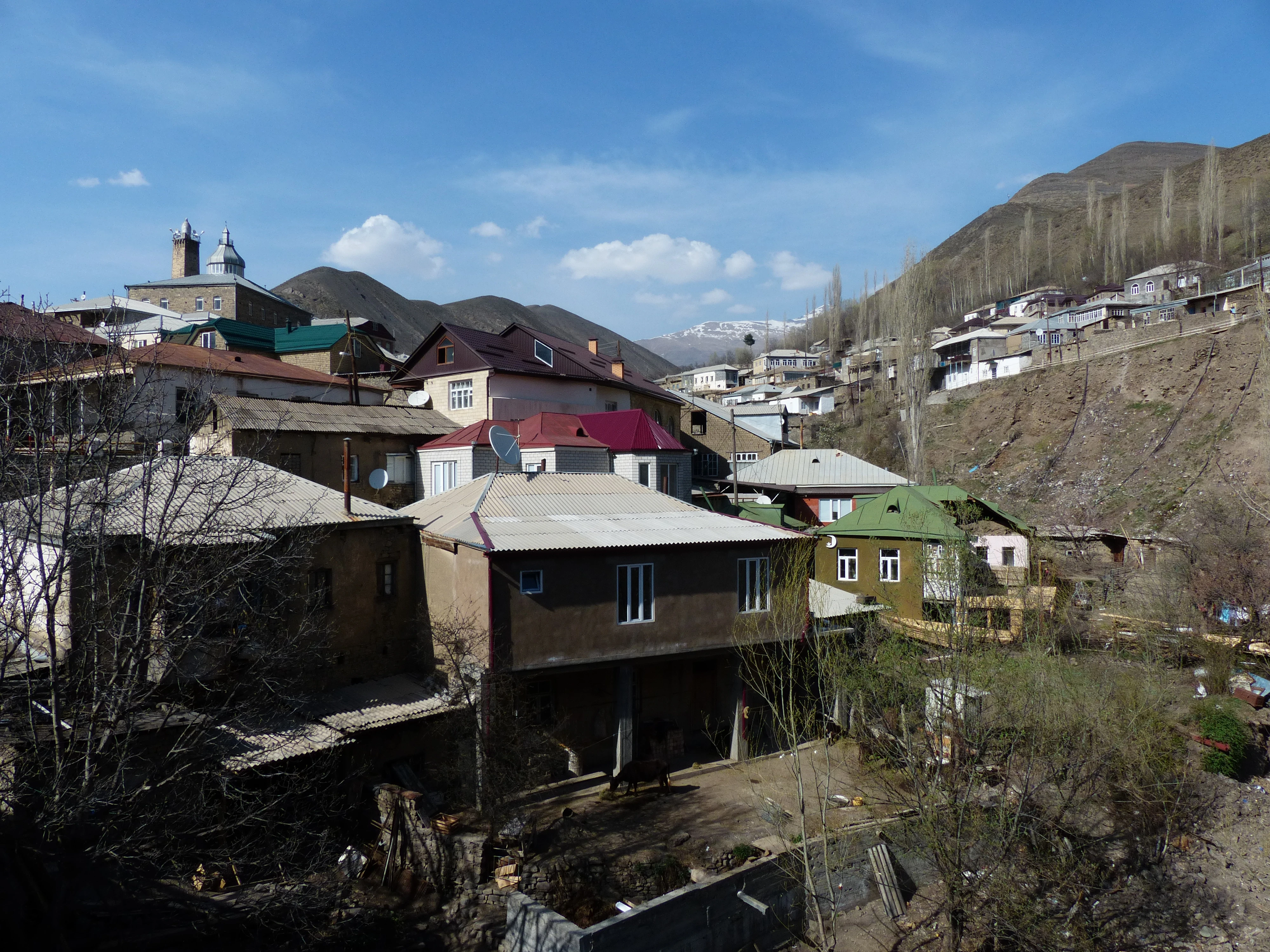
A major historical center of local communities. The documentary photograph on the page shows the village in April 2013, with modern buildings.Shinaz
One of the villages included in the atlas of Rutul dialects. Its speech and cultural features are studied alongside materials from other villages.Ikhrek and Myukhrek
Important centers of local dialects and historical culture. Monuments of mosque architecture and local traditions require separate descriptions.Khnov and the communities of Azerbaijan
The geography of the people crosses modern district and state borders. The communities maintain their own ties and local variants of culture.
Names: examples of usage
Men's
Women's
People and cultural memory
Dzhamaseb Salarov
A Rutul ashug and poet whose work is examined in a scholarly study of the connections between folklore and literature.Khezerchi Gadzhiev
An ashug-poet in whose works researchers trace the development of traditional motifs, images and genres.Svetlana Makhmudova
A linguist and researcher of the Rutul language, author of works on grammar and spiritual culture. Scholarly description and literary work both contribute to the preservation of the language.
Media
Photo gallery
Authorship and licenses are indicated in the image captions.