
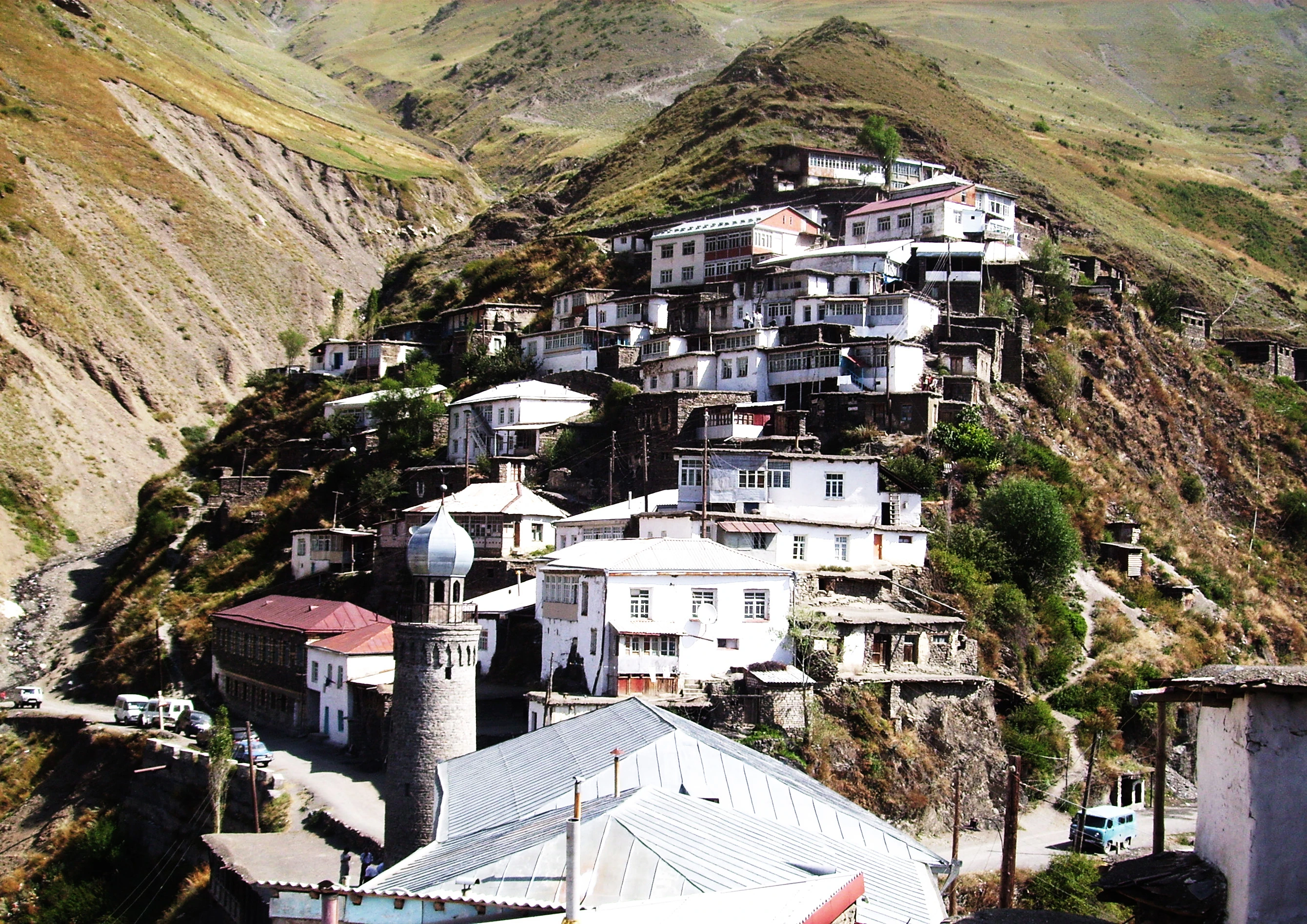
Stone houses and the minaret of the village of Tsakhur on a mountain slope: documentary photograph
← All peoples

North Caucasus · Dagestan

Tsakhurs

Yykhby

Tsakhurs: the history of the communities of the upper Samur and northwestern Azerbaijan, language, culture and settlement. Former beliefs, the spread of Islam, the Tsakhur madrasa, a detailed chronology and scholarly materials.
Village of Tsakhur · author Tsakhurets · CC BY-SA 3.0

Language

Tsakhur

Family

Nakh-Daghestanian family · Lezgic group

Population

12,541 in Russia (2021); 13.4 thousand in Azerbaijan (2019)

History

A people on both sides of the ridge. The Tsakhurs are an indigenous people of the eastern Caucasus. Their historical settlement area unites the upper reaches of the Samur in Daghestan and the northwest of Azerbaijan. The modern state border does not divide the people's history into two isolated parts.
Names and the ancient Caucasus. Self-designation: yikhby. The external name is connected with the village of Tsakhur. Ancient Lakz and Caucasian Albania belong to the historical context of the region; their populations cannot automatically be identified with a single modern people.
A medieval centre of learning. In the 13th century al-Qazwini described Tsakhur as a significant centre with a preacher, a judge and a madrasa. A. N. Genko showed that old collective designations of populations require cautious translation onto the modern ethnic map.
Political history. In the late Middle Ages and the modern era, Tsakhur societies were linked with the Tsakhur, and later the Elisu, sultanate. The transfer of the residence to Ilisu and migrations across the passes strengthened ties between mountain and foothill communities.
The Caucasian War. In 1844 Daniyal-bek joined Shamil. In 1852 fifteen villages of the Mountain Mahal were devastated, and their inhabitants were forcibly resettled to the Alazan plain. In 1861 return was permitted.
The village community. Assemblies of representatives, elders and qadis took part in governance. Communal institutions changed along with the political order.
Economy of two natural zones. Summer mountain pastures and the warmer southern slopes complemented each other. Herding, farming and seasonal movements maintained ties between relatives and villages.
Population in Russia. The census with a reference date of 1 October 2021 counted 12,541 Tsakhurs, of whom 10,320 are in Daghestan. Ethnic population figures differ from the number of speakers of the language.
Population in Azerbaijan. The official table of the 2019 census indicates 13.4 thousand Tsakhurs. This is a rounded figure. It cannot be presented as an exact count of the entire people or added to the Russian census without noting the different years.

Settlement and local communities

Northern slope. Tsakhur, Helmets, Mishlesh, Muslakh and other villages of the upper Samur are linked by local dialects and the history of their communities. The name of the people is not limited to the inhabitants of one Tsakhur. Southern slope. The Tsakhur communities of the Zakatala and Qakh districts maintain ties with the mountain villages. Suvagil, Mamrukh, Sabunchu and other settlements have their own local traditions. Old museum terminology. Early photographs of Helmets and Kurdul may have been registered as "Lezgin". The museum explains the Tsakhur affiliation of the communities: a historical caption cannot be read mechanically in today's sense.

Language

The Tsakhur language belongs to the Lezgic group of the Nakh-Daghestanian family. Its closest relative is considered to be Rutul; linguistic kinship does not mean that they are one people or one language.
The speech of Tsakhur villages is not uniform. In the classification of G. Kh. Ibragimov, the Tsakh and Gelmech dialects are distinguished; other descriptions group the varieties differently, including materials from Azerbaijan.
In 1934 A. N. Genko devised a Latin alphabet; in 1938 teaching and book publishing in Tsakhur ceased. At the turn of the 1980s–1990s writing was revived on a Cyrillic basis.
In Daghestan the newspaper Nur is published, and educational and literary materials appear. The preservation of the language also depends on transmission within families, schooling and the opportunity to use it outside the home.

Faith and history of religions

Pre-Islamic heritage. It is studied through myths, rituals and ethnographic records. The full composition of the ancient pantheon is unknown. Hunting and sacred animals. Abdal acts as the patron of game; stories about white aurochs link hunting with prohibitions and moral restraints. Luminaries and seasonal rites. In communities of Azerbaijan, veneration of the sun, moon and fire, spring festivals and the first furrow have been described. These are local ethnographic testimonies. The Christian context. The medieval Christian culture of the Caucasus is important for the history of the region. But a common Christian period for all Tsakhurs does not follow from this. Early penetration of Islam. M. R. Seferbekov dates the beginning to the 7th–9th centuries and its establishment to the 10th–12th centuries. This is a periodization of the process, not a single date of conversion. How religion took hold. The medieval description shows the role of the preacher, the judge and the teachers. Law, education and the translation of books integrated Islam into the daily life of the community. The Nizamiyya madrasa. A. R. Shikhsaidov dated its foundation to the last third of the 11th century, comparing al-Qazwini's report with the lifetime of Nizam al-Mulk. The traditional date of 1075. In 2025 the 950th anniversary of the madrasa was marked in Tsakhur. The anniversary date reflects an accepted tradition; it does not replace a dated building inscription. The Shafi'i school. Al-Qazwini characterized the inhabitants of medieval Tsakhur as followers of Imam al-Shafi'i. This is an early testimony to the Sunni legal tradition. Saints and ziyarats. Legends about Baba-molla Rajab combine Muslim sanctity with earlier motifs of patronage over animals. They are studied as historical folklore. The calendar. Nowruz is associated with spring renewal. The records mention a winter rite, gode, for stopping snowfall; this is a folk a practice, not an obligatory Islamic prescription. The mosque and its reconstructions. The inscription of 1318 AH, that is, 1900–1901, is connected with the reconstruction of the present building. The history of the building differs from the history of the medieval madrasa. Soviet period. Religious institutions experienced restrictions. During a survey in 1952, the building of the Tsakhur mosque was used as a school. Contemporary religious life. The historical tradition of Tsakhur believers: Sunni Islam. The revival of religious institutions takes place in the general context of Dagestan, but personal religiosity and local practices differ.

Verified information

Language

  • The Tsakhur language belongs to the Lezgic group of the Nakh-Daghestanian family.

Settlement and population

  • 2021 Russian census: 12,541 Tsakhurs, of whom 10,320 are in Daghestan.
  • 2019 Azerbaijani census: 13.4 thousand Tsakhurs, a rounded figure.

Culture and daily life

  • Historical photographs of Gelmech show the dance culture of Tsakhur communities.

History

  • The madrasa of Tsakhur was described by al-Qazwini in the 13th century; its foundation is associated with the last third of the 11th century.
  • The inscription of 1318 AH refers to the rebuilding of the mosque in 1900–1901.

Detailed chronology

  1. Pre-Islamic heritage

    Hunting and nature beliefs
    Reconstructed from folklore and later ethnographic records.
  2. Early Middle Ages

    Caucasian Albania and Lakz
    Regional names cannot be directly equated with modern ethnonyms.
  3. 7th–9th centuries

    The initial stage of the spread of Islam
    A scholarly periodisation of the early penetration of the religion.
  4. 10th–12th centuries

    The establishment of Muslim tradition
    The process spans several centuries, not a single date.
  5. The last third of the 11th century

    The founding of the madrasa
    The dating is derived from al-Qazwini's account of Nizam al-Mulk.
  6. 13th century

    The testimony of al-Qazwini
    Teaching, the qadi and the Shafi'i school of law are described.
  7. The late Middle Ages

    Tsakhur political societies
    The communities are linked with sultanate authority and neighbouring territories.
  8. 17th–18th centuries

    Ilisu and the mountain communities
    Political and economic ties develop across the ridge.
  9. First half of the 19th century

    Russian advance
    The administration of the sultanate and the mountain societies changes.
  10. 1844

    Daniel-bek on Shamil's side
    The Caucasian War changes the political position of the communities.
  11. 1852

    Destruction and forced resettlement
    Fifteen mountain villages were destroyed; the inhabitants were resettled to the plain.
  12. 1861

    Permission to Return
    The return to the mountain villages begins.
  13. Late 19th century

    Communal and Family Economy
    The mountain pastures are linked to the foothill settlements and to relatives.
  14. 1900–1901

    Rebuilding of the Mosque
    The inscription of 1318 AH refers to the present building.
  15. Early 20th century

    Museum Documentation of Dances
    Helmets photographs preserve the local festive culture.
  16. 1913

    Adolf Dirr's Grammar
    A description of the Tsakhur language is published.
  17. 1933

    A. N. Genko's Expedition
    The researcher works with Rutul and Tsakhur material.
  18. 1934

    Latin script
    A. N. Genko compiles a Tsakhur alphabet.
  19. 1938

    Cessation of Teaching and Book Publishing
    The first program for the development of a written language is interrupted.
  20. 1941

    "The Arabic Language and Caucasian Studies"
    Genko's study of medieval materials is published.
  21. 1952

    The Mosque Is Used as a School
    An architectural survey records the building's new function.
  22. 1950s

    Schooling in Russian
    The language of school instruction in Dagestan changes.
  23. 1968

    Field Study of Clothing
    Material was collected on the Dagestani Tsakhur villages.
  24. 1974

    Publication of an Ethnographic Study
    The materials on clothing are included in the Dagestan Ethnographic Collection.
  25. 1976

    New Survey of the Mosque
    The architect K. A. Kalinina draws up a plan of the monument.
  26. 1990

    Return of a National Written Language
    A Cyrillic alphabet is officially adopted in Dagestan.
  27. 1990

    G. Kh. Ibragimov's Grammar
    The monograph "The Tsakhur Language" is published.
  28. 1992

    Cultural and Historical Society
    The society "Tsakhurs" is founded, focused on preserving culture.
  29. 1996

    Latin Script in Azerbaijan
    The publication of materials in the Tsakhur language develops.
  30. 1999

    Typological Grammar
    A collective work edited by A. E. Kibrik is published.
  31. 2009

    "Tsakhur Folklore"
    K. Z. Omakhanov's collection is published.
  32. 2010

    Tsakhur-Russian Dictionary
    The dictionary by G. Kh. Ibragimov and Yu. M. Nurmamedov is published.
  33. 2019

    Census of Azerbaijan
    The official table indicates 13.4 thousand Tsakhurs.
  34. 1 October 2021

    Census Reference Date in Russia
    12,541 Tsakhurs were counted, including 10,320 in Dagestan.
  35. 28 December 2022

    Expert Review of the Restoration Project
    The architecture and historical information about the Tsakhur mosque were studied.
  36. August 2025

    Anniversary of the Madrasa
    In Tsakhur the 950th anniversary of An-Nizamiyya is celebrated according to the accepted commemorative dating.

Cuisine

  • Khinkal and flour dishes

    In traditional cuisine, dough, grains, meat and dairy products are important. Recipes and methods of serving differ by family and village.
  • Spring baking

    For Nowruz, flatbreads decorated with eggs and nuts, sweet biscuits and layered bread were prepared. The names and shapes are recorded in ethnographic descriptions.
  • Dairy products and preserves

    Sheep's milk, cheese, butter and meat preparations are linked to the livestock economy. Modern cuisine includes dishes of neighbouring peoples.

Adats and traditions

  • Kinship and mutual assistance

    Family and neighbourly ties sustained the household, hospitality and help in difficult circumstances. Tukhums were divided into narrower kin groups.
  • The Seyran festival

    In descriptions of Azerbaijani communities this is a youth spring outing in the mountains. A local custom cannot automatically be extended to all Tsakhur villages.
  • Wedding and community participation

    The festive cycle brought together relatives from mountain and foothill villages. Historical family norms should be distinguished from modern rights and personal choice.

Clothing

The traditional women's costume included the "dugmache" headdress, forehead ornaments, coins, pendants, a belt, bracelets and earrings. The combination of elements shows links with the culture of Azerbaijan and Dagestan.
A 1968 field study describes the clothing of the Dagestani Tsakhurs and its changes. Wool, leather and sheepskin were important materials; age, wealth and occasion influenced the composition of the outfit.

Dances

  • Gelmets: museum evidence

    Photographs from the early 20th century show dancing girls. The museum emphasises the diversity of local forms of the lezginka and the peculiarities of old ethnic captions.
  • Paired and collective performance

    Festive dances existed in local variants and interacted with Azerbaijani culture. A stage production does not replace descriptions of village performance.

Music

The musical culture used the tar, saz, zurna and drum. Songs were sung in Tsakhur and Azerbaijani; stories and tales supported the transmission of the native speech.
"Tsakhur Folklore" by K. Z. Omakhanov and the volumes of the Dagestan folklore corpus preserve oral texts. Their genres include tales and ritual poetry.

Crafts

  • Wool and cloth

    Home clothing production relied on livestock products. Field materials make it possible to study fabrics and the ways they were used in a specific local environment.
  • Stone architecture

    The mosque of Tsakhur demonstrates work with mountain stone, pillars and arches. The architectural forms reflect several stages of construction.
  • Book culture and translation

    Reports about the madrasa include translations of legal works. This is the history of written culture, not proof of the existence of a modern national alphabet in the 11th century.

Memorable Places

  • Tsakhur

    The historical centre of the upper Samur. The documentary photograph on the page shows the actual buildings of the village.
  • The Juma Mosque of Tsakhur

    The surviving building has later reconstructions, a stone arcade and remnants of painting. It cannot be dated entirely to the time of the madrasa's foundation.
  • Gelmets and Mishlesh

    Tsakhur villages with local speech and cultural peculiarities. Gelmets is represented in the historical photo collection of the ethnographic museum.
  • Suvagil, Mamrukh and Sabunchu

    Villages of north-western Azerbaijan belong to the historical geography of Tsakhur communities. Their culture requires account to be taken of local variants.

Names: examples of usage

Men's

    Women's

      People and cultural memory

      • Hajiali of Tsakhur

        A 19th-century poet-singer mentioned in an academic description of Tsakhur culture.
      • Huseyn of Mishlesh

        A representative of the 19th-century poetic tradition linking oral song and authored work.
      • K. Z. Omakhanov

        Author of publications of Tsakhur folklore and literary works in the native language.
      • A. N. Genko

        Caucasologist who studied Tsakhur culture in the 1933 expedition and the Arabic-language materials of their history.

      Media

      Photo gallery

      Authorship and licenses are indicated in the image captions.